
Tax Loss Harvesting Crypto with Koinly: Complete 2026 Guide
This article contains affiliate links. If you sign up for Koinly through a link on this page, I may earn a commission at no extra cost to you. I only recommend tools I have genuinely evaluated.
This article is for informational purposes only and does not constitute professional tax or financial advice. Tax laws vary by country and change frequently. Consult a qualified tax professional for advice specific to your situation.
Tax loss harvesting crypto is one of the most practical ways to legally reduce your tax bill before year-end — but only when the strategy is applied correctly for your jurisdiction. You sell crypto positions sitting at a loss, use those realised losses to offset capital gains elsewhere in your portfolio, and reduce the amount of tax you owe on your overall investment activity.
For ordinary crypto assets such as Bitcoin or Ethereum, the US wash sale rule does not currently apply in the same way it applies to stocks and securities. That means US investors may be able to sell a crypto position at a loss and repurchase it without the standard 30-day wash sale restriction. However, this area remains politically and regulatorily sensitive, and tokenized securities can be treated differently — so confirm your position with a qualified tax professional before relying on immediate repurchase as a tax strategy.
After thirty years in finance, I have seen investors leave significant money on the table simply because they did not track their unrealised losses systematically. The manual approach — logging into each exchange individually, calculating cost basis across wallets — is what makes this feel harder than it is. Koinly consolidates all of that into a single dashboard and flags harvesting opportunities directly. This guide covers how tax loss harvesting crypto works with Koinly — including the step-by-step workflow, a worked example with real numbers, jurisdiction rules, common mistakes, and when the strategy is not worth pursuing.
If you are not already tracking your portfolio in Koinly, the free plan typically lets you import transactions and preview gains, losses, and tax optimisation data before purchasing a report. Start with Koinly free here.
Quick Answer: Tax Loss Harvesting Crypto with Koinly
Tax loss harvesting means selling a crypto asset below your purchase price, realising a capital loss, and using that loss to offset capital gains from other investments. In Koinly, go to the Dashboard and click the Tax Optimization tab to see all positions with unrealised losses. Identify the largest short-term losses first — these offset the highest-taxed gains — sell on your exchange, sync Koinly, and verify the loss is recorded correctly. In the US, ordinary crypto assets are not currently subject to the standard stock wash sale rule, although tokenized securities and future rule changes require caution. UK investors should not assume they can sell and immediately repurchase the same asset while preserving the expected loss treatment, because HMRC’s same-day and 30-day matching rules can change how the disposal is matched for Capital Gains Tax purposes.
Jurisdiction Overview: Key Considerations by Country
The rules differ significantly by jurisdiction. This table summarises the key issues — but because tax laws change and individual circumstances vary, always confirm your specific position with a qualified professional before acting.
| Country | Main Issue | Practical Takeaway |
|---|---|---|
| United States | Ordinary crypto is not currently covered by the standard stock wash sale rule, but tokenized securities and future rules require caution | Immediate repurchase may be possible for ordinary crypto, but document the transaction and confirm treatment with a tax professional |
| United Kingdom | Same-day and 30-day matching rules apply | Near-term repurchases can change how the disposal is matched for CGT purposes — immediate repurchase is not straightforward |
| Australia | ATO anti-avoidance rules can apply to wash-sale style transactions | A genuine investment change matters; purely tax-motivated sell-and-rebuy activity can be challenged |
| Germany | Crypto held long enough may receive different tax treatment than short-term holdings | Harvesting can reset your holding period, so local tax advice is essential before acting |
What Is Tax Loss Harvesting and How Does Koinly Help?
Tax loss harvesting means selling a digital asset that has declined below your purchase price, realising a capital loss, and using that loss to offset capital gains from other investments. The result is a lower net taxable gain and a lower tax bill. Koinly automates the tracking side of this process, making it far easier to identify and act on opportunities without manually reconciling data across multiple exchanges.
Koinly can show unrealised losses, realised gains, holding periods, and estimated tax impact, but it does not replace tax advice. It cannot know your full income situation, other investment gains, local anti-avoidance rules, or whether a repurchase strategy is appropriate for your circumstances. Use Koinly to identify and document opportunities, then confirm the decision against your full tax position before executing large trades.
For crypto investors, the mechanism works as follows:
- You hold a crypto asset whose current market value is below what you paid for it — an unrealised loss.
- You sell that asset, converting the unrealised loss into a realised capital loss.
- That realised loss offsets capital gains you have made elsewhere — from other crypto sales, stock sales, or other investments.
- Your net taxable capital gain is reduced, lowering your tax liability for that year.
- You may then consider repurchasing the same asset, subject to the rules in your jurisdiction.
In the US, if your capital losses exceed your capital gains in a given year, you can deduct up to $3,000 of excess losses against ordinary income annually. Any losses beyond that threshold carry forward to future tax years. Loss carryforward rules vary by country — do not assume a crypto loss will be available in future years unless it has been reported or claimed correctly under your local rules.
A Worked Example: How the Numbers Work
Concrete numbers make this easier to understand than abstract descriptions. Here is a realistic US-based scenario you can model directly in Koinly before executing any trades.
- You sold Bitcoin earlier in the year, realising a capital gain of $12,000
- You hold Ethereum, currently sitting at an unrealised loss of $7,000 (you paid $10,000 and it is now worth $3,000)
- You are in the 15% long-term capital gains tax bracket
Without harvesting: You owe tax on the full $12,000 Bitcoin gain. At 15%, that is $1,800 in tax.
With harvesting: You sell your Ethereum position, realising the $7,000 loss. That loss offsets $7,000 of your Bitcoin gain, reducing your net taxable gain to $5,000. At 15%, you now owe $750 in tax.
Tax saved: $1,050 — from a single decision made before December 31.
Under current US rules for ordinary crypto assets, some investors may be able to repurchase Ethereum immediately while maintaining their market exposure, with the repurchase creating a new cost basis of $3,000. Confirm this treatment with a qualified tax professional before relying on immediate repurchase as part of a tax strategy. If Ethereum recovers and you sell in the future, that gain will be calculated from the new lower basis — this deferred and potentially reduced tax liability is the core mechanism that makes the strategy attractive to US investors currently.
The Wash Sale Rule and Crypto: What You Need to Know in 2026
The Current US Position
The wash sale rule — which disallows a loss if you repurchase the same or substantially identical asset within 30 days before or after the sale — applies to securities under US tax law. The IRS classifies most cryptocurrency as property, not a security. As of 2026, the standard stock wash sale rule does not currently apply to ordinary crypto assets such as Bitcoin or Ethereum in the United States.
However, Form 1099-DA includes a wash sale loss disallowed field — but the IRS instructions apply that discussion specifically to tokenized securities treated as stock or securities under section 1091. That is different from saying ordinary cryptocurrency is currently subject to the stock wash sale rule. The distinction matters and is worth confirming with a tax professional for any specific asset you are considering harvesting.
The Regulatory Direction
This position is under active pressure. Congress has attempted to extend wash sale rules to crypto multiple times — the Build Back Better Act in 2021, the Lummis-Gillibrand Act, and further proposals in 2024 and 2025. None have passed into law as of early 2026, but the direction is unmistakable. The practical implication: the current treatment of ordinary crypto assets may not last indefinitely. If you are harvesting losses aggressively, document your transactions carefully and maintain awareness of any legislative changes.
Form 1099-DA and 2026 Reporting
For certain reportable digital asset sales effected after 2025, US digital asset brokers are required to report transactions on Form 1099-DA. IRS instructions state that gross proceeds reporting applies broadly, while basis reporting is required for covered digital asset securities and may be voluntary or unavailable for noncovered assets. This means your own cost basis records still matter — especially for assets transferred between wallets, acquired before broker basis reporting applied, or held outside custodial platforms. According to IRS digital assets guidance, all crypto disposals must be reported with accurate cost basis regardless of whether a 1099 is issued.
Jurisdiction Rules: Tax Loss Harvesting Outside the US
United Kingdom
The UK has same-day and 30-day matching rules that serve a similar anti-avoidance purpose to wash sale rules, but they work differently. If you sell a cryptoasset and acquire the same type of token within the following 30 days, HMRC matches the later acquisition against the earlier disposal rather than adding it to the Section 104 pool. This can prevent the loss from being used in the way the investor expected. UK investors should not rely on immediate repurchase without understanding the matching rules or getting professional advice. The annual Capital Gains Tax exemption is £3,000 for the 2025/26 tax year.
Australia
Australia’s ATO treats crypto as a CGT asset, and capital losses can reduce capital gains. However, the ATO has specifically warned against wash-sale style arrangements involving assets such as crypto and shares, where an investor disposes of an asset to create a tax loss and quickly restores substantially the same economic position. This is not only a stock-market issue — the ATO’s warning applies directly to crypto. Australian investors should only harvest losses where there is a genuine investment rationale and should seek professional advice before selling and repurchasing primarily for tax reasons.
Germany
Germany’s crypto tax treatment can differ significantly from the US and UK, especially because holding-period rules may affect whether gains are taxable at all. Selling to harvest a loss can reset the holding period if you later repurchase, which may reduce or eliminate the benefit of harvesting. German investors should model the trade-off carefully and confirm the current rules with a qualified German tax professional before acting.
Other Jurisdictions
International crypto reporting is becoming more formal under frameworks such as CARF and DAC8, with implementation timelines varying by country. If you are filing in multiple jurisdictions or are uncertain about your local rules, consult a qualified tax professional familiar with crypto taxation in your country before executing a harvesting strategy.
Step-by-Step: Tax Loss Harvesting Workflow in Koinly
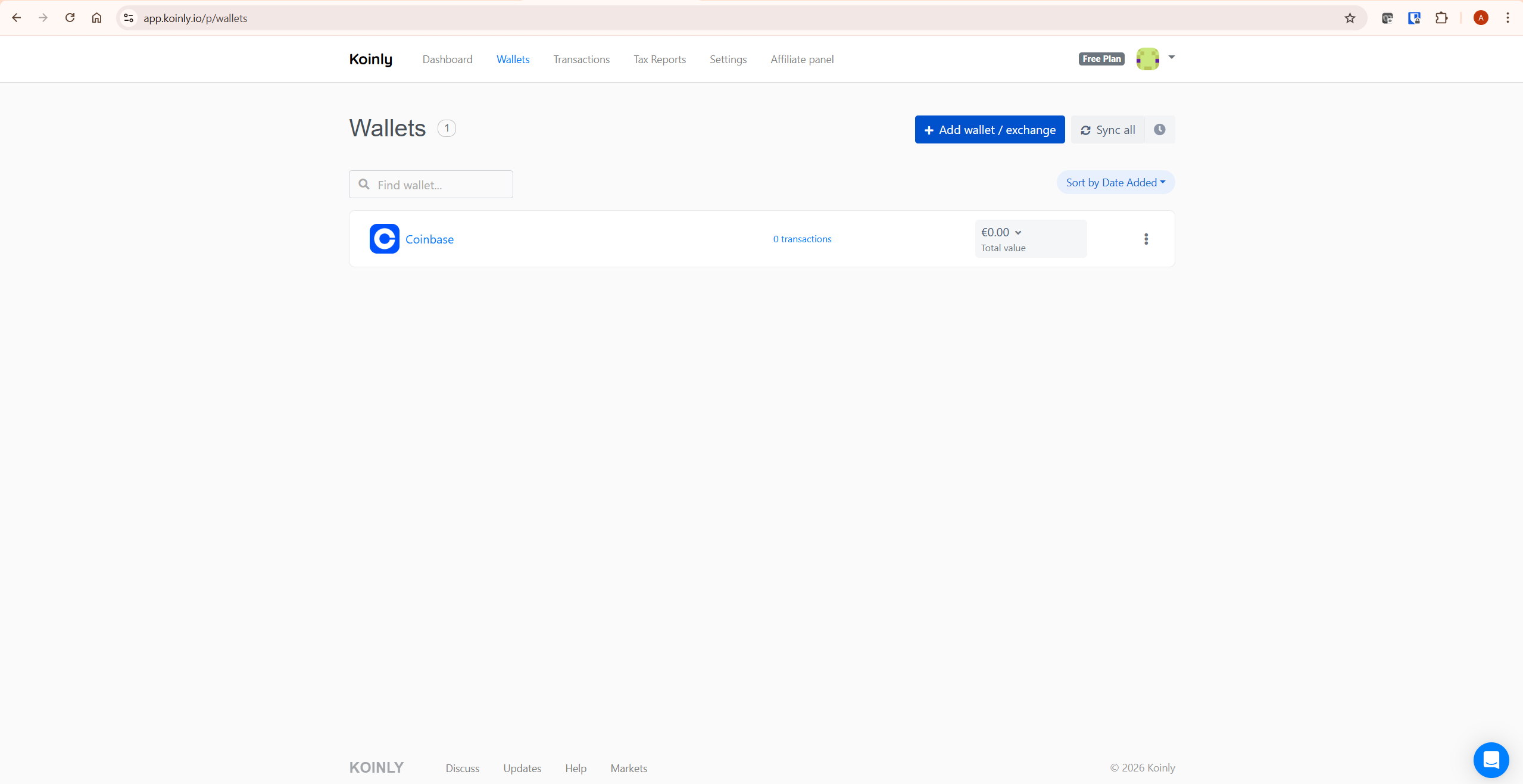
Step 1: Import All Wallets and Exchanges
Before Koinly can show you accurate unrealised loss data, it needs your complete transaction history across all connected accounts. Connect every exchange and wallet you use via API or CSV file upload. Missing wallets create cost basis gaps that lead to inaccurate gain and loss calculations — which defeats the purpose of the exercise.
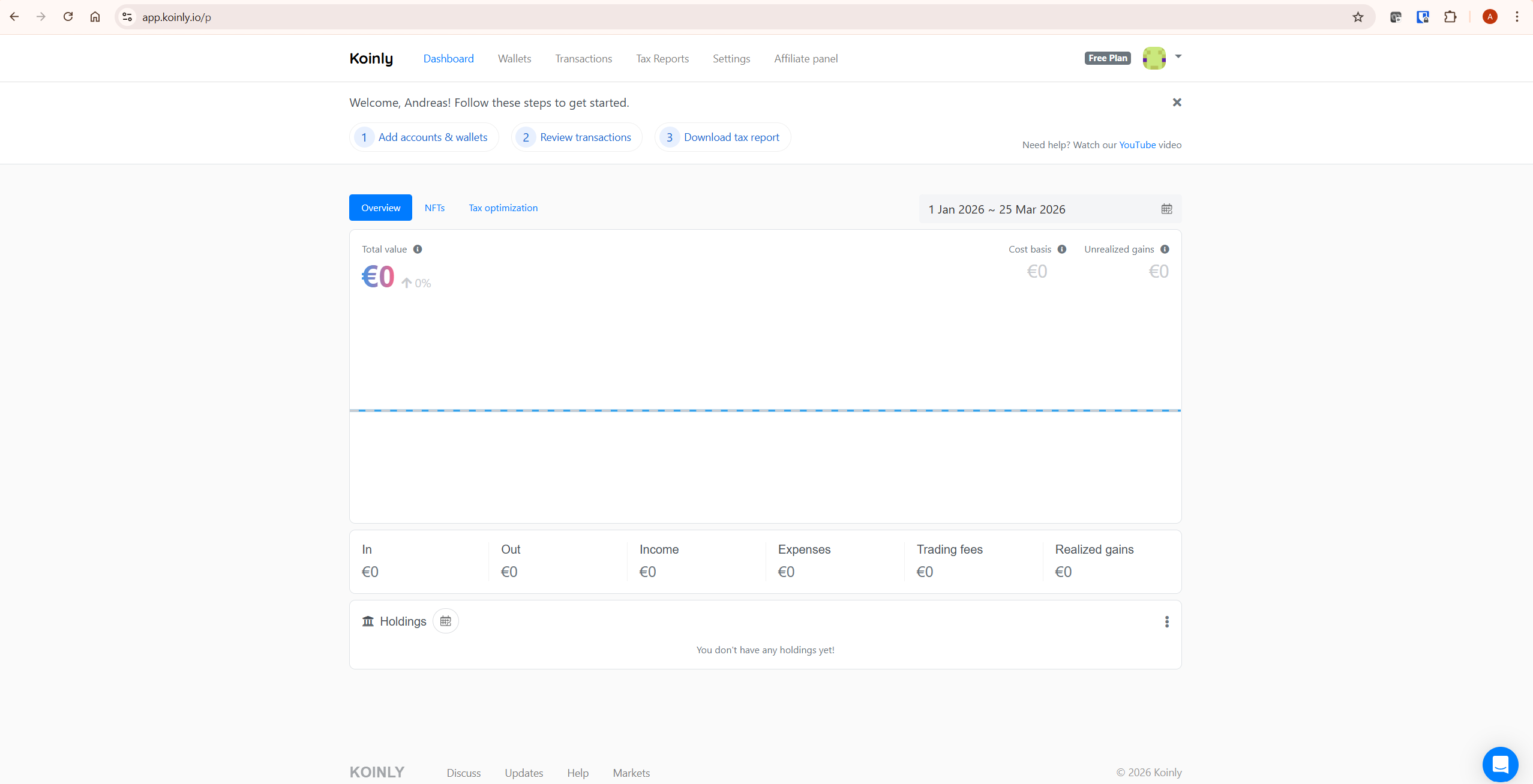
Step 2: Open the Tax Optimization Tab
Once your data is imported, navigate to the Koinly Dashboard. You will see tabs including Tax optimization. Click it to access Koinly’s dedicated harvesting tools showing unrealised gains and losses across all connected accounts.
Step 3: Identify Your Harvesting Candidates
Review the assets showing unrealised losses. Prioritise in this order:
- Short-term losses first — assets held for less than one year. Short-term gains are taxed at ordinary income rates, so offsetting them with short-term losses produces the greatest tax saving per dollar of loss harvested.
- Large unrealised losses — where the absolute loss amount is significant enough to justify the transaction costs of selling and repurchasing.
- Assets you are comfortable selling — temporarily or permanently, with a genuine investment rationale for the transaction.
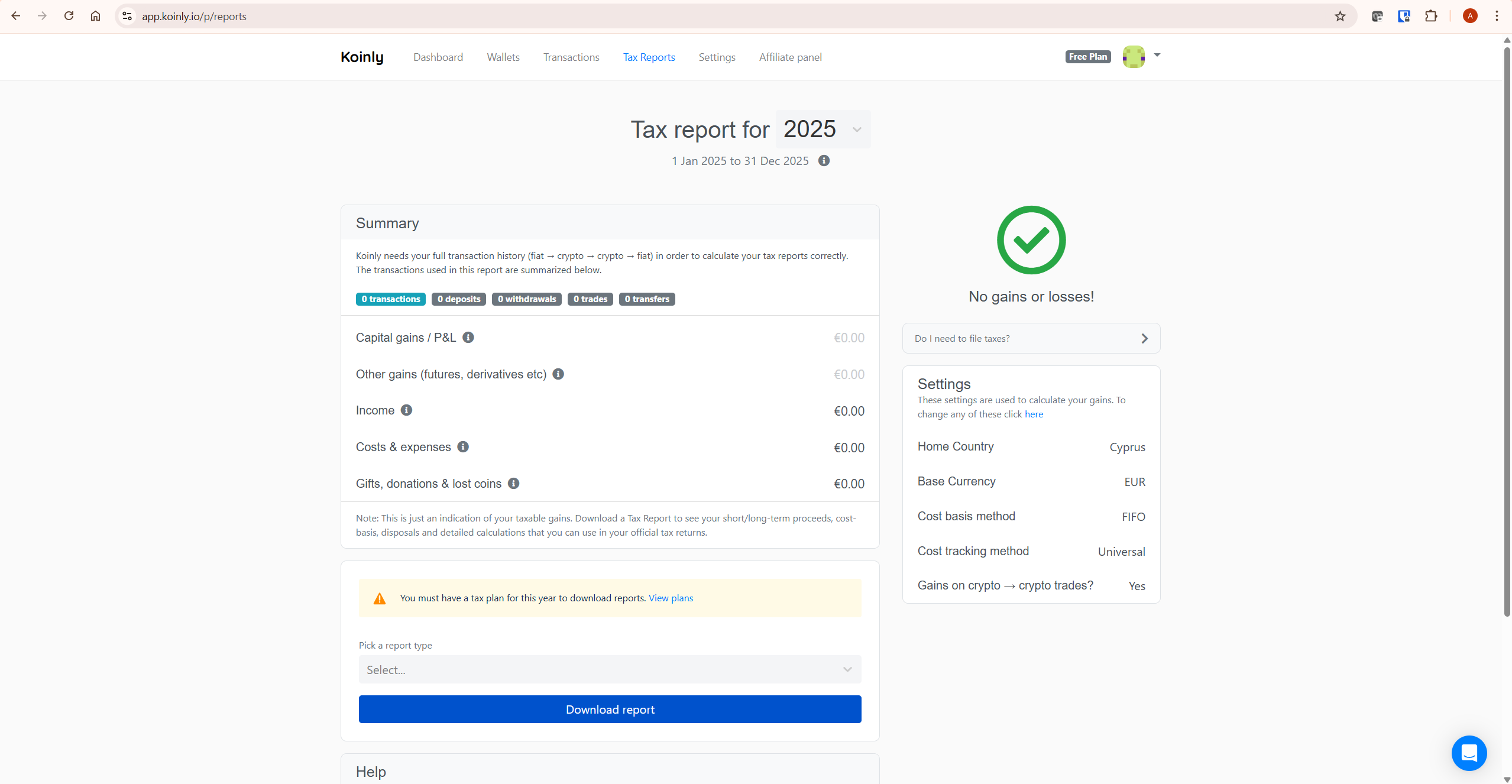
Step 4: Review Your Capital Gains Summary
Before selling, check Koinly’s Tax Reports page for your capital gains summary for the current tax year. This tells you how much in realised gains you have already accumulated — which determines how much harvesting is actually useful.
Step 5: Execute the Sale on Your Exchange
Go to the relevant exchange and sell the identified position. Koinly does not execute trades — it is a tax reporting and portfolio tracking tool. The sale must be made directly on your exchange or wallet.
Step 6: Sync Koinly and Verify the Loss
After the sale, sync your exchange in Koinly to import the new transaction. Check that the realised loss is reflected correctly in your capital gains summary. Verify the cost basis Koinly has assigned to the sold lot.
Step 7: Consider Whether to Repurchase
If you want to maintain your position in the asset, review the repurchase rules in your jurisdiction before buying back the same asset. US treatment, UK matching rules, and Australian anti-avoidance rules can produce very different tax outcomes. In all cases, sync the new transaction into Koinly so your cost basis stays complete.
For a full overview of everything Koinly tracks and calculates, see our complete Koinly review.
When You Should Not Repurchase Immediately
Even where immediate repurchase is permitted, it is not always the best decision. Repurchasing immediately resets your cost basis to the new lower price. If the asset later recovers, your future taxable gain may be larger because your new basis is lower. The strategy works best when the current tax benefit is valuable enough to justify the future basis reset.
You should also avoid immediate repurchase if the transaction is being executed purely for a tax result with no investment rationale, if your jurisdiction has anti-avoidance rules that could apply, or if you are close to a more favourable long-term holding period. Tax loss harvesting is a planning tool, not a reason to make economically poor trades.
Short-Term vs Long-Term Losses: Which to Harvest First
Not all capital losses are equal in their tax impact, and harvesting order matters. Short-term capital gains — from assets held less than one year — are taxed at ordinary income rates in the US, which can be as high as 37% for higher earners. Long-term capital gains — from assets held more than one year — are taxed at preferential rates of 0%, 15%, or 20% depending on income.
Short-term losses offset short-term gains first, and long-term losses offset long-term gains first under IRS netting rules. The practical implication: if you have a mix of gains, prioritise harvesting short-term losses first, as these offset the highest-taxed gains and generate the greatest dollar-for-dollar tax saving. Koinly’s capital gains summary separates short-term and long-term figures, making this straightforward to assess.
Common Mistakes When Harvesting Crypto Losses
Harvesting Without Complete Cost Basis Data
If your transaction history is incomplete — missing wallets, unimported exchange data, gaps from exchanges that have since closed — Koinly cannot calculate your cost basis accurately. A loss that appears on screen may be incorrect. Import your complete transaction history before making any harvesting decisions. If your unrealised losses look strange or your gains do not match your expectations, see our guide on why Koinly shows wrong gains and how to fix cost basis errors before executing any harvesting trades.
Harvesting Too Late in the Tax Year
For US taxpayers, capital losses generally need to be realised before December 31 to apply to the current tax year. Other countries use different tax year dates — for example, the UK tax year runs from 6 April to 5 April — so confirm your local deadline before planning any harvest. Reviewing opportunities well before year-end gives you time to act deliberately rather than reactively.
Ignoring Transaction Costs
Every sale generates a transaction fee. If the tax saving from harvesting a loss is smaller than the combined transaction costs of selling and repurchasing, the exercise costs you money. Koinly’s capital gains preview lets you model the impact of a sale before executing it.
Misidentifying Internal Transfers as Losses
Moving crypto between your own wallets is not a taxable event and does not generate a capital loss. If Koinly is not correctly identifying internal transfers — because wallets are not all connected — what appears as a loss may be a miscategorised transfer. Always verify that flagged losses represent genuine disposals before acting on them.
Assuming the Wash Sale Exemption Will Last
Building an aggressive multi-year tax strategy around a regulatory exemption that may change is a risk management problem, not just a tax problem. Document every harvest transaction carefully and stay current with any legislative developments.
Forgetting That Repurchasing Resets Your Holding Period
When you sell an asset and repurchase it, your holding period resets. If you were approaching the one-year threshold for long-term capital gains treatment, harvesting and immediately repurchasing means starting the clock again. In some cases, waiting until you cross the one-year mark before selling is worth considering.
When Tax Loss Harvesting Is Not Worth It
Your Losses Are Small Relative to Transaction Costs
If your unrealised losses are modest and your exchange charges meaningful fees, the net benefit after transaction costs may be negligible or negative.
You Are in a Low Tax Bracket
US investors whose taxable income falls below the 0% long-term capital gains threshold already pay no tax on long-term crypto gains. Harvesting losses provides limited benefit for the current year, though losses can carry forward to higher-income years.
You Are a German Investor Approaching the Long-Term Threshold
Germany’s holding-period rules may make harvesting counterproductive. Selling to harvest a loss resets your holding period, potentially costing you more favourable treatment on the recovered position. Confirm the trade-off with a German tax professional before acting.
You Have No Gains to Offset This Year
If you have had a low-gain or no-gain year, the immediate benefit of harvesting losses is limited to the $3,000 ordinary income deduction in the US. Losses carry forward, so there is no penalty for harvesting in a low-gain year — but the urgency is lower.
Using Koinly for Year-Round Loss Tracking
One of the most underused aspects of Koinly is the ability to monitor unrealised losses throughout the year, not just at tax time. The tax optimizer updates as your portfolio data syncs, which means you can identify harvesting opportunities during market dips rather than scrambling in December.
Koinly typically lets users import transactions and preview gains, losses, and tax optimisation data before purchasing a report. Feature access can change by plan and region, so confirm current access inside your Koinly account. You generally need a paid plan only when you want to download official tax reports for filing. If you only have one exchange, very few transactions, and no meaningful realised gains, Koinly may not reveal a large harvesting opportunity — but it can still help confirm whether there is anything worth acting on before year-end. See our Koinly free plan guide for a full breakdown of what is available at no cost, and our Koinly pricing guide for a complete plan comparison.
What To Do Next
Do not wait until December. Here is what to do this week:
Open Koinly and confirm every exchange and wallet is connected. Go to the Dashboard and click the Tax optimization tab. Review every position showing an unrealised loss. For each one, note the loss amount, how long you have held it, and whether the tax saving after transaction costs justifies the harvest. Cross-reference with your capital gains summary on the Tax Reports page to confirm how much you need to offset.
If you find positions worth harvesting, execute the sales on your exchange, sync Koinly, and verify the losses are recorded correctly. Before repurchasing the same asset, review the rules in your jurisdiction — US, UK, and Australian treatment can produce very different outcomes.
Start with Koinly free here — connect your wallets, check your position, and see what harvesting opportunities are available before year-end. For the full platform evaluation, read our complete Koinly review.
Frequently Asked Questions
Does the wash sale rule apply to crypto in 2026?
For ordinary crypto assets such as Bitcoin or Ethereum, the standard stock wash sale rule does not currently apply in the United States as of 2026. However, tokenized securities may be treated differently, and the regulatory direction suggests this could change. UK investors face same-day and 30-day matching rules under HMRC guidance. Always confirm the current position with a qualified tax professional before executing a harvesting strategy that relies on immediate repurchase.
Can I harvest losses and immediately repurchase the same crypto?
For ordinary crypto assets in the US, immediate repurchase may be possible under current rules — but confirm your position with a tax professional, particularly for any assets that could be classified as tokenized securities. UK investors need to consider HMRC’s same-day and 30-day matching rules, which can change how the disposal is matched for CGT purposes. Australian and German investors should review their jurisdiction’s specific anti-avoidance and holding-period rules before acting.
How much can I deduct in crypto losses?
In the US, capital losses offset capital gains without limit. If your losses exceed your gains, you can deduct up to $3,000 of the excess against ordinary income per year, with remaining losses carrying forward to future tax years. Rules differ in other jurisdictions — consult a qualified tax professional for country-specific guidance.
Does Koinly automatically identify tax loss harvesting opportunities?
Koinly’s tax optimizer tool displays unrealised gains and losses across all connected wallets and exchanges, flagging positions that could be harvested. You still need to execute any trades manually on your exchange — Koinly is a tracking and reporting tool, not a trading platform. Confirm current feature access inside your Koinly account, as availability can vary by plan and region.
What happens to unused capital losses?
In the US, capital losses that exceed your capital gains in a given year can be used to offset up to $3,000 of ordinary income, with any remaining balance carried forward to future tax years indefinitely under current law. Other jurisdictions have different carryforward rules and reporting requirements — verify the specific treatment with a tax professional and ensure losses are claimed correctly so they remain available for future use.
Is tax loss harvesting crypto legal?
Yes — it is a legal and widely used tax optimisation strategy, not tax evasion. It is the proper use of capital loss provisions within the tax code. The key constraint is that transactions must represent genuine economic activity. Purely artificial arrangements designed solely to manufacture losses with no real change in investment position can be challenged by tax authorities, particularly in jurisdictions with anti-avoidance provisions such as Australia.
The Bottom Line
Tax loss harvesting crypto can be a legitimate way to reduce taxable gains, but the strategy only works when your cost basis data is complete and your jurisdiction’s rules are followed carefully. In the US, ordinary crypto assets are not currently treated the same as stocks under the standard wash sale rule, but future rule changes and tokenized securities require caution. In the UK, Australia, Germany, and other jurisdictions, immediate repurchase can create very different tax outcomes.
Koinly is useful because it centralises your transaction history, shows unrealised losses, and helps you review harvesting opportunities before year-end. But it does not replace professional tax advice. Use Koinly to identify and document opportunities, then confirm the strategy against your full tax position before executing large trades.
Start with Koinly free here — connect your wallets, review your unrealised losses, and decide whether tax loss harvesting makes sense before the tax year closes.
Related Koinly Guides
- Koinly Review: Is It the Best Crypto Tax Software in 2026?
- Koinly Free Plan: What Can You Actually Do Without Paying?
- Koinly Pricing: Plans, Limits and Which One You Actually Need
- Is Koinly Accurate? How Reliable Is It for Crypto Taxes in 2026?
- Koinly vs CoinTracker: Which Crypto Tax Software Is Better in 2026?
- Does Koinly Report to the IRS?
Tax rules and reporting requirements referenced in this article were reviewed against IRS digital asset guidance, IRS Form 1099-DA instructions, HMRC cryptoasset guidance, and ATO wash sale guidance as of May 2026. Tax rules can change quickly, so always confirm current treatment with the relevant tax authority or a qualified tax professional before acting.
