
Koinly Review 2026: Is It the Best Crypto Tax Software? Honest Verdict
Affiliate Disclosure: This article contains affiliate links. If you sign up for Koinly through a link on this page, I may earn a commission at no extra cost to you. I only recommend tools I have genuinely evaluated.
This article is for informational purposes only and does not constitute professional tax or financial advice. Tax laws vary by country and change frequently. Consult a qualified tax professional for advice specific to your situation.
Last verified: July 2026, using Koinly’s official pricing page, feature documentation, and IRS.gov guidance.
Koinly is one of the most widely used crypto tax software platforms available in 2026 — and after putting it through a rigorous evaluation using the same criteria I applied across 30 years of assessing financial systems professionally, the verdict is clear: for most crypto investors managing moderate to complex portfolios across multiple exchanges and wallets, Koinly delivers accurate tax calculations, a well-structured interface, and reporting formats that align with the requirements of major tax authorities including the IRS, HMRC, and ATO.
That said, it is not the right tool for everyone. The free plan is genuinely limited, the pricing for high-transaction-volume investors is significant, and the accuracy of its output depends entirely on the completeness of the data you import. This review gives you the honest picture — what Koinly does well, where it falls short, who should pay for it, and who should consider an alternative.
- Koinly supports 750+ integrations including exchanges, wallets, and DeFi protocols — one of the broadest coverage sets in the market
- The free plan lets you import all transactions and preview your tax position — you only pay when you need to download a tax report
- Accuracy depends on complete data import — missing wallets or exchanges cause inflated gains, not software errors
- Koinly supports IRS (Form 8949), HMRC, ATO, and 20+ other tax authority report formats
- For DeFi and NFT activity, Koinly handles more edge cases than most competitors — but complex DeFi still requires manual review
- Rated 4.2/5 on Trustpilot from verified users — strong for a tax software platform in a complex regulatory environment
Quick Answer: Is Koinly Worth It?
For crypto investors with transactions across multiple exchanges, wallets, or DeFi protocols — yes. Koinly’s automated import system, broad exchange coverage, and multi-jurisdiction tax report generation make it significantly more efficient than manual calculation. The free plan lets you import everything and see your full tax position before paying anything — which removes the risk of paying for a tool that does not cover your specific integrations. Where Koinly is not worth it: very simple portfolios limited to one or two exchanges with low transaction counts, where a free tool or manual calculation may suffice.
Koinly Pricing 2026
Koinly’s pricing is based on transaction count per tax year, not a flat subscription. This structure means the cost scales with portfolio complexity — simple investors pay less, high-volume traders pay more.
| Plan | Transactions | Price per Tax Year | Best For |
|---|---|---|---|
| Free | Unlimited imports, preview only | $0 | Previewing your tax position |
| Newbie | Up to 100 | $49 | Casual investors, single exchange |
| Hodler | Up to 1,000 | $99 | Active traders, multiple exchanges |
| Trader | Up to 3,000 | $179 | High-frequency traders, DeFi users |
| Pro | Unlimited | $279 | Professional traders, accountants |
Pricing verified July 2026. Always confirm current figures at koinly.io before purchasing — plans and limits change regularly.
According to IRS digital assets guidance, all crypto disposals must be reported regardless of whether a 1099 is issued — making accurate cost basis calculation essential for every crypto investor filing US taxes.
The per-tax-year pricing model has an important implication: you pay separately for each tax year you need a report for. If you need to file for three prior years, that is three separate purchases. For investors with clean, low-volume portfolios, the Newbie plan at $49 is a genuinely affordable entry point. For DeFi-heavy users with thousands of transactions, the Pro plan at $279 is the realistic tier. For a detailed breakdown of every plan and its limits, my dedicated Koinly pricing guide covers the full cost structure.
What Koinly Does: Core Features
Koinly is a crypto tax calculation and reporting platform. Its core workflow is: import your transaction history from exchanges and wallets, calculate your taxable events and gains using your jurisdiction’s rules, and generate a downloadable tax report in the correct format for your tax authority.
Exchange and Wallet Integration
Koinly supports over 750 integrations — exchanges, wallets, blockchains, and DeFi protocols. Major exchanges including Binance, Coinbase, Kraken, and Gemini connect via API for automatic transaction sync. Wallets connect via public address, with Koinly reading the blockchain directly. CSV import is available for any exchange that does not have a direct integration.
The breadth of coverage is one of Koinly’s strongest practical advantages. Investors who have used multiple exchanges over several years — including some that have since closed — can typically import all their history through a combination of API, wallet address, and CSV. For the step-by-step process of connecting your exchanges, my guide on how to use Koinly covers the full setup workflow.
Tax Calculation Engine
Koinly calculates capital gains and income across all standard taxable crypto events: disposals (selling for fiat, trading crypto-to-crypto, spending on goods and services), income events (staking rewards, mining income, airdrops, referral bonuses, hard forks), and DeFi interactions (liquidity pool entries and exits, yield farming, lending).
The platform supports multiple cost basis accounting methods — FIFO, LIFO, HIFO, and jurisdiction-specific methods including the UK’s share pooling rules and Australia’s specific identification method. Selecting the correct method for your jurisdiction is critical — the same transaction data produces meaningfully different gain figures under different methods. Koinly’s country-specific settings apply the correct default for most jurisdictions, but I always recommend confirming with a qualified tax professional before filing.
Tax Reports and Supported Jurisdictions
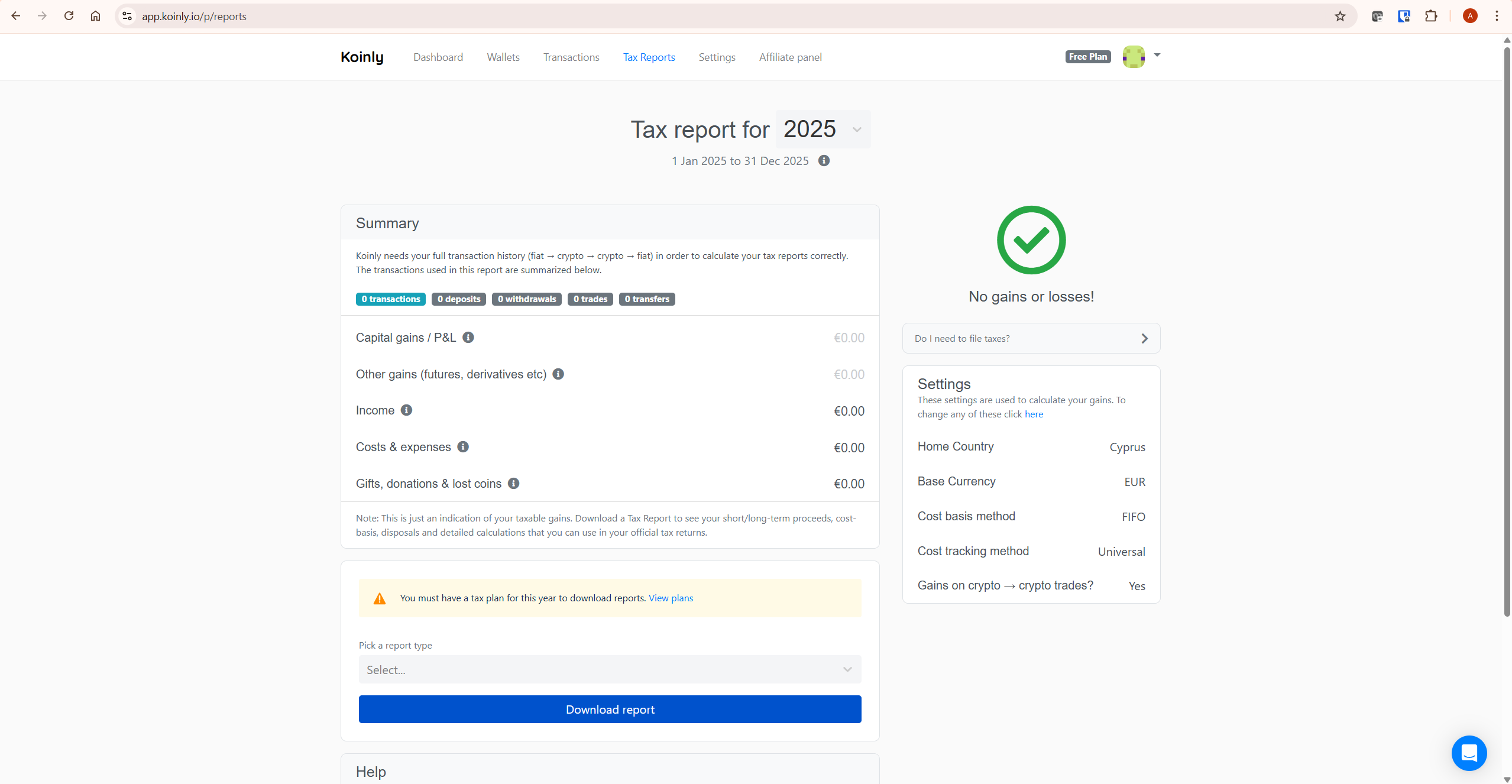
Koinly generates tax reports for 20+ countries and tax authorities. For US investors, this includes Form 8949 (capital gains detail), Schedule D summary, and TurboTax-compatible export. For UK investors, HMRC Capital Gains Summary. For Australian investors, ATO-compatible reports. For German investors, FIFO and HIFO reports compatible with ELSTER.
The report generation process is straightforward — select your country, choose the tax year, select your accounting method, and download. The resulting report is formatted for direct submission or accountant handoff. For US-specific guidance, my article on how to import Koinly into TurboTax covers the complete filing workflow.
For UK investors, Koinly generates HMRC-compatible Capital Gains Summary reports. According to HMRC’s cryptoassets guidance for individuals, UK investors must report crypto gains through Self Assessment — Koinly produces the documentation needed for that process.
DeFi and NFT Handling
DeFi tax treatment is one of the most complex areas of crypto taxation, and Koinly handles more edge cases than most competitors. Liquidity pool entries and exits, yield farming rewards, wrapped token conversions, bridge transactions, and NFT purchases, sales, and royalties are all supported with specific transaction classification options.
The honest caveat: complex DeFi activity still requires manual review. Koinly’s automated classification covers the majority of standard DeFi interactions correctly, but edge cases — particularly multi-step transactions across protocols, gas fee treatment in certain jurisdictions, and novel DeFi structures — may require manual tagging. For the complete picture of Koinly’s DeFi capabilities, my Koinly DeFi and NFTs guide covers every scenario in detail.
Portfolio Tracking
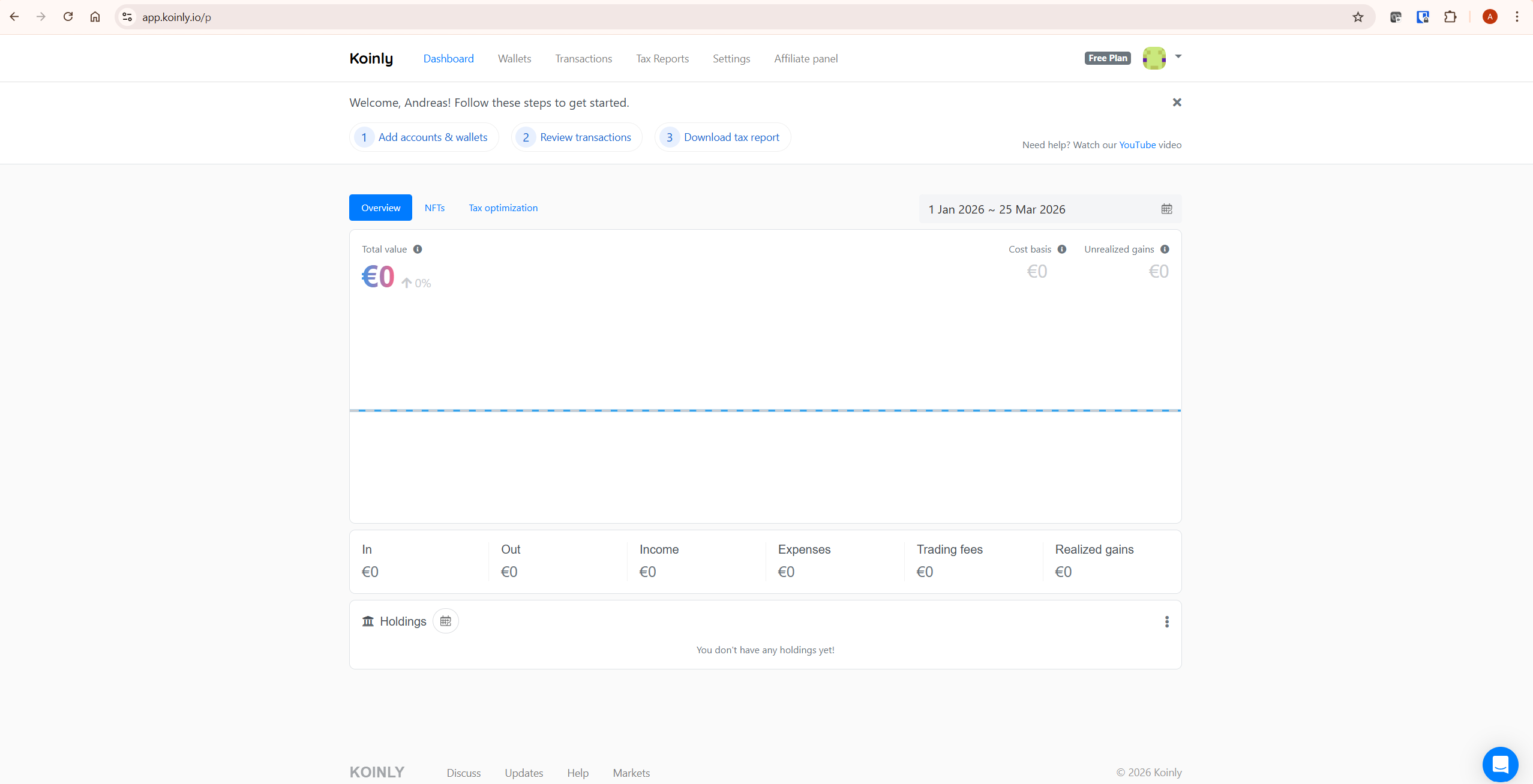
Beyond tax reporting, Koinly provides a real-time portfolio overview showing current holdings, historical performance, and unrealised gains across all connected wallets and exchanges. This dashboard is available on the free plan and gives investors a consolidated view of their crypto position without needing to log into individual exchanges.
Koinly Accuracy: What the Evidence Shows
Koinly’s calculation accuracy is strong when given complete data — and variable when data is incomplete. This is the single most important thing to understand about the platform.
The calculation engine correctly applies cost basis rules, identifies taxable events, and generates accurate reports when every exchange and wallet has been imported with full transaction history. When data is missing — an old exchange account, a forgotten wallet, a staking platform not connected — Koinly defaults to zero cost basis on the affected assets, inflating gains significantly.
Rated 4.2/5 on Trustpilot from verified users — notable for a tax software platform operating in a complex regulatory environment where user error frequently contributes to reported issues. The most common negative reviews cite inflated gains — which in most cases trace back to incomplete data import rather than calculation errors. For the complete accuracy analysis, my is Koinly accurate guide covers the methodology and known edge cases in detail.
Koinly Security: Is It Safe?
Koinly uses read-only API access for all exchange connections — it can retrieve your transaction history but cannot place orders, withdraw funds, or transfer assets. Your exchange credentials are never stored by Koinly. Data is encrypted in transit and at rest. Two-factor authentication is available on all accounts.
One important clarification that comes up repeatedly: Koinly does not report your data to the IRS or any other tax authority. It generates reports for you to submit yourself. For the complete security analysis including API permission guidance, my is Koinly safe guide covers every aspect of the platform’s security model. For the reporting question specifically, my does Koinly report to the IRS guide gives a direct answer.
Koinly Pros and Cons
What Koinly Does Well
Breadth of integrations. 750+ supported exchanges, wallets, and protocols — more than most competitors. For investors with fragmented history across multiple platforms, this coverage is the most practically important feature.
Free plan with full import. You can import all your transactions, see your complete tax position, and identify any data gaps before paying anything. This is genuinely useful — it eliminates the risk of paying for a tool that cannot handle your specific integrations.
Multi-jurisdiction support. 20+ country-specific tax report formats with correct accounting methods applied by default. For investors with cross-border crypto activity or who have relocated between countries, this is a significant practical advantage.
DeFi handling. More comprehensive DeFi transaction classification than most competitors, with specific support for liquidity pools, yield farming, wrapped tokens, and NFTs.
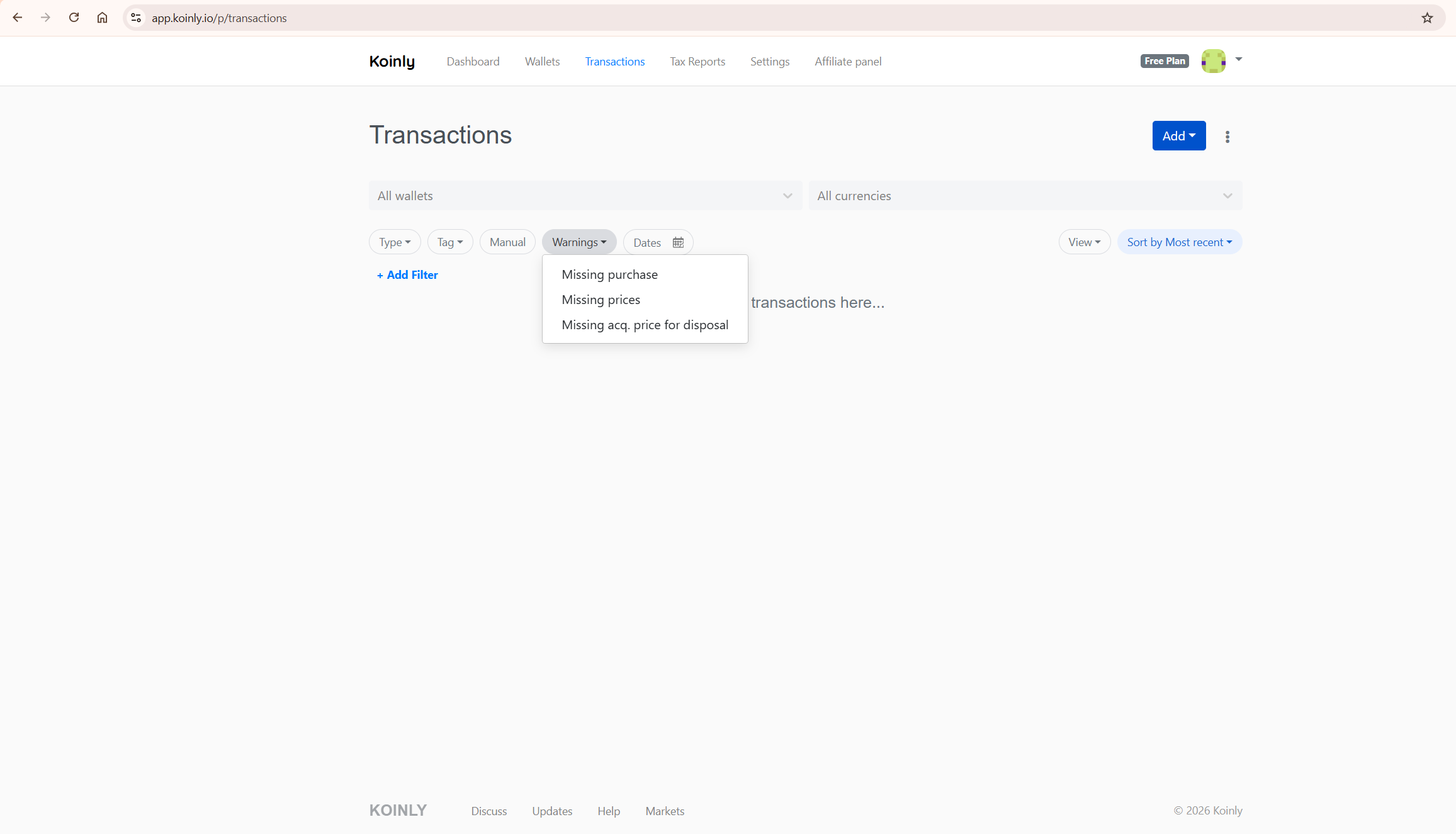
Warning system. Koinly’s transaction warning flags — Missing Purchase, Missing Cost Basis, Negative Balance — surface data gaps before they corrupt the final report. This proactive error identification is one of the most valuable features for users with complex portfolios.
Where Koinly Falls Short
Per-year pricing adds up. Paying separately for each tax year you need a report for means catching up on multiple prior years becomes expensive quickly. Investors who need three or four years of reports face a significant upfront cost.
Accuracy requires complete data. The platform’s accuracy is entirely dependent on the completeness of what you import. This is not a software limitation per se — it is an inherent characteristic of any calculation tool — but it means the output requires careful verification before filing.
Complex DeFi still needs manual review. Automated classification covers most standard DeFi interactions but edge cases require manual tagging. For highly active DeFi users, this review process adds meaningful time to the workflow.
Customer support response times. Support response times during peak tax season (January–April) are slower than year-round. For investors working to a filing deadline, this is worth factoring into your timeline.
Koinly Compliance Checklist
| Step | Action | Why It Matters |
|---|---|---|
| 1 | Import every exchange and wallet — including old or inactive accounts | Missing sources cause zero cost basis errors and inflated gains |
| 2 | Resolve all Warning flags before generating a report | Unresolved warnings indicate data gaps that corrupt the final calculation |
| 3 | Confirm your country and accounting method in Settings | Wrong method produces a correctly calculated result under the wrong rules |
| 4 | Check for duplicate imports — remove CSV wallets if API is connected | Duplicates double transaction counts and inflate gains |
| 5 | Verify wallet-to-wallet transfers are labelled correctly | Misclassified transfers create artificial taxable disposals |
| 6 | Review staking, airdrop, and DeFi transaction classifications | Income events need correct tagging for accurate income vs gains split |
| 7 | Cross-check Koinly gains against any 1099 forms received from exchanges | IRS cross-references exchange-reported data against your filed return |
| 8 | Consult a qualified tax professional before filing | Koinly generates reports — the filing responsibility and accuracy verification remains yours |
This checklist is a practical guide only and does not substitute for professional tax advice. Consult a qualified tax professional before filing.
How Koinly Compares to Alternatives
Koinly is not the only credible option in the crypto tax software market. Here is where it stands against the main alternatives.
Koinly vs CoinLedger: CoinLedger has a cleaner interface and stronger customer support reputation. Koinly leads on integration breadth and DeFi coverage. For most investors, both produce accurate results — the choice often comes down to which platform covers your specific exchanges. My Koinly vs CoinLedger comparison covers this in detail.
Koinly vs CoinTracker: CoinTracker integrates with TurboTax more seamlessly and has a stronger portfolio tracking interface. Koinly leads on transaction volume limits at comparable price points and broader international tax support. My Koinly vs CoinTracker comparison covers the full picture.
Koinly vs TokenTax: TokenTax offers more hands-on support and accountant services, making it better for investors who want professional assistance rather than a self-service tool. Koinly is significantly more affordable for self-service use. My Koinly vs TokenTax comparison covers this trade-off in detail.
Koinly vs Blockpit: Blockpit is stronger for European investors, particularly in Germany and Austria, with deeper ELSTER integration. Koinly leads on global coverage and English-language support. My Koinly vs Blockpit comparison covers this directly.
Who Should Use Koinly
Koinly is the right choice if you have transactions across multiple exchanges, wallets, or DeFi protocols; if you need multi-jurisdiction tax reports; if you want to preview your complete tax position before paying anything; or if you are filing in the US, UK, Australia, Germany, or any of the 20+ supported jurisdictions.
Consider an alternative if your portfolio is limited to a single exchange with fewer than 25 transactions per year — at that volume, a free tool or manual calculation may be sufficient. Also consider alternatives if you need hands-on accountant support rather than a self-service platform, or if you are based in a jurisdiction not currently supported by Koinly’s report formats.
For the complete worth-it analysis across different investor profiles, my dedicated guide on is Koinly worth it covers the decision framework in full.
What To Do Next
The most useful first step is to import your transactions on the free plan before paying anything. Connect every exchange and wallet you have used, resolve any warning flags, and review your capital gains total. That process alone tells you whether Koinly covers your specific integrations correctly and gives you a realistic picture of your tax position before committing to a paid report.
Start with Koinly’s free plan here — import all your exchanges and wallets and preview your complete tax position before paying. For setup guidance, my how to use Koinly guide walks through the complete workflow step by step.
Frequently Asked Questions
Is Koinly free to use?
Koinly’s free plan allows unlimited transaction imports and full portfolio tracking — you can see your complete tax position without paying anything. The free plan does not include downloadable tax reports. To download a Form 8949, HMRC report, or any other tax authority report, you need a paid plan starting at $49 for up to 100 transactions per tax year.
How accurate is Koinly?
Koinly’s accuracy is strong when given complete transaction data. The calculation engine correctly applies cost basis rules and identifies taxable events across standard crypto, DeFi, and NFT activity. Accuracy issues almost always trace back to incomplete data import — missing exchanges, wallets, or historical records — rather than calculation errors. Import everything, resolve all warning flags, and the output is reliable for most investors.
Does Koinly work for DeFi and NFTs?
Yes — Koinly supports DeFi transactions including liquidity pool entries and exits, yield farming, staking, wrapped tokens, bridge transactions, and NFT purchases, sales, and royalties. Complex multi-step DeFi transactions may require manual review and tagging, but coverage is more comprehensive than most competing platforms.
Which countries does Koinly support?
Koinly generates tax reports for 20+ countries including the US (Form 8949, Schedule D, TurboTax export), UK (HMRC Capital Gains Summary), Australia (ATO-compatible), Germany (ELSTER-compatible), Canada, France, Sweden, and others. Country-specific accounting methods are applied by default when you select your jurisdiction in Settings.
How does Koinly handle missing cost basis?
When Koinly cannot find the original acquisition record for an asset being disposed of, it defaults to a zero cost basis — treating the full disposal value as a taxable gain. This is why resolving Missing Purchase and Missing Cost Basis warnings before generating a report is essential. Import the exchange or wallet holding the original acquisition record to resolve these warnings and restore accurate cost basis calculation.
