
Semrush Keyword Research: Best 7-Step Affiliate Workflow
This site earns revenue through affiliate partnerships with other platforms. This article does not currently contain affiliate links for Semrush. Any tool recommendations are based on independent evaluation.
You have Semrush open. You have a niche. And you have absolutely no idea which keywords are actually worth your time — because every tool gives you numbers, but no tool tells you what those numbers mean for a site at your stage. That is the real problem with Semrush keyword research: not a lack of data, but a lack of a decision framework for acting on it.
Semrush keyword research gets searched by thousands of affiliate site owners every month — and most of the answers they find treat it as a software tutorial. This guide treats it as a strategy problem. Because that is what it actually is.
After 30 years in finance, I approach keyword research the same way I approach any capital allocation decision: validate the opportunity before committing resources, understand the competitive landscape before entering, and build positions that compound over time rather than produce one-off gains. That framework translates directly into how you use Semrush to find keywords worth ranking for.
By the end of this guide, you will have a complete, repeatable 7-step workflow — from seed keyword to published article plan — using Semrush’s core tools, with every decision point explained in plain terms.
Quick Answer
For Semrush keyword research on an affiliate site: start with a seed keyword in Keyword Overview to check difficulty and intent, expand using the Keyword Magic Tool filtered by word count (4+), difficulty (under 40 for newer sites), and commercial or informational intent, then validate the SERP by checking whether weak pages are actually ranking — not just whether the difficulty score looks low. Group findings into clusters around a single pillar topic, map each keyword to a monetisation outcome, and publish in sequence rather than randomly. The Keyword Gap tool run against two or three competing affiliate sites will surface opportunities your initial search misses entirely.
The 7-Step Semrush Keyword Research Workflow at a Glance
Before the detail, here is the full workflow mapped to the tools that execute it. This table is your reference — each step is explained fully in the sections that follow.
| Step | Semrush Tool | What You’re Doing | Output |
|---|---|---|---|
| 1 | Keyword Overview | Viability check on seed keyword | Go / No-go decision |
| 2 | Keyword Overview SERP panel | Reading actual ranking pages | Structural opportunity confirmed |
| 3 | Keyword Magic Tool | Expand into long-tail variants | Full keyword list by type |
| 4 | Keyword Gap | Find competitor-validated gaps | Missing + Weak keyword lists |
| 5 | Spreadsheet (manual) | Map keywords to monetisation | Prioritised content calendar |
| 6 | Keyword Magic Tool | Build cluster architecture | Pillar + support article plan |
| 7 | Domain Overview | Final competitor validation | Content gap confirmed |
Why Most Affiliate Keyword Research Fails Before It Starts
The problem is not the tool. It is starting with the tool at all.
Most affiliate site owners open Semrush, type in a keyword, look at the volume and difficulty score, and make a decision based on those two numbers. That process produces content calendars full of articles that either never rank because the competition is stronger than the KD% suggests, or rank for traffic that never converts because the intent was informational when the site needed commercial.
Before you open any tool, three things need to be defined: what monetisation outcome each article is supposed to support, what stage your domain is at in terms of authority, and what a realistic ranking timeline looks like for your situation. Without those anchors, keyword data is noise dressed up in a spreadsheet.
For an affiliate content site, every keyword you target should map to one of three outcomes: direct monetisation through a review or comparison that converts to a commission, authority building through informational content that supports a money page via internal links, or cluster expansion that strengthens topical authority around a pillar topic. If a keyword does not map cleanly to one of these, it is not a priority — regardless of what the volume looks like.
Step 1: Start Semrush Keyword Research with Keyword Overview
Keyword Overview is your first filter — a quick viability check, not a ranking decision. Open it, enter your seed keyword, set the country to your primary target market, and assess five metrics: Keyword Difficulty (KD%), search intent classification, CPC as a commercial-value proxy, search volume, and the SERP features triggered.
Volume matters, but it is the least important of the five for a newer or mid-authority site. A keyword doing 500 searches per month with commercial intent, a KD of 28%, and no featured snippet lock-in from a major domain is a far better opportunity than a keyword doing 5,000 searches with a KD of 65% dominated by Forbes, NerdWallet, and Investopedia.
Pay attention to the intent classification. Semrush labels keywords as informational, commercial, transactional, or navigational. For affiliate content, you want commercial and informational — in that order. Transactional keywords are dominated by e-commerce. Navigational keywords are searches for a specific brand or website. Neither belongs in an affiliate content strategy.
One check I always run at this stage: the CPC figure, even if you are not running paid ads. A CPC above £1.50 or $2.00 signals that advertisers believe this audience converts. That is market validation for your affiliate angle. Low CPC with high volume often means the audience browses but does not buy — a warning sign worth noting before you write 3,000 words.
Step 2: Read the SERP Before You Trust the Difficulty Score
KD% is a calculation based on the authority of currently-ranking pages. It does not tell you whether those pages are actually good — and that distinction changes everything about the opportunity.
Scroll down in Keyword Overview to see the current top 10 results for your keyword. You are looking for structural weakness — not just a low number. Forums ranking in positions four through seven is a weakness signal. Thin affiliate posts from 2021 with no updates is a weakness signal. A Reddit thread in position three is one of the clearest signals you will find that Google has not yet found a genuinely authoritative answer. That is your opening.
Weak content ranking is a structural opportunity, not a numerical one. It means Google is willing to rank something better, and that something can be you — even without a high-authority domain — if your content is demonstrably more useful than what is currently there.
Conversely, if the top 10 is entirely major publications and established SaaS review sites with 90+ domain ratings, a KD of 45% is not an invitation — it is a warning. The metric understates the real competitive barrier because the authority gap between you and those domains is too wide to bridge with content quality alone at this stage.
This SERP analysis takes three minutes per keyword. It is the most valuable three minutes in the entire Semrush keyword research process. Do not skip it.
Step 3: Expand Your List Using the Keyword Magic Tool
The Keyword Magic Tool is where you build the full opportunity picture around a topic — the expansion phase of Semrush keyword research, moving from a single seed to a complete cluster of article candidates.
Enter your seed keyword and apply these filters immediately: word count of four or more words (long-tail queries have lower difficulty and more specific intent), KD range appropriate to your domain stage (under 40% for sites under twelve months old, up to 55–60% for established sites with growing authority), and intent set to informational plus commercial. Export what remains to a spreadsheet before you start evaluating — the Magic Tool gives you a lot to work through and doing it all inside the tool leads to decision fatigue and missed opportunities.
You are mining for four specific keyword types that build monetisation layers for an affiliate site. First, commercial modifier keywords — searches containing words like “best”, “review”, “vs”, “worth it”, “alternative” — these are buyers at the decision stage. Second, problem-based queries describing a specific problem the tool or topic solves. Third, feature-specific searches about a particular capability of a product you promote. Fourth, comparison queries — some of the highest-converting pages an affiliate site can publish, because the reader has already narrowed their choices and just needs a clear verdict.
Each keyword type serves a different role in your content funnel. Commercial modifiers convert directly. Problem-based articles build trust and internal link to money pages. Feature articles establish practical expertise. Comparison articles capture readers at the final decision point. A well-structured affiliate cluster contains all four types working together — and the Keyword Magic Tool finds all of them efficiently from a single seed keyword.
According to Search Engine Journal’s SEO guidance, long-tail keywords with four or more words consistently show stronger conversion rates for affiliate content than short, high-volume terms — which aligns exactly with the Keyword Magic Tool filtering approach described here.
If you want a broader view of everything Semrush can uncover across your full niche, our Semrush review covers every major tool in the platform with an honest assessment of what each one actually delivers for affiliate site owners.
Step 4: Use Keyword Gap to Find What Competitors Already Validated
The Keyword Gap tool is the most underused step in Semrush keyword research — and often where the best opportunities are hiding, because your competitors have already done the validation work for you.
The tool lets you compare your domain against up to four competitors simultaneously and identifies keywords they rank for that you do not. For a newer affiliate site, this is more valuable than any amount of seed keyword research from scratch. You are not guessing which keywords work in your niche. You are reading the results of experiments your competitors have already run — and building your content calendar on proven demand.
Enter your domain alongside two or three affiliate sites in your niche — specifically sites at a similar authority level or slightly above yours, not the giant comparison portals that dominate every category. Filter the results by “Missing” keywords first — these are keywords your competitors rank for and you have no ranking position at all. Then review “Weak” — keywords where you have a position but it is significantly lower than theirs.
The Missing list is your content gap. The Weak list is your improvement queue. Both are more immediately actionable than starting from scratch, because demand is already proven and the competitive benchmark is right in front of you.
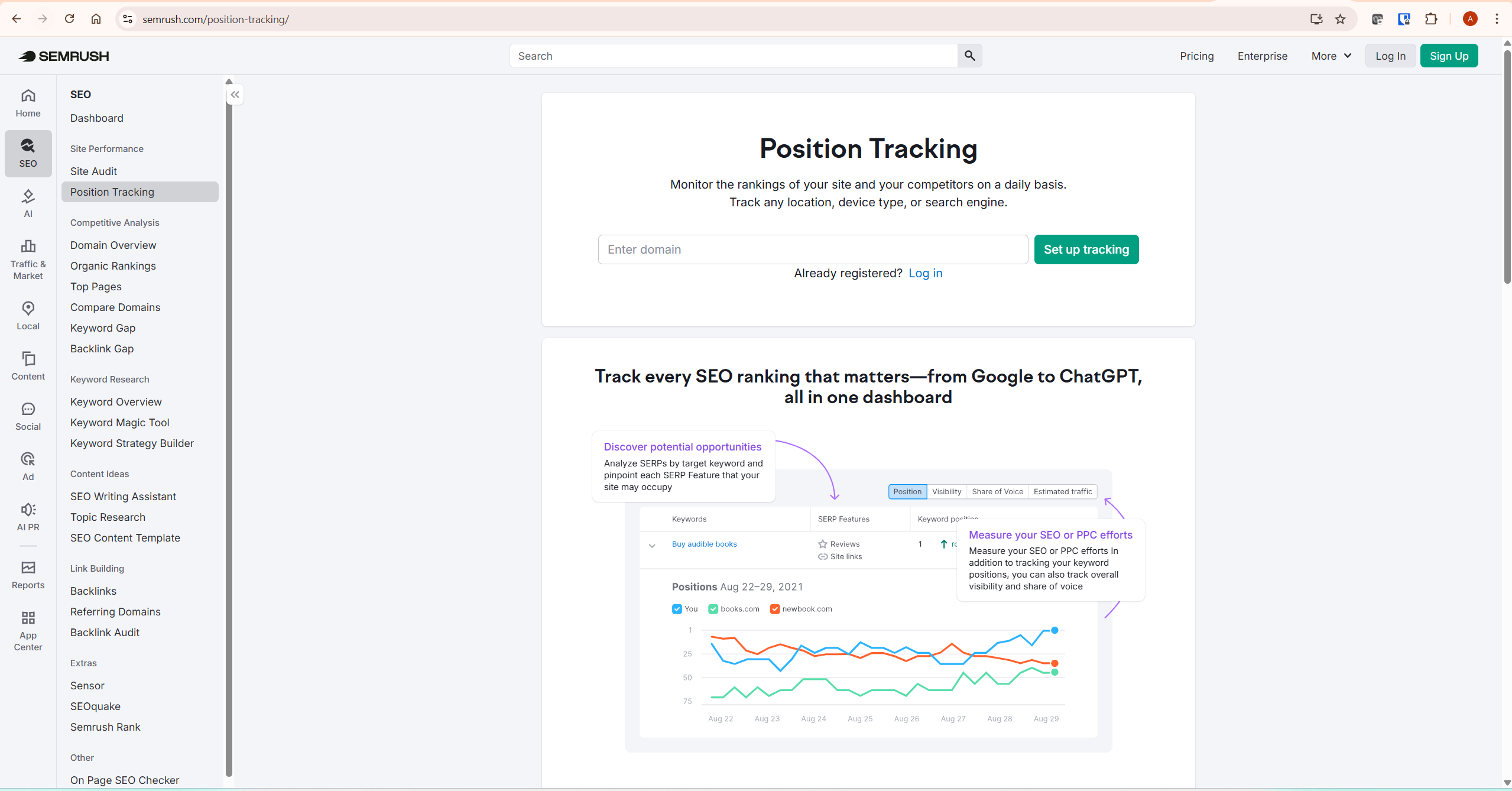
Cross-referencing this gap analysis with your Semrush Position Tracking setup shows you how quickly your existing content is moving — which helps you decide whether to prioritise writing new articles or strengthening the ones you already have.
Step 5: Map Every Keyword to a Monetisation Outcome
Every keyword that survives your research process needs to pass one final filter before it earns a place on your content calendar: does it map to a monetisation outcome? If it does not, it stays off the list regardless of how attractive the volume looks.
This is where the capital allocation mindset matters most. Each article you publish costs time, research effort, internal linking power from your existing content, and the opportunity cost of not writing something else instead. When you treat Semrush keyword research as a resource allocation decision — not a topic discovery exercise — every keyword decision becomes cleaner.
Map each keyword against three questions. Can this traffic convert directly — either through an affiliate link in the article itself, or through a clear path to a money page? Can this article support a cluster pillar via internal links, passing authority and relevance to a page that converts? Does this keyword help build topical depth in a cluster where you are developing authority — strengthening Google’s understanding of your site’s expertise in this area?
If a keyword answers yes to at least one of those three questions, it earns a place. If it answers no to all three, it is traffic for its own sake — and traffic that does not serve a business purpose is vanity, not strategy. This filter typically removes a third of keywords that look attractive in raw data but contribute nothing meaningful to affiliate revenue or authority architecture.
For a practical breakdown of what Semrush’s subscription actually costs versus what is accessible for free, our Semrush pricing guide covers the free tier in detail — the free tools cover most of what a newer affiliate site needs to run this full research workflow.
Step 6: Build Cluster Architecture Around Every Pillar Keyword
The goal of professional Semrush keyword research is not a list of individual articles — it is a cluster architecture, a planned group of articles built around a single pillar topic, each reinforcing the others through internal links and topical depth.
Google rewards topical authority. A site that has published ten to fifteen articles covering every angle of a single topic — the review, the pricing breakdown, the comparison articles, the how-to guides, the troubleshooting pieces — signals genuine expertise in a way that fifteen unrelated articles across different topics never can. That topical depth is what allows newer sites to compete against larger domains on mid-difficulty keywords, because the cluster as a whole carries more authority than any individual article.
From a single seed keyword, a complete affiliate cluster typically contains: a pillar review or overview article (your highest-authority page on the topic), a pricing and plan breakdown article (captures evaluating intent), comparison versus competitor articles (captures final-decision intent), how-to guides for specific features (captures tutorial intent and builds practical authority), and troubleshooting articles (captures high-anxiety searches where the reader has a specific problem they need solved right now).
The Keyword Magic Tool surfaces keywords for every one of these article types if you apply the right filters. The cluster architecture is not something you design separately from the research — it emerges from the research itself, if you know what patterns to look for.
Once your cluster articles are published, running a Semrush Site Audit will identify internal linking gaps, crawl issues, and on-page problems that prevent your cluster articles from passing authority properly to the pillar — one of the most overlooked ranking factors for content sites at every stage of growth.
Step 7: Use Domain Overview for Final Competitor Validation
Domain Overview is the final check before you write — competitor validation that confirms the opportunity is real and shows you exactly where the gap is.
Enter two or three competing affiliate domains into Domain Overview. Look at their top traffic pages. If multiple similar affiliate sites are all driving significant traffic from the same cluster of keywords, that confirms demand — this topic converts for sites at a comparable authority stage. If a competitor has strong traffic from one article type but nothing on a specific angle you have identified, that gap is yours to own before anyone else spots it.
The critical discipline here is to identify where their content is incomplete, not just where it exists. A competitor ranking in position three with a thin 1,200-word article on a commercial topic is not a barrier — it is an invitation. Build something structurally stronger, cover the topic with more depth and specificity, and your chances of displacing that page are genuinely high.
Do not look at a competitor ranking and assume the keyword is taken. Look at what they published and ask honestly whether you can produce something more useful. Almost always, you can. That gap between existing content and genuinely helpful content is exactly where affiliate authority sites are built.
According to Backlinko’s SEO tools research, competitor gap analysis is consistently one of the highest-ROI activities for content sites in their first two years — precisely because it redirects effort from guesswork to validated demand.
Common Keyword Research Mistakes Affiliate Sites Make with Semrush
These are patterns that appear repeatedly in affiliate content sites that plateau at low traffic despite consistent publishing — and they are all avoidable once you apply Semrush keyword research as a structured workflow rather than a browsing session.
Overvaluing search volume. A keyword doing 200 searches per month with genuine commercial intent, low competition, and a clear conversion path is worth more to an affiliate site than a keyword doing 8,000 searches with no purchase intent. Volume is a vanity metric when the intent does not align with how your site earns money. Filter for intent first, volume second — without exception.
Trusting KD% without reading the SERP. Keyword Difficulty is a calculation, not a verdict. A KD of 38% dominated by Reddit threads and outdated blog posts is a completely different opportunity from a KD of 38% where every top-ten result is a major publication with a strong backlink profile. Always read the actual SERP before making a ranking decision.
Publishing without a cluster plan. Isolated articles — one review here, one comparison there, no internal linking architecture — do not build topical authority. Google does not reward a collection of individual pages. It rewards an expert site on a topic. Without cluster architecture, you are working harder for less compounding return on every article you publish.
Skipping the Keyword Gap tool. This is where some of the most immediately actionable opportunities live — keywords your competitors have already validated and you are not yet targeting. Running Keyword Gap takes ten minutes and typically produces a stronger content calendar than several hours of seed keyword research from scratch.
Targeting keywords owned by enterprise domains too early. If a keyword is dominated by Investopedia, Forbes, and NerdWallet, no amount of content quality will displace those results while your domain is under twelve months old. Target the gaps in the mid-tier first, build authority there, and move up the difficulty range as your site matures and your topical depth increases.
Free vs Paid: What Semrush Covers for Keyword Research Without a Subscription
On the free tier, you get ten Keyword Overview lookups per day, ten Keyword Magic Tool searches per day, and limited Domain Overview access — which is workable for a site publishing one or two articles per week if you batch your research deliberately.
Plan one dedicated Semrush keyword research session per week, prepare your seed keywords in advance, and use your lookups with a clear objective rather than browsing without a plan. The daily limits force focus, which is actually useful discipline for a newer site that can only publish two or three articles per week anyway.
The Keyword Gap tool requires a paid account. So does unlimited position tracking and full competitor domain analysis. For a site under 30 articles, the free tier covers the core 7-step workflow described in this guide. Once you are publishing at scale and managing multiple clusters simultaneously, the daily limits become a genuine bottleneck — and at that point the paid plan pays for itself in research efficiency alone.
For an honest breakdown of whether Semrush is worth the investment at your specific stage, our Is Semrush Worth It? guide covers the decision in detail — including the specific article volume milestone at which the paid upgrade makes clear financial sense for a content affiliate site.
What To Do Next
Run this workflow on one cluster this week — not your entire niche, just one focused topic area. Here is exactly what to do in the next 30 minutes:
Open Semrush’s Keyword Overview. Type in your seed keyword — the core topic of your next pillar article. Set your country. Check KD%, intent classification, and CPC. If KD% is under 40 and intent is commercial or informational, scroll down and read the top 10 SERP results. Look for Reddit threads, outdated posts, or thin affiliate pages ranking in the top 7. If you see two or more of those, the opportunity is confirmed.
Open the Keyword Magic Tool. Enter the same seed keyword. Apply filters: word count 4+, KD under 40, intent informational + commercial. Export the first 50 results to a spreadsheet. In a new column, label each keyword as Direct / Authority / Cluster based on the monetisation map from Step 5. That list is your next six to eight articles — sequenced pillar first, then support articles linking back to it.
For a complete breakdown of what Semrush offers across all its tools — and an honest assessment of whether it is the right investment for your affiliate site right now — read our full Semrush review.
Frequently Asked Questions
How accurate is Semrush’s keyword difficulty score for affiliate sites?
Semrush’s KD% is a reasonable starting filter but should never be your final decision. It calculates difficulty based on the domain authority of pages currently ranking — but it cannot assess content quality, topical relevance, or SERP intent match, all of which affect your actual ranking chances. Use KD% to create an initial shortlist, then read the SERP manually for every keyword that makes the cut. The manual check is what separates a good keyword decision from a costly one.
How many keywords should I target per article when using Semrush?
One primary keyword and two to four secondary or related keywords per article. The primary keyword drives your title, meta description, and H2 structure. Secondary keywords are natural variations and related terms that appear organically in the body text — not forced insertions. Targeting multiple unrelated primary keywords in a single article dilutes the topical signal and confuses search intent. One article, one clear topic, one dominant intent.
Can I do effective keyword research with Semrush’s free plan?
Yes — for a site in its first year, the free plan covers the essential steps of this workflow. You get Keyword Overview, Keyword Magic Tool access with daily limits, and basic domain lookups. The main limitations are the daily search caps and no Keyword Gap tool access. Batch your research into weekly sessions to work within the limits efficiently. Once your site crosses 30 to 40 published articles and you are managing multiple clusters simultaneously, the daily caps become a genuine constraint and the paid plan is worth evaluating seriously.
What is the difference between keyword difficulty and actual ranking difficulty for my site?
Keyword difficulty is a general metric based on average domain authority across the top 10 results. Actual ranking difficulty for your specific site depends on your domain authority relative to the specific pages you would be competing against — which can be significantly higher or lower than the general KD%. A keyword with a KD of 35% is much easier to rank for when the current top 10 contains weak pages from low-authority sites than when it contains pages from major publications with strong backlink profiles. Always evaluate your site’s authority against the specific pages ranking, not the KD% figure in isolation.
Does Semrush keyword research work for small affiliate sites with low domain authority?
Yes — but only if you use the filtering approach described in this guide. Low-authority sites need to target keywords where the current top 10 contains genuinely weak content: thin pages, outdated posts, forum threads, and low-DR domains. Semrush’s SERP analysis panel (visible in Keyword Overview) shows you the domain rating of every page currently ranking, which lets you assess whether your site is competitive for that specific keyword — not just whether the KD% number looks manageable. For a site under 20 articles, target KD under 30% with weak SERP content. As your authority grows, expand the range gradually.
