
Is Semrush Worth It? Honest Verdict for Bloggers and Affiliates (2026)
This article contains affiliate links. If you sign up for Semrush through a link on this page, I may earn a commission at no extra cost to you. I only recommend tools I have genuinely evaluated.
If you are asking is Semrush worth it before committing to a subscription — or if you are already subscribed and questioning whether you are getting enough value from it — this guide gives you a direct answer based on what the platform actually does, not what the marketing says it does. Is Semrush worth it is a question that deserves a structured evaluation rather than a simple yes or no, because the honest answer depends entirely on how you are using the tool and what your publishing discipline looks like.
After 30 years in finance, I evaluate every operational investment the same way: what does it cost, what does it produce, and does the output justify the input at my current stage of activity? Is Semrush worth it through that lens has a clear answer for specific operator profiles — and a clear no for others. This guide tells you which profile you fit and what the ROI calculation actually looks like in practice.
By the end of this guide you will know exactly whether is Semrush worth it for your specific situation, what you are actually paying for, how to calculate the real return on investment, and what the honest limitations of the platform are that most reviews skip.
Quick Answer: Is Semrush Worth It?
Is Semrush worth it? Yes — for operators who publish consistently, rely on organic search traffic for revenue, and make content decisions based on keyword data. No — for casual bloggers who publish occasionally, do not track ranking performance, or acquire traffic primarily through social media or paid advertising. The distinction is not about website size or experience level. It is about publishing discipline. Is Semrush worth it becomes a straightforward yes when you are writing four articles per week informed by keyword research, tracking ranking movements, and making competitor gap analysis part of your content planning. It becomes a straightforward no when the platform sits unused between monthly publishing sessions.
Is Semrush Worth It: What You Are Actually Paying For
Is Semrush worth it requires understanding what the subscription actually includes — because the platform is not a keyword suggestion tool. It is a structured decision-making system that combines keyword research, competitor intelligence, site auditing, backlink analysis, and rank tracking in a single interface.
Is Semrush worth it for keyword research specifically? Yes — the keyword database covers billions of search queries across global markets, with keyword difficulty scores, search volume estimates, search intent categorisation, and SERP analysis for each term. The competitor keyword intelligence is where Semrush earns its price point for serious operators: you can see exactly which keywords any competitor is ranking for, which pages are generating their organic traffic, and where their coverage has gaps that you can target. Our guide on how to do keyword research with Semrush covers the complete workflow for turning this data into a structured content plan.
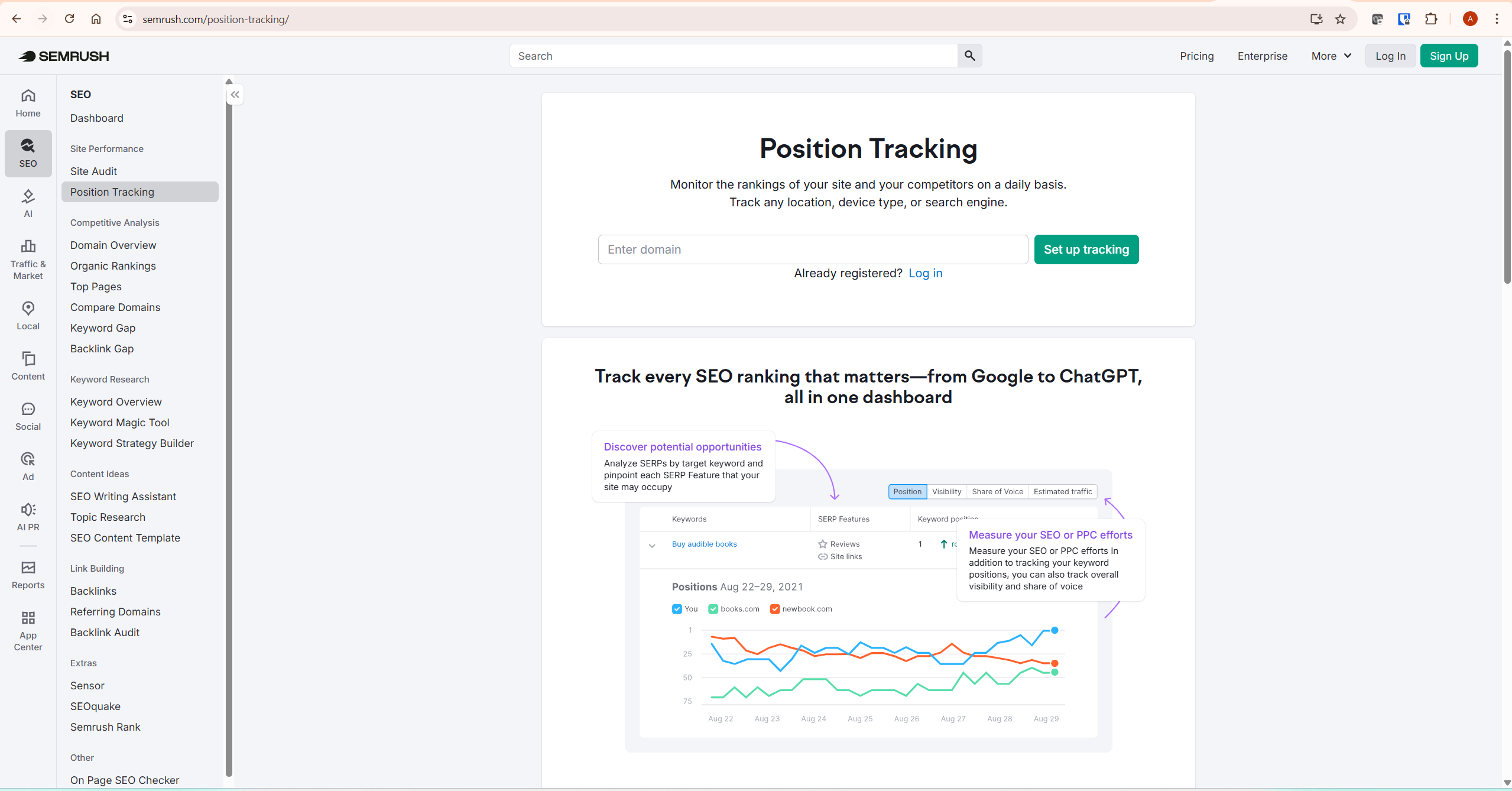
Is Semrush worth it for rank tracking? Yes — Position Tracking shows your keyword ranking movements daily across any target geography, device type, and search engine. For operators running structured content cluster strategies, this data is what converts keyword research from a planning exercise into a feedback loop. You publish, you track, you optimise based on what is actually moving. Our guide on how to use Semrush Position Tracking walks through the setup and interpretation in detail.
Is Semrush worth it for site auditing? Yes — the Site Audit tool crawls your entire site and identifies technical SEO issues including broken links, crawl errors, page speed problems, Core Web Vitals issues, and duplicate content. For growing sites where technical problems can suppress rankings across large numbers of pages simultaneously, this feature alone can justify the subscription cost.
Is Semrush Worth It: The ROI Calculation
Is Semrush worth it financially requires running the numbers rather than comparing the monthly cost against free alternatives. The relevant comparison is not Semrush versus a free keyword tool. It is Semrush-informed content production versus uninformed content production, measured over 12-24 months.
Is Semrush worth it on a cost-per-article basis: at the Pro plan price with four articles published per month, the effective cost per article is approximately €35. If one of those articles ranks on page one for a medium-difficulty keyword and generates 500 monthly organic visitors with a 2% affiliate conversion rate at an average commission of €50, that single article produces €500 per month in recurring affiliate income. Against a monthly subscription cost, the ROI on that single ranking page is substantial — and the article continues generating revenue for years after publication.
Is Semrush worth it when viewed through a risk-reduction lens: the platform’s primary financial value for content operators is not accelerating rankings — it is preventing content misfires. Every article targeting a keyword with difficulty 70+ on a new site is wasted production time and publishing budget. Semrush identifies these misfires before you write the article. At four articles per week, preventing even two content misfires per month — articles that would have taken six hours each to produce and generated zero organic traffic — saves twelve hours of production time. Is Semrush worth it at that rate of misfire prevention? For most consistent publishers, yes clearly.
According to Backlinko’s analysis of SEO tools, Semrush is consistently ranked among the strongest platforms for keyword database depth and competitor intelligence accuracy — the two features that most directly drive misfire prevention in content planning. Is Semrush worth it for the specific use cases that Backlinko identifies as high-value? Yes — keyword gap analysis, content opportunity identification, and competitor ranking research are all areas where Semrush’s data quality justifies the subscription premium over free alternatives.
Is Semrush Worth It: Who Benefits Most
Is Semrush worth it depends on your operator profile more than on your budget. These are the profiles where the answer is clearly yes.
Affiliate bloggers publishing 3-5 articles per week. Is Semrush worth it for affiliate content operators? Yes — because affiliate SEO depends on commercial intent keyword targeting, comparison term identification, and competitor gap analysis. These are exactly the scenarios where Semrush’s competitor keyword intelligence produces its highest value. Knowing which commercial keywords your direct competitors are ranking for, and which ones they are missing, allows you to build content that captures affiliate-converting traffic more efficiently than any free alternative.
Content cluster builders in competitive niches. Is Semrush worth it for structured content cluster strategies? Yes — because building topical authority requires tracking dozens of related keywords across pillar articles and supporting content simultaneously. The Position Tracking feature at this scale is genuinely irreplaceable with free tools. Tracking 50+ keywords across a cluster, monitoring which supporting articles are improving the pillar’s authority, and identifying which cluster gaps need filling — all of this requires the tracking capacity that Semrush provides.
Site operators focused on technical SEO. Is Semrush worth it when technical issues are suppressing rankings? Yes — the Site Audit tool at the Pro plan crawls 100,000 pages per month and identifies technical problems that free tools miss or underreport. For sites where crawl errors, broken internal links, or Core Web Vitals issues are holding down rankings across large content sets, a single site audit session identifying fixable technical problems can improve rankings across dozens of articles simultaneously.
Is Semrush Worth It: Who It Does Not Make Sense For
Is Semrush worth it honestly requires acknowledging the profiles where the answer is no — and being direct about why.
Casual bloggers publishing once or twice per month. Is Semrush worth it at low publishing volumes? No — the platform’s value scales with publishing frequency. At two articles per month, the keyword research and competitor analysis capabilities are underutilised and the cost-per-optimised-article becomes difficult to justify. Free tools with limited capability are sufficient for occasional publishing at low keyword research volume.
Operators who have not validated their niche. Is Semrush worth it before you know what you are optimising for? No — committing to a structured SEO platform before niche validation wastes the tool’s core value. Spend the first 2-3 months of a new site validating content direction with free tools, then introduce Semrush when you have a clear content cluster strategy to execute against.
Traffic acquisition through paid or social channels only. Is Semrush worth it when organic search is not your primary acquisition channel? No — the platform is built specifically for search visibility improvement. If your growth model does not depend on organic rankings, the subscription cost is not justified by the features you would actually use.
Is Semrush Worth It: Addressing the Common Objections
“Can’t I just use free tools?” Is Semrush worth it compared to free alternatives? The honest answer is that free tools are adequate for basic keyword brainstorming and are not adequate for structured competitor analysis, accurate keyword difficulty scoring, or systematic rank tracking at publishing scale. Free keyword tools provide suggestions. Semrush provides competitive intelligence. The difference is the ability to see what is ranking, why it is ranking, and where the gaps are — not just what people search for.
“My site is too new.” Is Semrush worth it for new sites? Yes — if you are publishing consistently from day one. The value for new sites is not in tracking high-volume keywords that a new domain cannot yet compete for. It is in identifying low-difficulty, low-competition opportunities that a new site can realistically rank for within 3-6 months. Semrush’s keyword difficulty filter at KD 0-30 with informational or commercial intent is exactly the research workflow that builds the early ranking history new sites need.
“The data is not 100% accurate.” Is Semrush worth it when no SEO tool provides exact search volumes? Yes — because relative accuracy across a large data set is more valuable than exact accuracy on a small one. Semrush’s keyword difficulty scores, volume estimates, and competitor ranking data are modelled from real search behaviour across billions of queries. The precision of a single data point matters less than the pattern across hundreds of keyword research decisions. Is Semrush worth it for the pattern-level intelligence it provides? Yes, clearly.
Is Semrush Worth It: The 90-Day Test Framework
Is Semrush worth it is a question that can be answered empirically rather than speculatively with a structured 90-day test. Start on the monthly Pro plan. In the first two weeks, run keyword research for your next 8-10 articles — specifically targeting keywords with KD below 35 and search intent matching your content type. In weeks three through twelve, publish one article per week against the researched keyword targets and monitor ranking movements in Position Tracking. At 90 days, evaluate: how many of the targeted articles have appeared in the top 50 for their primary keyword? How many organic impressions are they generating? What affiliate or advertising revenue is attributable to the organic traffic?
Is Semrush worth it after running this test honestly? For most operators who execute the publishing cadence consistently, yes — because the keyword targeting improvement over unresearched content is visible in the ranking data within the 90-day window. If after 90 days of consistent execution the organic metrics are flat, the issue is either niche competition level, content quality, or site authority — not the tool. Is Semrush worth it as a diagnostic for that scenario? Yes — because the data tells you which of those three factors is the constraint.
According to Search Engine Journal’s SEO importance analysis, organic search consistently delivers the highest long-term ROI of any digital marketing channel for content-based businesses — making the tools that improve organic search performance a justified operational investment for operators whose growth depends on search visibility. Is Semrush worth it within that context? Yes — when organic search is your primary acquisition channel and you are executing consistently enough to generate measurable ranking data within 90 days.
Is Semrush Worth It: Semrush vs Free Tools in Practice
Is Semrush worth it compared to the combination of free tools most content operators use before upgrading? The practical comparison covers three specific scenarios.
Scenario one — competitor research. Is Semrush worth it for understanding what competitors rank for? Free tools show you limited competitor data, typically the top few keywords for a domain with no export capability. Semrush shows you every keyword a competitor ranks for, sorted by traffic value, with the specific landing page that is ranking. For identifying content opportunities, this data quality difference is the single biggest practical argument for is Semrush worth it over free alternatives.
Scenario two — keyword difficulty assessment. Is Semrush worth it for accurate difficulty scoring? Free tools use simplified difficulty models that frequently misclassify achievable keywords as competitive and competitive keywords as achievable. Semrush’s difficulty scoring incorporates domain authority distribution among current ranking pages, backlink profiles, and SERP feature presence. For new sites targeting low-competition opportunities, this accuracy difference directly affects whether published articles rank or not.
Scenario three — rank tracking at scale. Is Semrush worth it for tracking 50+ keywords simultaneously? Free tools typically limit rank tracking to a handful of keywords with delayed updates. Semrush tracks up to 500 keywords daily on the Pro plan with historical trend data. For operators running multi-cluster content strategies, this capacity difference is not a convenience improvement — it is the difference between having a feedback loop and not having one.
For the complete breakdown of which plan fits which publishing volume and budget, our Semrush pricing explained guide covers every tier in detail. And for the complete platform evaluation including all features and use cases, our full Semrush review covers everything available across all plans.
Is Semrush Worth It: EU and International Operators
Is Semrush worth it for operators based in the EU — including Cyprus, Germany, France, the Netherlands, and other member states? Yes — Semrush covers keyword data for all EU markets with country-specific search volume, keyword difficulty, and competitor ranking data. For EU-based affiliate operators targeting local search audiences, the geo-specific data quality is comparable to what US operators get for US English searches.
Is Semrush worth it in the context of EU digital market development? The European Commission’s Digital Markets Act and related frameworks are increasing the importance of organic search presence for digital businesses operating in EU markets. According to ESMA’s digital finance and innovation guidance, structured data and compliance with evolving digital frameworks are increasingly important for financial content operators in the EU — making the quality and reliability of SEO data infrastructure a material operational consideration rather than a discretionary upgrade for EU-based financial content sites.
Frequently Asked Questions: Is Semrush Worth It
Is Semrush worth it for beginners?
Is Semrush worth it at the beginner stage? Yes — if you are serious about learning SEO from a structured data foundation rather than from intuition. The platform’s learning curve is real but manageable. The keyword research workflow, competitor analysis tools, and position tracking features are not difficult to use — they require understanding what to do with the data, which comes from consistent practice. Is Semrush worth it for a beginner who commits to publishing weekly and tracking results? Yes. Is Semrush worth it for a beginner experimenting casually? No — free tools are adequate for occasional, unstructured publishing.
Is Semrush worth it for a single website?
Is Semrush worth it when managing only one site? Yes — provided that site is your primary revenue focus and you publish consistently. The Pro plan’s five-project limit is more than sufficient for a single site operator, and the keyword tracking capacity covers the keyword sets needed for a focused content cluster strategy on one authority site.
Is Semrush worth it compared to Ahrefs?
Is Semrush worth it versus the main alternative? Both platforms offer comparable core functionality — keyword research, competitor analysis, backlink data, and rank tracking. Semrush’s advantage is in keyword database breadth and the integrated content marketing tools on the Guru plan. Ahrefs’ advantage is generally considered to be backlink database quality. Is Semrush worth it for operators prioritising keyword research and content strategy over backlink analysis? Yes — it is the stronger choice for content-focused operators. For link building-focused strategies, the comparison is closer.
How long until Semrush pays for itself?
Is Semrush worth it within a specific timeframe? For operators publishing 3-4 articles per week with consistent keyword targeting, the first ranking articles typically appear within 60-90 days. Revenue attribution depends on niche, monetisation model, and traffic volume — but one affiliate article ranking on page one for a commercial keyword in a mid-competition niche can generate enough monthly commission to cover the Pro plan subscription cost. Is Semrush worth it over 12 months of consistent execution? For most affiliate and content operators, yes — the compounding effect of multiple ranking articles generates returns that substantially exceed the annual subscription cost.
Is Semrush Worth It: Final Verdict
Is Semrush worth it? The answer is clear once you map your publishing discipline to the platform’s actual value drivers. For operators who publish consistently, rely on organic search for revenue, and make content decisions based on keyword data — is Semrush worth it? Yes, clearly. The competitor intelligence, keyword difficulty accuracy, and rank tracking capacity produce measurable improvements in content targeting efficiency that compound over time.
For casual bloggers publishing occasionally without tracking results — is Semrush worth it? No. The platform’s value is proportional to how consistently you use it, and occasional publishing does not generate enough data or revenue flow to justify the subscription cost at any tier.
The practical starting point: begin on the monthly Pro plan for 90 days with a structured keyword research workflow for every article you publish. Track ranking movements weekly. Evaluate the results at 90 days based on impression data, ranking positions, and any attributable affiliate revenue. Is Semrush worth it after 90 days of consistent execution? For most serious content operators, the data answers that question definitively.
For the complete platform evaluation covering every feature and use case, read our full Semrush review. For the plan-by-plan breakdown and which tier fits your publishing volume, our Semrush pricing explained guide covers every detail.
