
Semrush Review: Honest Verdict for Affiliate Marketers (2026)
Affiliate Disclosure: This site earns revenue through affiliate partnerships with other platforms. This article does not currently contain affiliate links for Semrush. Any tool recommendations are based on independent research and publicly available data.
Last verified: August 2026, using Semrush’s official pricing page, feature documentation, and G2 verified reviews.
Semrush is one of the most widely used SEO and digital marketing platforms available in 2026 — and after evaluating it through the same rigorous lens I apply to any financial or operational tool after 30 years in professional finance, the verdict is clear: for affiliate marketers and content publishers where organic search drives revenue, Semrush delivers genuine, measurable value. The keyword research is deep, the competitive intelligence is actionable, and it integrates traditional SEO with AI search visibility unusually well within one platform.
That said, it is not the right tool for everyone. At $139/month for the entry plan, the price is a genuine barrier for early-stage sites. The learning curve is real. And the output is only as good as the workflow you build around it. This review gives you the honest picture — what Semrush does well, where it falls short, and who should actually pay for it.
- Semrush is one of the most comprehensive SEO platforms available in 2026 — keyword research, competitor analysis, site auditing, backlink tracking, and AI visibility monitoring in one subscription
- Current plans are SEO ($139/mo), Starter ($199/mo), Pro+ ($299/mo), and Advanced ($549/mo) — the cost becomes much easier to justify when organic search materially contributes to revenue or client work
- For affiliate publishers, Keyword Gap is the feature I find most immediately actionable — it shows exactly which keywords competitors rank for that you do not
- Starter and above add the fuller AI Visibility Toolkit — monitoring your brand’s appearance in ChatGPT, Perplexity, and Google AI Overviews — one of the stronger integrated offerings currently available
- Rated roughly 4.4/5 on G2 from over 4,000 verified reviews — ranked #1 in six G2 Spring 2026 categories, including SEO Tools and Answer Engine Optimisation
- A free $0/month plan exists for testing the interface, though it isn’t sufficient for ongoing SEO work
Quick Answer: Is Semrush Worth It?
For an affiliate or content business where organic search materially drives revenue, Semrush can be worth it. SEO at $139/month is the sensible starting tier for many solo publishers; Pro+ at $299/month becomes more compelling once you need historical data, higher tracking limits, content optimization, or multi-location/device analysis. For an early-stage site with little revenue and no regular need for competitive research, rank tracking, or auditing, $139/month may be difficult to justify. Start with the free tools at semrush.com to evaluate data quality in your niche before committing to any plan.
Semrush Review: Plans and Pricing
Semrush’s current pricing page leads with four tiers — SEO ($139/month) for core research, Starter ($199/month) which adds the fuller AI Visibility Toolkit, Pro+ ($299/month) for content publishers running structured clusters, and Advanced ($549/month) for agencies. A free $0/month plan exists for testing the interface, and roughly 17% is saved on annual billing across paid tiers.
You may also see Semrush’s older Pro, Guru, and Business names in its documentation or in older reviews — those still exist in Semrush’s Help Center and map roughly to the current tiers by capacity, but the pricing page itself now leads with SEO, Starter, Pro+, and Advanced. The plan names are simple, but the real cost has fine print worth knowing — extra user seats, add-on toolkits, and keyword tracking limits all affect what you actually end up paying. I’ve broken all of that down in full, including the hidden fees most comparisons skip, in my dedicated Semrush pricing guide.
Pricing verified August 2026 directly against semrush.com. Always confirm current figures at semrush.com before purchasing.
What Is Semrush and Who Is It For?
Semrush is an all-in-one digital marketing platform used by over 10 million marketers globally. It started as an SEO keyword tool in 2008 and has since expanded to cover 55+ tools across keyword research, competitor analysis, technical auditing, backlink analysis, content marketing, PPC research, and AI visibility tracking.
For affiliate marketers and content site owners specifically, Semrush solves one fundamental problem: understanding exactly what to write, how competitive those topics are, and whether published content is gaining ground. Those three questions drive every content strategy decision, and Semrush answers all three with more depth than any single-purpose alternative.
For the exact current figures behind any claim in this review, Semrush’s own SEO & AI Search pricing page and G2 listing are the primary sources worth checking directly — both change often enough that this review is a snapshot, not the final word.
According to Backlinko’s research on SEO tools, Semrush is consistently ranked among the most comprehensive platforms for keyword research and competitive intelligence — making it a benchmark tool for serious content-focused SEO practitioners.
Semrush Review: Core Features Assessed Honestly
Keyword Research
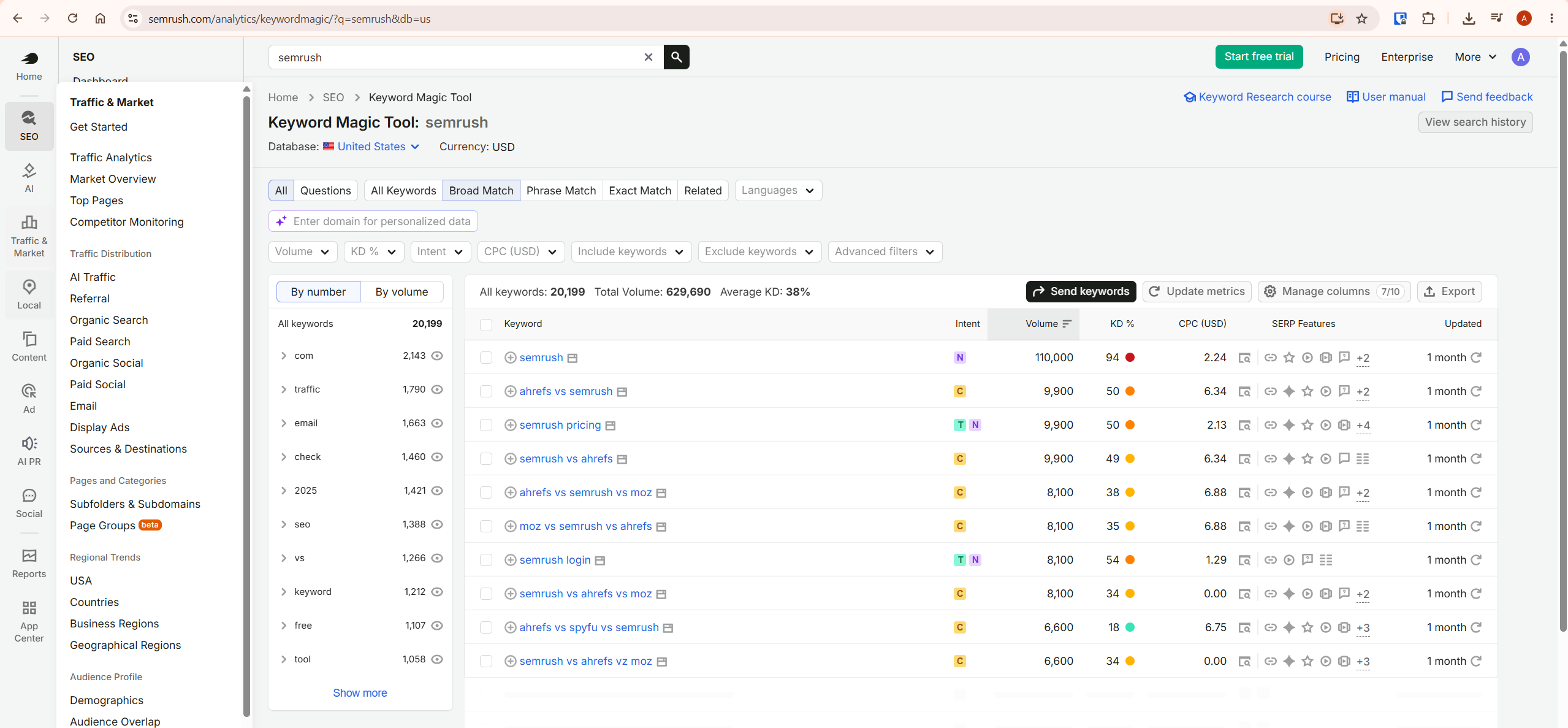
The Keyword Magic Tool pulls from a database of over 28 billion keywords across 142 geographic databases, filtering by search volume, keyword difficulty, search intent (informational, commercial, transactional, navigational), CPC, and competitive density. The intent filter is the standout feature for affiliate sites — filter for commercial and transactional intent and you are targeting buyers rather than browsers, which directly affects whether organic traffic converts into commissions.
The Keyword Gap tool is the most immediately actionable feature for content publishers. Enter your domain and up to five competitors and Semrush shows the keywords they rank for that you do not — an evidence-based opportunity list you still need to validate for relevance, search intent, difficulty, and business value before building content around it. For a complete workflow walkthrough, see my guide on how to do keyword research with Semrush.
Competitor Research and Domain Overview
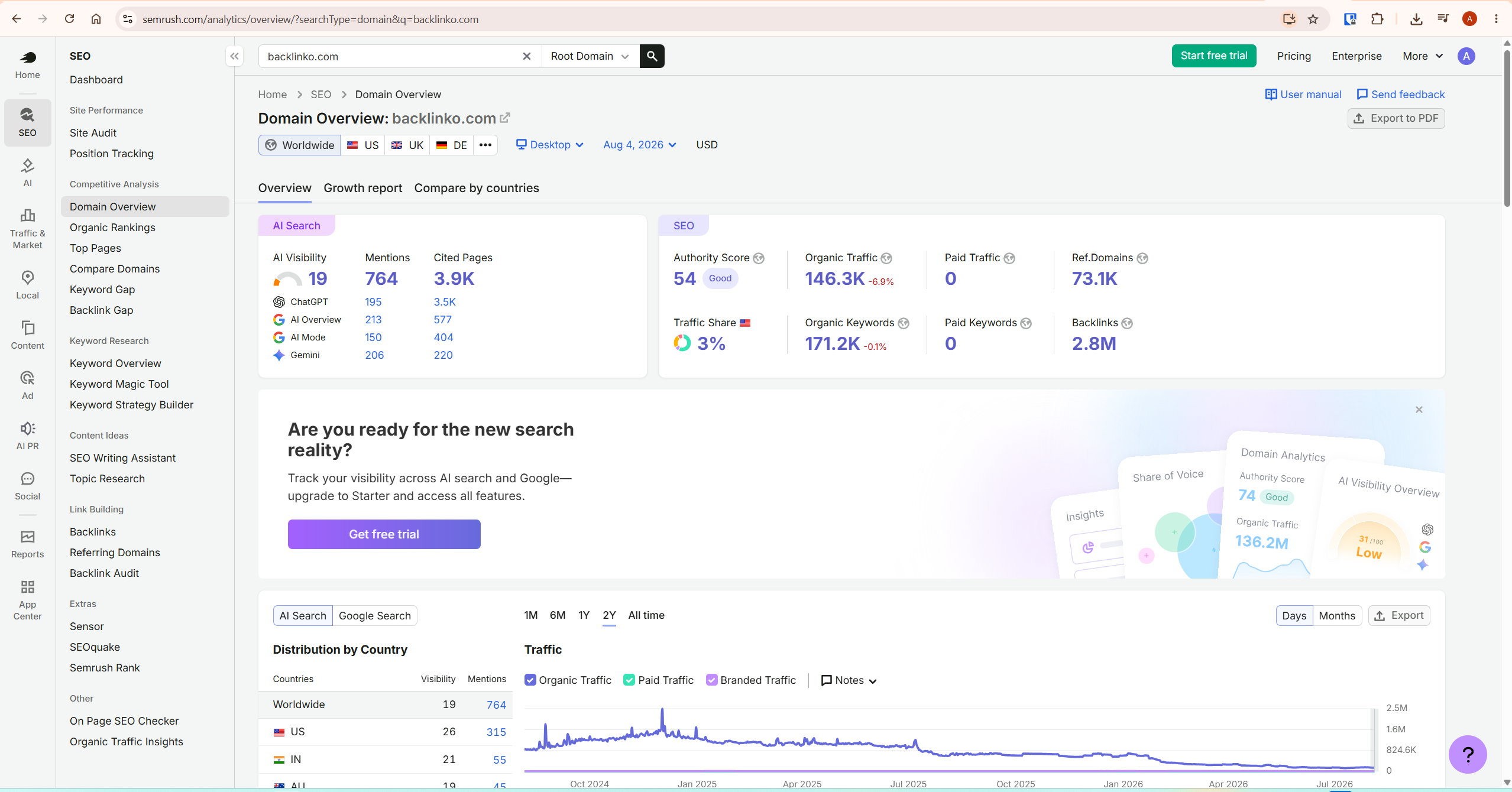
Organic Rankings shows the keywords Semrush detects a competitor ranking for, their estimated organic traffic, top pages, position changes, and search competitors. Pair it with Domain Overview or Backlink Analytics when you want to investigate their link profile. The workflow for affiliate sites is direct: find sites monetising the same products you promote, analyse their top-performing pages, and build better versions targeting the same keywords.
Position Tracking
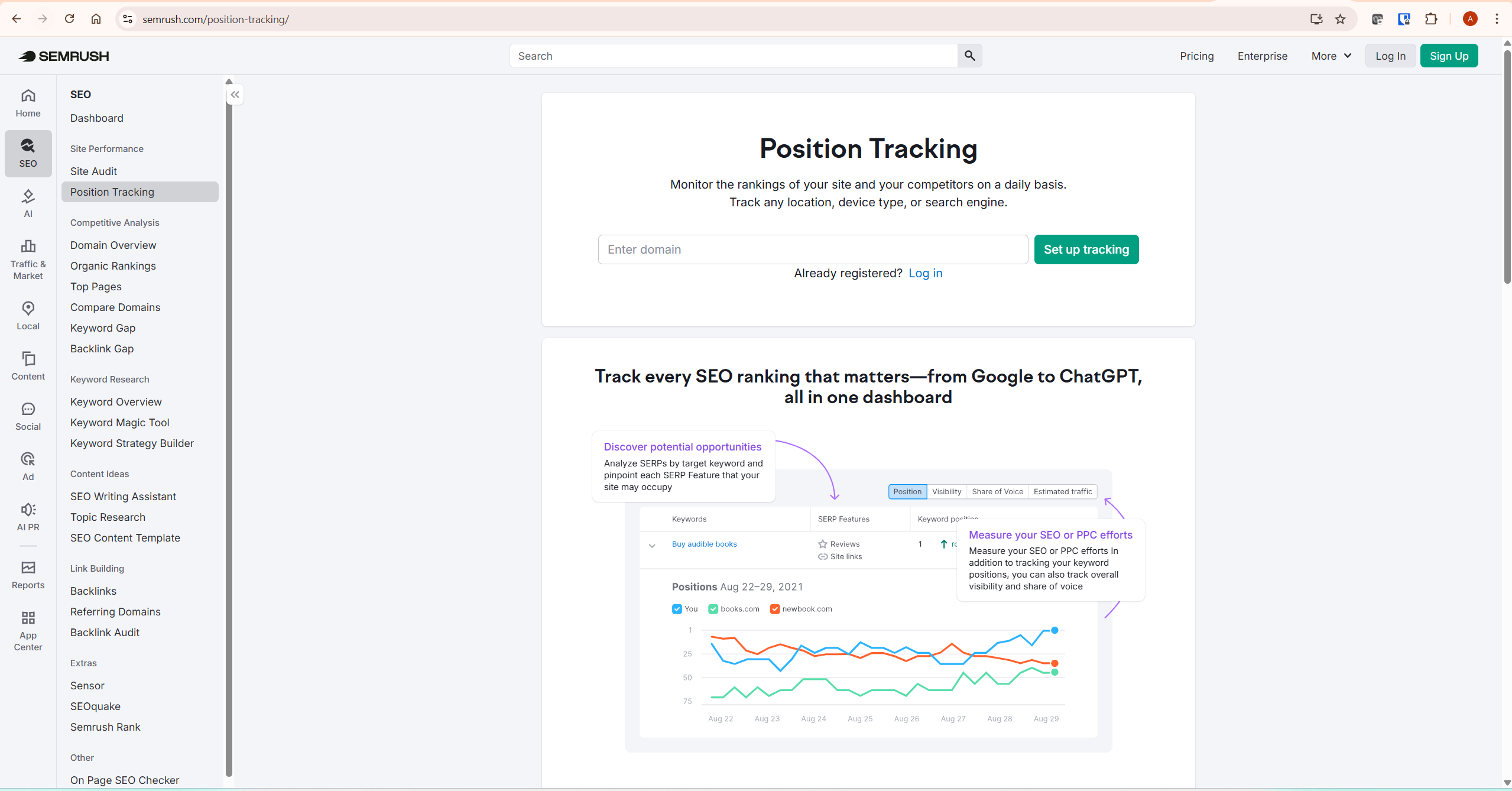
Position Tracking monitors keyword rankings daily across search engines, locations, and devices — the feedback loop that tells you whether your content strategy is working. Without it, you publish articles and hope. With it, you see exactly which pages are gaining ground, which are stalling, and where competitors have recently overtaken you. For setup guidance, see my Semrush Position Tracking tutorial.
Site Audit
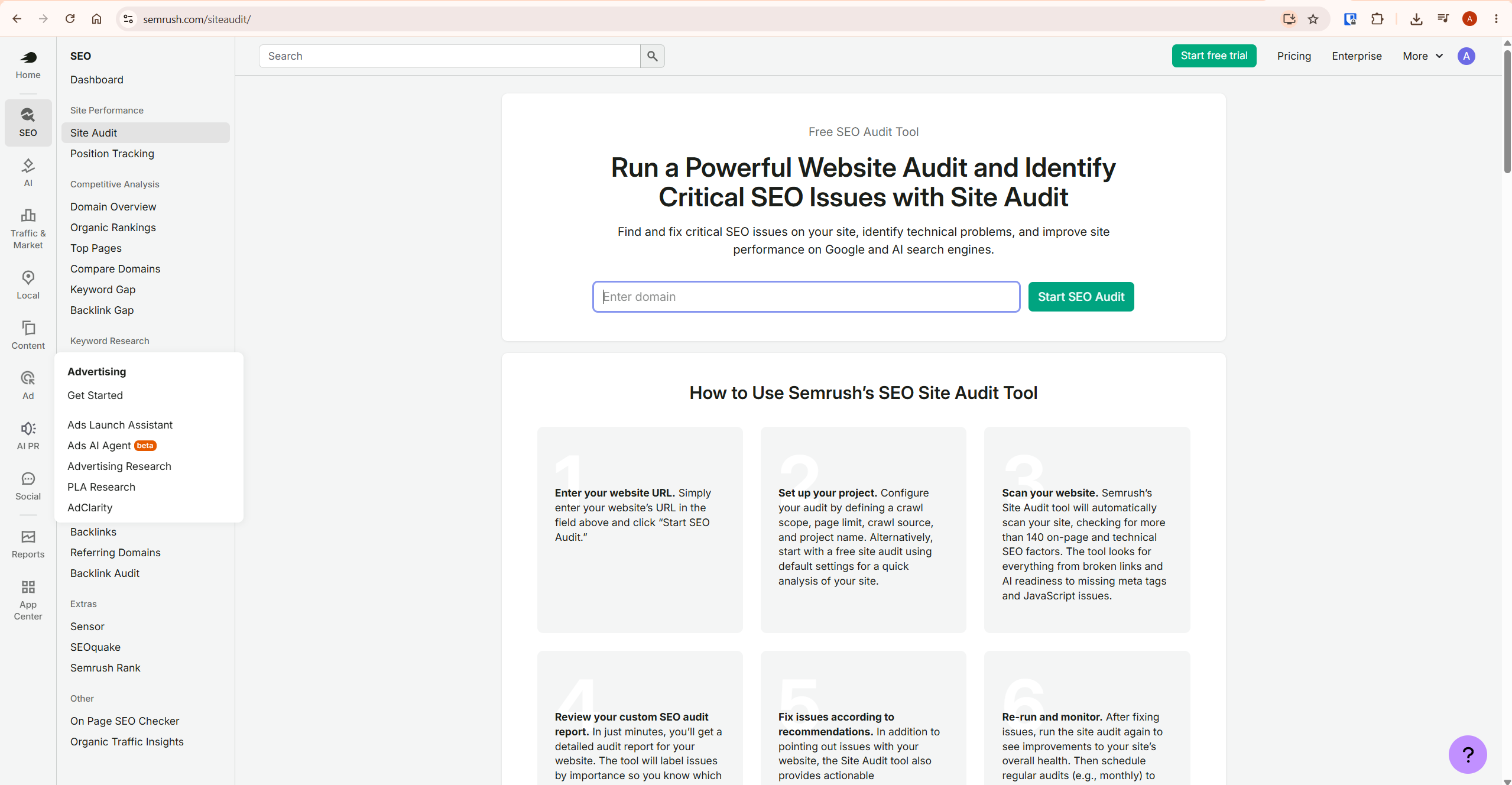
The Site Audit tool crawls your site and runs over 140 technical checks — flagging broken internal links, crawl errors, missing meta tags, slow-loading pages, duplicate content, and misconfigured canonical tags, all prioritised by severity. What separates this from lighter alternatives is the actionability of the output: rather than listing problems, it explains what each issue means for rankings and how to fix it. My Semrush Site Audit guide covers the full process.
Backlink Analytics
Semrush indexes over 43 trillion backlinks from 390 million domains. The Backlink Analytics tool shows Semrush’s detected backlink profile for any site: total backlinks, referring domains, anchor text distribution, Authority Score, and new or lost links over time. Ahrefs claims the largest live backlink index; vendors count and canonicalise links differently, so if link analysis is your main use case, compare both tools against domains you actually work with rather than relying on either vendor’s headline figure. See my Semrush vs Ahrefs comparison for more.
Content Optimization and the Content Toolkit
Pro+ adds content-optimization capability within the core SEO + AI Search plan. Separately, Semrush sells a dedicated Content Toolkit for $60/month — Topic Finder, SEO Brief Generator, AI Article Generator, and Content Optimizer. Don’t assume the standalone Content Toolkit is automatically included just because you’re on Pro+; check what’s actually bundled into your specific plan before relying on it for content planning at scale.
AI Visibility Tracking
The most significant development in this Semrush review is AI Visibility Tracking, bundled into Starter and above. It tracks whether your content is being cited in AI-generated answers from ChatGPT, Perplexity, and Google’s AI Overviews — showing which prompts surface your pages, which competitors appear instead, and whether your site is technically accessible to AI crawlers. It’s one of the stronger integrated SEO + AI-visibility offerings currently available, alongside newer competing tools like Ahrefs’ Brand Radar. The entry SEO plan includes some basic AI-search signals; the fuller toolkit starts at Starter, $199/month.
Semrush Pros and Cons
What Semrush Does Well
Depth of keyword research. A database of roughly 28 billion keywords with intent classification is one of the strongest research foundations available in 2026 — on par with Ahrefs’ similarly-sized index. For affiliate content publishers where targeting the right keyword determines whether you rank, this depth matters more than any other single feature.
Competitive intelligence. Reverse-engineering a competitor’s organic strategy — seeing their top pages, keyword positions, traffic estimates, and backlink sources — directly shapes which content you write and how you position it.
Actionable site audits. Most audit tools list problems. Semrush explains them, prioritises them by impact, and tells you how to fix them. For a solo publisher without technical SEO expertise, that difference is significant.
Third-party validation. G2 currently shows Semrush at roughly 4.4/5 from more than 4,000 verified reviews. In G2’s Spring 2026 Reports, Semrush ranked #1 across six categories, including SEO Tools and Answer Engine Optimisation — a strong, current signal of consistent user satisfaction.
AI visibility features. Semrush’s AI Visibility Toolkit integrates traditional SEO and AI-search monitoring unusually well within the same platform — one of the stronger combined offerings currently available, though not the only one.
Where Semrush Falls Short
Price is the primary barrier. At $139/month for SEO and $299/month for Pro+, the cost is the most consistent complaint across user reviews. For early-stage sites without established revenue, this is a real limitation.
One seat per plan. Every plan includes just one user by default — adding a second person costs extra, and that cost isn’t obvious from the headline price. See my pricing guide for the exact figures.
Steep learning curve. The platform covers 55+ tools. New users typically spend significant time navigating before establishing an efficient workflow.
Traffic estimates are directional. Competitor traffic figures should be used directionally rather than as precise measurements. Actual traffic can differ meaningfully from what the tool reports.
Backlink coverage is hard to compare directly. Ahrefs claims the world’s largest live backlink index; Semrush maintains a similarly large 43T+ backlink database. Vendors count and canonicalise links differently, so raw numbers aren’t directly comparable — if link analysis is your primary workflow, compare both tools against domains you actually work with rather than relying on either vendor’s headline figure.
Who Should Use Semrush — and Who Should Not
Use Semrush if you run a content site where organic search is the primary traffic source, publish consistently, compete in a niche where keyword intelligence has direct revenue implications, and your site is generating income or on a credible path to doing so. At Pro+ level, the keyword research, competitor analysis, position tracking, and content planning tools combine into a coherent workflow that accelerates what would otherwise take weeks of manual research.
Consider an alternative if you have a limited budget or manage a small site where SEO is not yet central to your revenue. SE Ranking is worth comparing if you want a lower-cost SEO/GEO platform — its current pricing sits below Semrush’s SEO tier, though the gap is narrower than older comparisons suggest, so check its current features and limits against what you actually need rather than assuming it’s roughly half the price.
For a detailed cost-benefit analysis across different user profiles, my dedicated article on whether Semrush is worth it covers the decision framework in full.
Semrush Affiliate Marketer Checklist
| Step | Action | Why It Matters |
|---|---|---|
| 1 | Run Keyword Gap against your top 3 competitors | Identifies proven content opportunities from real ranking data |
| 2 | Filter Keyword Magic Tool by commercial and transactional intent | Targets buyer keywords that convert, not just informational traffic |
| 3 | Set up Position Tracking for your 20 most important keywords on day one | Needs several days to build trend data — set up early |
| 4 | Run Site Audit and prioritise critical crawl, index, internal-linking, and performance issues | Serious technical problems can restrict crawling or indexing — but not every warning deserves to delay new content |
| 5 | Use Organic Research on competitor top pages monthly | Surfaces new content opportunities as competitors grow |
| 6 | Use the trial to test workflows, data quality, and limits — not to bulk-export data | Semrush disables exports during trial periods, even on plans where exports are normally included, so plan accordingly |
| 7 | Evaluate the AI Visibility Toolkit if AI search visibility matters to your strategy | AI search is becoming an increasingly important visibility and discovery surface worth monitoring |
How Semrush Compares to Alternatives
Semrush vs Ahrefs: Both now operate keyword databases of roughly 28-29 billion terms — a difference too small to matter in practice. Semrush leads on content marketing tools, PPC research, and AI visibility integration. Ahrefs claims the largest live backlink index. The practical decision should come down to workflow, metrics, country coverage, and feature set rather than raw database size. My full Semrush vs Ahrefs comparison covers this in detail.
Semrush vs Moz: Semrush leads on keyword database depth, competitor research, and feature breadth. Moz is simpler to learn and more affordable for basic use cases. My Semrush vs Moz comparison covers the full picture.
Semrush vs Ubersuggest: Ubersuggest is significantly cheaper and covers basic keyword research adequately. Semrush leads on data depth, competitor intelligence, and the full feature suite. My Semrush vs Ubersuggest comparison covers which is better for beginners.
What To Do Next
Before committing to any Semrush plan, spend 10 minutes on the free tools at semrush.com. Use the free Keyword Magic Tool to search your primary focus keyword and note the difficulty score and related terms. Then enter a competitor domain into the free Domain Overview. That exercise tells you whether the platform surfaces data genuinely new to you — and if it does, the subscription decision becomes straightforward. For a complete breakdown of plans, see my Semrush pricing guide and my analysis of whether Semrush is worth it for different user types.
Frequently Asked Questions
Is Semrush worth it for a small affiliate site?
It depends on your revenue and workflow more than article count. For an early-stage site with little revenue and no regular need for competitive research, rank tracking, or auditing, the $139/month SEO plan is difficult to justify. For a site already generating meaningful affiliate income where SEO drives the majority of traffic, Pro+ can become easier to justify when its additional data, tracking capacity, and content-optimization tools materially improve your keyword selection, competitor research, and content decisions. The inflection point is roughly when you are publishing consistently and competing in a niche where knowing what competitors rank for directly influences your content decisions.
What is the difference between Semrush SEO and Pro+?
Pro+ raises SEO capacity from 5 monitored websites and 500 tracked keywords to 15 websites and 1,500 keywords, and adds historical SEO data, content optimization, keyword-cannibalization analysis, and multi-location/device tracking. Semrush’s separate Content Toolkit — with Topic Finder, SEO Brief Generator, AI Article Generator, and Content Optimizer — is its own subscription at $60/month, so don’t confuse that with the content-optimization capability included in Pro+.
Does Semrush offer a free trial?
Semrush offers a free trial on certain plans but requires payment details upfront in most cases. Trial availability and duration change regularly — always verify current terms directly at semrush.com. A range of free tools are available without any account registration, including keyword research, backlink checking, and domain overview — worth using before committing to a paid plan. For a full guide to the trial, see my Semrush free trial guide.
How does Semrush compare to Ahrefs?
Both are industry-leading platforms with different strengths. Semrush and Ahrefs now operate similarly sized keyword databases (roughly 28-29 billion terms each), so database size alone isn’t a meaningful differentiator. Semrush leads on content marketing tools, PPC research, and AI visibility integration. Ahrefs claims the largest live backlink index. For affiliate content publishers where keyword research and competitor content analysis are the primary workflows, Semrush has the edge. My full Semrush vs Ahrefs comparison covers this in detail.
What is Semrush’s AI Visibility Toolkit?
It’s a feature bundled into Starter and above that adds AI Visibility Tracking on top of the core SEO toolkit. It monitors whether your content is being cited in AI-generated answers from ChatGPT, Perplexity, and Google’s AI Overviews. It can also be purchased as a standalone add-on for around $99/month per domain. For most affiliate sites in 2026, the core SEO plans remain the priority and AI tracking can be added when it becomes a strategic need.
Is there a free version of Semrush?
Yes — a $0/month Free plan requires no credit card and gives limited daily usage across core tools, enough to preview the platform’s data quality. It isn’t sufficient for ongoing SEO work. Semrush also provides free tools on its website without account registration: keyword research, backlink checker, and domain overview.
