
Is Koinly Worth It in 2026? Honest Verdict & Who Should Use
Affiliate Disclosure: This article contains affiliate links. If you sign up for Koinly through a link on this page, I may earn a commission at no extra cost to you. I only recommend tools I have researched and believe are worth your time.
Tax Disclaimer: This article is for informational purposes only and does not constitute professional tax or financial advice. Consult a qualified tax professional for advice specific to your situation.
Koinly is worth it for active crypto investors managing multiple wallets and exchanges — and not worth it for casual holders with minimal trading activity who can manage with free exchange-generated reports. That’s the honest verdict after evaluating the platform against the alternatives, and the rest of this article explains exactly why.
The question “is Koinly worth it” comes up at a specific moment: you’re approaching tax season, you have crypto activity spread across multiple platforms, and you’re trying to decide whether to pay $49, $99, or more for software that promises to make this easier. The decision isn’t complicated — but it depends entirely on your situation, and most reviews don’t give you a clear enough framework to make it.
After thirty years in finance, I’ve evaluated a lot of financial software. Koinly stands out in this category not because it’s perfect — it isn’t — but because it solves a genuinely difficult problem better than the alternatives at its price point. What it does with cost basis tracking, transfer matching, and multi-jurisdictional reporting would take hours to replicate manually. For most active crypto investors, that time saving alone justifies the cost.
This article gives you a complete picture: what is Koinly worth it for, where it falls short, what it costs, and who should look elsewhere.
If you want to test Koinly with your own data before deciding, the free plan lets you import everything and see your tax position before paying anything: try Koinly free here.
Quick Answer: Is Koinly Worth It?
Yes — for most active crypto investors. Koinly automates the most time-consuming parts of crypto tax reporting: importing transactions from 800+ exchanges and wallets, calculating cost basis accurately across all of them, identifying internal transfers as non-taxable events, and generating jurisdiction-specific reports ready for filing. The free plan lets you verify all of this with your actual data before spending anything. If you use more than one exchange, have DeFi activity, or have traded across multiple tax years, Koinly pays for itself in time saved alone.
It is not worth it if you hold crypto on a single exchange, made fewer than 10 trades last year, and your exchange already generates a usable tax report. In that scenario the cost isn’t justified.
What Koinly Actually Does
Understanding whether Koinly is worth it starts with understanding what the software actually solves — and why the problem is harder than it looks.
Every time you sell, trade, or spend crypto, you trigger a taxable event. Your tax liability is calculated as the difference between what you received and your cost basis — what you originally paid for that specific unit of crypto. When you’re trading across multiple exchanges, moving assets between wallets, receiving staking rewards, and using DeFi protocols, tracking that cost basis manually across hundreds or thousands of transactions becomes genuinely unmanageable for most investors.
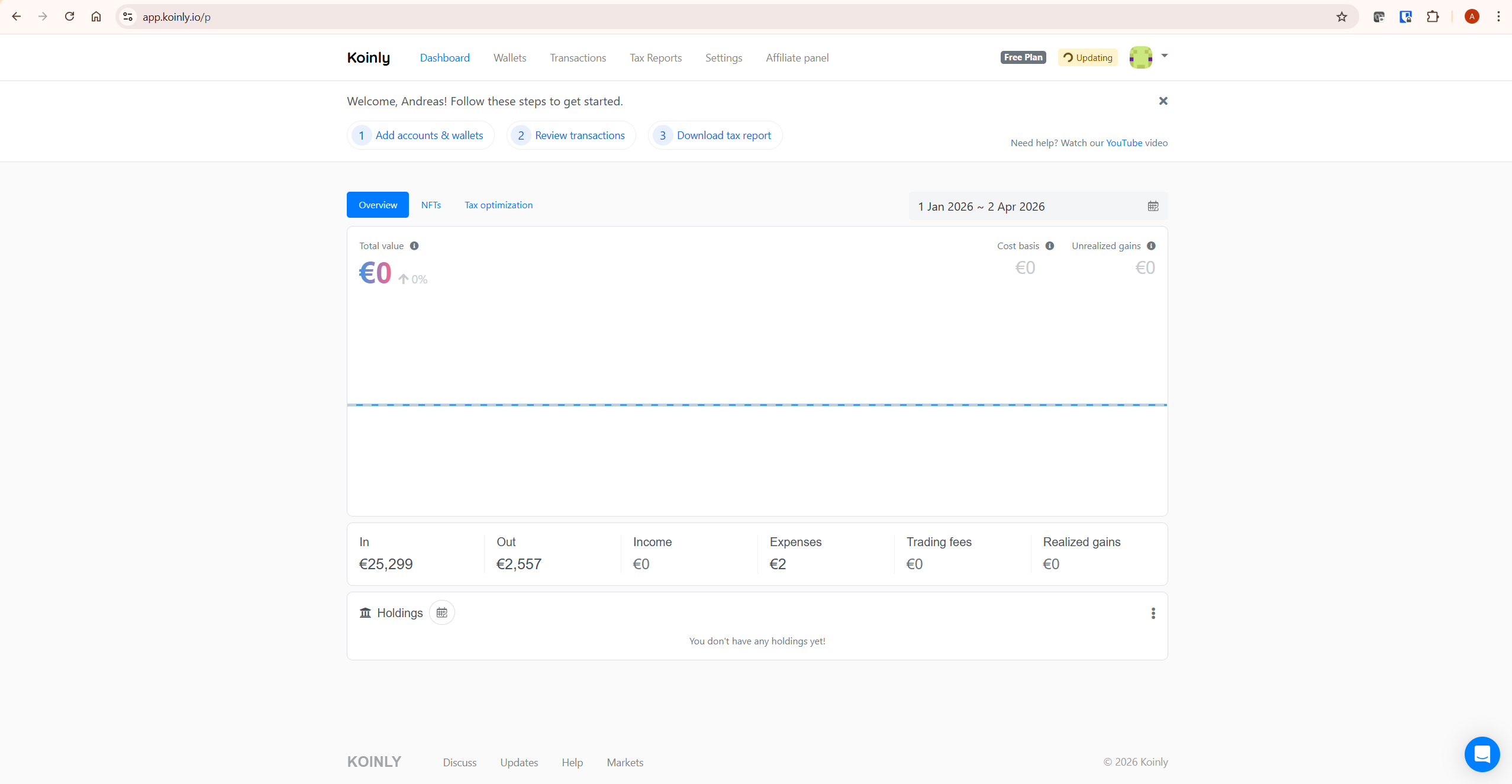
Koinly connects to your exchanges and wallets via API or CSV import, pulls in every transaction automatically, identifies internal wallet transfers as non-taxable events, calculates your cost basis using your chosen accounting method, and produces tax reports formatted for your specific jurisdiction. That’s the core value proposition.
Is Koinly Worth It? The Case For
It Handles the Problem That Wastes the Most Time
The single biggest time sink in crypto tax preparation is reconciling transfers between your own wallets. If you move ETH from Coinbase to MetaMask, that’s not a taxable event — but without software that can match the outgoing and incoming transactions, it looks like a disposal followed by a new acquisition. Koinly’s smart transfer matching identifies these automatically using asset amounts, timestamps, and wallet addresses. Without this, you’re manually reviewing every transfer across every wallet to avoid being taxed on movements that weren’t sales. For investors with more than two or three wallets, this alone justifies the cost.
The Free Plan Lets You Verify Before You Pay
Koinly’s free plan is one of the strongest in the crypto tax software category. You can import up to 10,000 transactions, connect unlimited wallets and exchanges, see your complete capital gains summary, and use the tax optimizer — all without spending a cent. You only pay when you need to download the official report. This means you can verify that Koinly handles your specific exchanges and transaction types correctly before committing to a paid plan. There’s no equivalent risk to trying it.
The Pricing Is Per Tax Year, Not a Subscription
Koinly charges per tax year — $49 for the Newbie plan (100 transactions), $99 for Hodler (1,000 transactions), $199 for Trader (3,000 transactions). You buy a plan for the specific year you need a report for, and it remains valid for ten years. If you don’t need a report every year, you only pay in the years you file. This is more cost-effective than subscription-based competitors for investors who don’t need annual reports consistently.
It Supports Over 800 Exchanges and 100+ Countries
Koinly’s integration breadth is one of its genuine strengths. Over 800 exchanges, wallets, and blockchains are supported, including every major centralised exchange, hardware wallets like Ledger and Trezor, DeFi protocols, and Layer 2 networks. Tax reports are available for more than 100 countries, including IRS Form 8949 and Schedule D for the US, HMRC-formatted reports for the UK, ATO-compliant reports for Australia, and country-specific formats for Germany, Canada, and others. For international investors or anyone holding assets across multiple chains, this coverage is difficult to match at this price point.
The Tax Optimizer Has Real Value Beyond Filing
Koinly’s tax optimizer identifies unrealised losses in your portfolio that could be harvested to offset capital gains before year-end. This is available on the free plan and represents a genuinely useful planning tool independent of the tax reporting function. For investors who actively manage their tax position throughout the year rather than just at filing time, this feature alone provides tangible financial value. See our dedicated guide on tax-loss harvesting with Koinly for a full walkthrough.
Trustpilot Evidence: 2,245 Verified Reviews
Koinly has over 2,245 verified reviews on Trustpilot. The consistent themes in positive reviews are accuracy of cost basis calculations, time saved versus manual spreadsheets, and the quality of customer support for complex import issues. Critical reviews focus on pricing for high-volume traders and occasional sync issues with less common exchanges. That pattern — strong core product with pricing sensitivity at the high-volume end — is consistent with what the platform actually delivers. Verify the current rating directly on Trustpilot before publishing this article.
Is Koinly Worth It? The Honest Limitations
No review that only covers the positives is worth reading. Here are Koinly’s genuine limitations.
Complex DeFi Transactions Still Require Manual Review
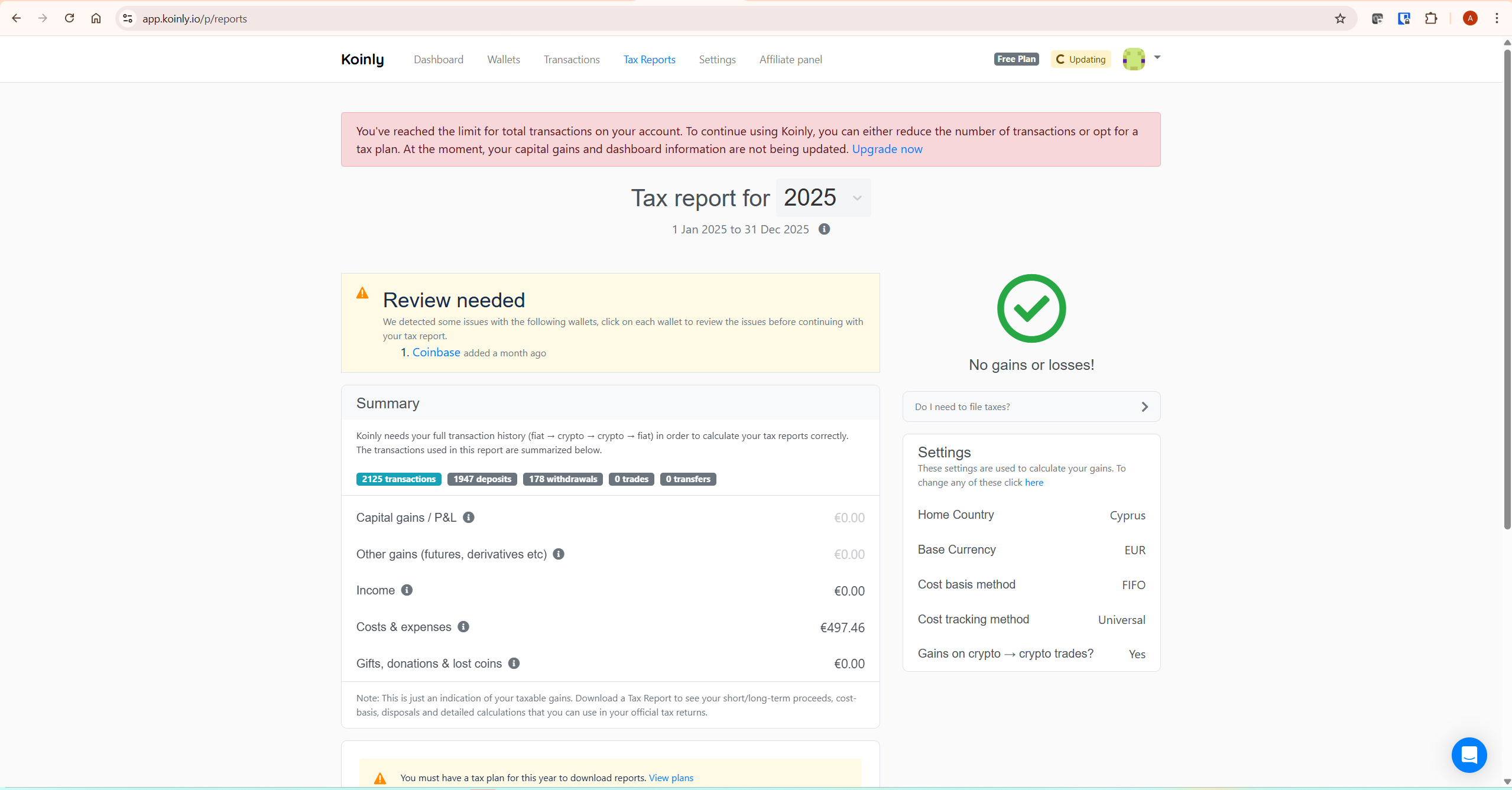
Koinly handles DeFi activity well for supported protocols, but complex cross-chain transactions — particularly on newer or less common protocols — often require manual categorisation. Liquidity provisioning, cross-chain bridging, and certain yield farming interactions may be flagged for review rather than automatically resolved. If your portfolio is heavily concentrated in cutting-edge DeFi activity across multiple chains, budget time for manual cleanup regardless of which tax software you use. This isn’t unique to Koinly, but it’s worth stating clearly.
Pricing Scales Quickly for High-Volume Traders
The per-tax-year pricing model is investor-friendly at moderate transaction volumes, but it becomes expensive for day traders or algorithmic traders with very high transaction counts. At the Trader tier ($199 for 3,000 transactions) and Pro tier ($279 for 10,000+ transactions), the annual cost is meaningful. High-volume traders should compare total cost across their actual transaction volume before committing — some competitors offer unlimited transaction plans that may be more cost-effective at scale.
No Direct Filing — You Still Need to Submit Yourself
Koinly generates the reports and exports the data. It does not file your taxes on your behalf. You still need to submit the completed forms to your tax authority — either yourself, through tax software like TurboTax (which Koinly exports to directly), or via an accountant. This is standard across the crypto tax software category, but it’s worth being clear about: Koinly is a reporting tool, not a filing service.
No Two-Factor Authentication
Koinly currently lacks two-factor authentication, which is a notable gap for a platform that holds your complete financial transaction history. The platform uses AES-256-GCM encryption for API keys and holds only read-only access to your exchange accounts — it cannot move funds — but the absence of 2FA is a legitimate security concern that some investors will find disqualifying. Use a strong unique password and monitor account access if this is a concern for you.
Koinly Pricing: Is the Cost Justified?
The pricing question is central to whether Koinly is worth it for your specific situation. Here’s a clear breakdown.
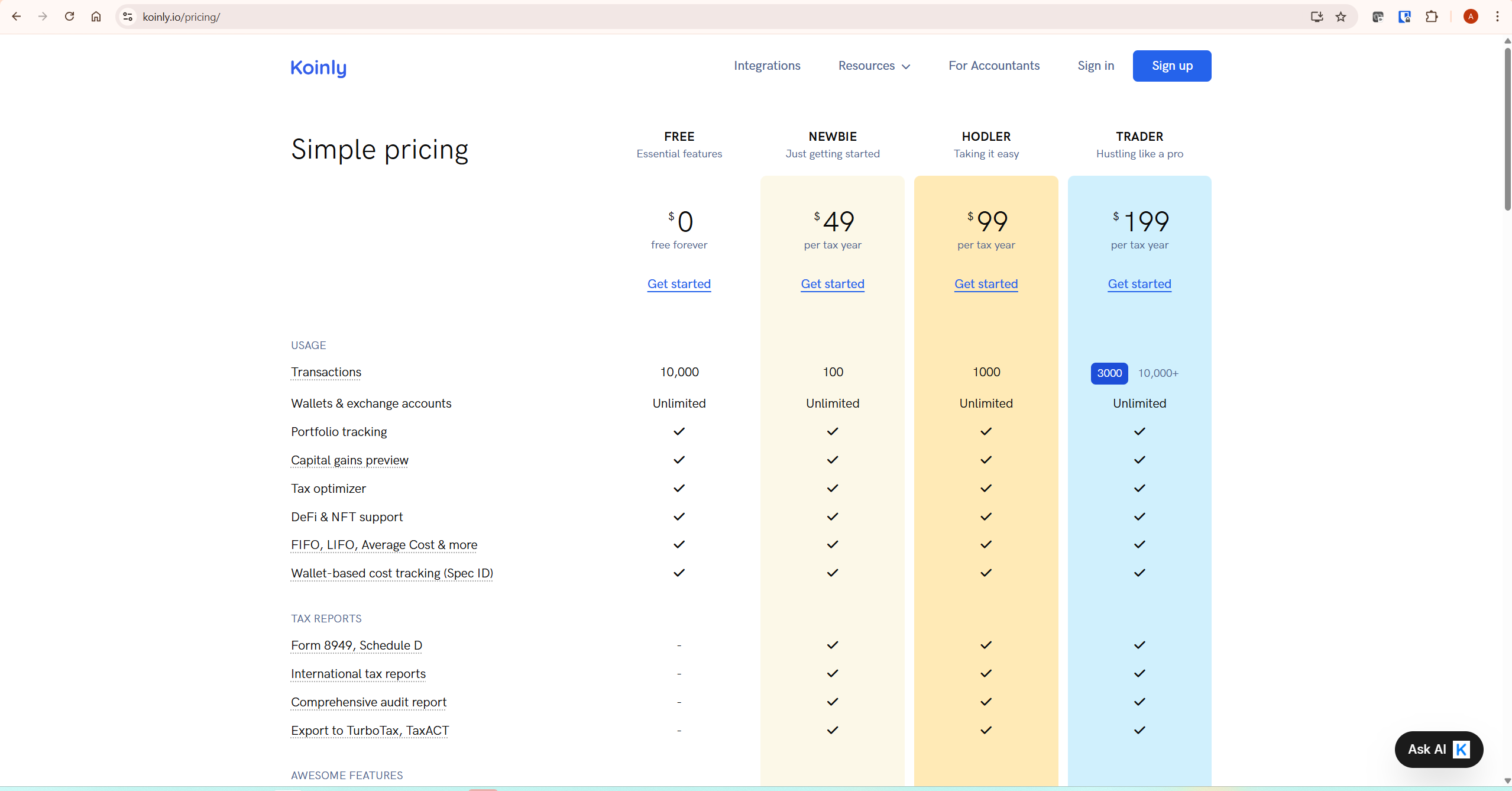
Always verify current pricing directly on Koinly’s pricing page, as figures may be updated.
| Plan | Price | Transactions | Best For | Worth It? |
|---|---|---|---|---|
| Free | $0 | 10,000 preview | Evaluation, portfolio tracking | Always yes |
| Newbie | $49/year | 100 | Buy-and-hold, minimal trades | Yes if 10–100 trades |
| Hodler | $99/year | 1,000 | Active investors, multi-exchange | Yes for most investors |
| Trader | $199/year | 3,000 | Frequent traders, DeFi users | Yes if volume justifies |
The value calculation is straightforward: if Koinly saves you two hours of manual reconciliation work, and you value your time at more than $25 per hour, the Newbie plan pays for itself. For investors with complex portfolios spanning multiple exchanges and years of transaction history, the time saving is substantially higher than that.
For a complete breakdown of what each plan includes and how to choose the right tier, see our dedicated Koinly pricing guide.
Who Is Koinly Worth It For?
Active Investors Using Multiple Exchanges
If you hold assets on more than one exchange or use any self-custody wallets, Koinly is worth it. The cost basis tracking and transfer matching across multiple platforms is the core problem Koinly solves. Doing this manually is time-consuming, error-prone, and increasingly risky as the IRS and other tax authorities increase enforcement and reporting requirements. At $99 for the Hodler plan, this is not an expensive solution relative to the problem it solves.
DeFi and NFT Investors
DeFi activity generates complex transaction types — swaps, liquidity provisions, staking rewards, bridging — that no spreadsheet handles cleanly. Koinly supports all major DeFi protocols and automatically categorises these transactions where possible. For DeFi-active investors, Koinly is not just worth it — it’s close to essential. The alternative is manual reconciliation of smart contract interactions across multiple chains, which is genuinely difficult to do accurately.
Investors With Multiple Years of Unfiled History
If you’ve been holding and trading crypto for several years without filing, Koinly is worth it simply because the problem compounds over time. Every historical transaction affects your current cost basis. Importing several years of history into Koinly and having it calculate the correct basis for every current position is significantly more reliable than attempting to reconstruct this manually from exchange records — many of which may no longer be accessible.
International Investors Filing in Multiple Jurisdictions
Koinly’s support for 100+ countries and its ability to generate jurisdiction-specific reports is a genuine differentiator. For investors filing in more than one country, or who have moved between countries while holding crypto, the jurisdictional flexibility is difficult to replicate with alternatives. The platform updates its compliance engine annually to reflect changing tax laws — a level of ongoing maintenance that a manual approach cannot match.
Who Should Not Use Koinly
Investors With a Single Exchange and Minimal Activity
If you bought Bitcoin on Coinbase two years ago, held it, and sold a portion once, Coinbase’s own tax reporting tools may be sufficient. The IRS Form 1099-DA that Coinbase now generates covers straightforward buy-and-sell activity on a single platform. Paying $49 for a Koinly report when your exchange already produces a usable one is not a justified expense.
Very High-Volume Day Traders
At 10,000+ transactions annually, Koinly’s Pro plan at $279 is competitive but not always the cheapest option. Some competitors offer unlimited transaction plans at a fixed annual price that may work out cheaper for algorithmic traders or bot traders generating extremely high transaction volumes. Compare your actual transaction count against alternative pricing before committing at this volume.
Is Koinly Worth It vs Alternatives?
The context of alternatives matters for this question. Koinly sits in a competitive market, and several platforms offer comparable core functionality.
CoinLedger starts at $49 for 100 transactions — identical entry pricing to Koinly — but charges more at higher transaction volumes. TokenTax starts at $65 for 500 transactions with no free plan. CryptoTaxCalculator uses an annual subscription model starting at $49 but requires paying regardless of whether you file that year. CoinTracker offers a comparable free tier but charges $199 for 1,500 transactions versus Koinly’s $99 for 1,000.
Koinly’s combination of a generous free tier, per-tax-year pricing, and broad integration coverage makes it the strongest overall value proposition for most active investors in the mid-range transaction volume category. It is not the cheapest option at every price point, but it consistently offers the best combination of coverage and cost for investors with 100–3,000 annual transactions.
For a head-to-head comparison, see our Koinly vs CoinTracker review.
2026 Context: Why Koinly Matters More This Year
The regulatory environment in 2026 makes accurate crypto tax reporting more important than it has ever been. Form 1099-DA is now mandatory — exchanges report your transaction data with cost basis directly to the IRS. CARF and DAC8 have activated global data sharing across 40+ countries, meaning tax authorities are receiving transaction data from crypto service providers internationally. IRS enforcement activity targeting crypto investors has increased significantly.
In this environment, the cost of getting crypto taxes wrong has increased. The value of software that gets it right — consistently, across all your wallets and exchanges — has increased proportionally. Koinly’s ongoing compliance updates to reflect the new Form 1099-DA requirements and international reporting standards represent genuine ongoing value beyond a one-time report download.
For more context on the compliance landscape, see the IRS digital assets guidance and our full Koinly review for a detailed look at the platform’s compliance features.
Frequently Asked Questions
Is Koinly worth it for small crypto portfolios?
It depends on complexity rather than portfolio size. A small portfolio spread across three exchanges with staking rewards is harder to reconcile than a large portfolio on a single exchange. Use the free plan to import your data and check your transaction count — if it’s under 100 and on one or two exchanges, the Newbie plan at $49 may be all you need. If your exchange already generates a usable tax report, evaluate whether Koinly adds enough additional accuracy to justify the cost.
Is Koinly worth it for DeFi investors?
Yes — DeFi is where Koinly’s value is clearest. The automatic categorisation of swaps, liquidity provision, staking rewards, and bridging transactions saves significant manual work and reduces the risk of misclassifying taxable events. For active DeFi investors, Koinly is close to essential rather than simply worth it.
Can I try Koinly before paying?
Yes. The free plan lets you import all your transactions, view your complete capital gains summary, and use the tax optimizer without spending anything. You only pay when you need to download the official tax report. This makes the evaluation risk-free — connect your wallets, check the accuracy of Koinly’s calculations, and decide from there.
Is Koinly accurate enough to rely on for tax filing?
Koinly is accurate when your data is complete. The most common source of inaccuracy is incomplete transaction history — missing wallets, unimported exchanges, or gaps in historical data. When all sources are connected and all transfers are correctly matched, Koinly’s calculations are reliable for tax filing purposes. For complex DeFi activity, manual review of flagged transactions is advisable. See our dedicated Koinly accuracy review for a full breakdown.
Does Koinly report to the IRS?
No. Koinly generates the reports and forms you need to file — it does not submit anything to the IRS on your behalf. You or your accountant must file the completed forms. Starting in 2026, exchanges themselves report transaction data to the IRS via Form 1099-DA, but Koinly as a tax software tool does not have a reporting obligation to tax authorities.
How does Koinly handle multiple tax years?
You can import transaction history spanning multiple years on the free plan. To download a report for a specific year, you purchase a plan for that year. Plans are valid for ten years from purchase, so you can generate reports at any point within that window. Each plan covers one tax year, so if you need reports for multiple years you purchase plans separately for each.
The Verdict: Is Koinly Worth It in 2026?
For most active crypto investors, yes. Koinly is worth it because the problem it solves — accurate cost basis tracking and tax reporting across multiple exchanges, wallets, and transaction types — is genuinely difficult to do any other way at this price point. The free plan eliminates the evaluation risk entirely. The per-tax-year pricing means you only pay when you actually need a report.
The investors for whom Koinly is most clearly worth it: anyone using more than one exchange, anyone with DeFi or staking activity, anyone with multiple years of crypto history to reconcile, and anyone filing in a jurisdiction that requires detailed capital gains reporting.
The investors for whom it may not be worth it: single-exchange holders with minimal activity who already receive usable tax documents from their exchange, and very high-volume traders who may find cheaper unlimited-transaction alternatives at their specific volume.
The right approach for everyone is the same: start with the free plan, import your data, check your transaction count and capital gains summary, and make the decision from a position of actual information rather than estimation. That’s exactly what the free plan is designed for.
Start with Koinly free here — no credit card required. See your tax position before committing to anything.
Related reading:
- Koinly Review: Is It the Best Crypto Tax Software in 2026?
- Koinly Pricing: Plans, Limits & Which One You Actually Need
- Koinly Free Plan: What Can You Actually Do Without Paying?
- Is Koinly Accurate? How Reliable Is It for Crypto Taxes in 2026?
- Koinly vs CoinTracker: Which Is Better in 2026?