
Koinly for DeFi and NFTs: How Well Does It Handle Complex Crypto?
This article contains affiliate links. If you sign up for Koinly through a link on this page, I may earn a commission at no extra cost to you. I only recommend tools I have genuinely evaluated.
This article is for informational purposes only and does not constitute professional tax or financial advice. Tax laws vary by country and change frequently. Consult a qualified tax professional for advice specific to your situation.
If you are active in crypto markets and searching for answers on Koinly DeFi NFTs tax reporting, you are dealing with one of the most complex areas in personal finance right now. Standard exchange transactions are relatively straightforward. Liquidity pools, yield farming rewards, NFT mints, cross-chain bridges, and auto-compounding strategies are not — and the stakes for getting them wrong are rising sharply in 2026 as IRS enforcement increases and global tax reporting frameworks like CARF and DAC8 expand across 40+ countries.
Koinly DeFi NFTs support is one of the most searched topics among active on-chain investors right now — and rightly so, because not every crypto tax tool handles this complexity at the same level. Some tools will silently misclassify transactions and hand you a report that looks clean but contains errors that a tax authority will eventually find. That is not a situation you want to be in.
After 30 years in finance, I understand how critical accurate reporting is — not just for compliance, but for your peace of mind. The anxiety of not knowing whether your Koinly DeFi NFTs report is correct is real, and it compounds every year you leave it unresolved.
By the end of this guide, you will know exactly what Koinly DeFi NFTs handles automatically, where you need to review manually, which specific scenarios require extra attention, and how to get the most accurate tax report possible from the platform.
Quick Answer: Koinly DeFi NFTs
Koinly DeFi NFTs support covers most standard on-chain activity well — token swaps, liquidity pool deposits and withdrawals, staking rewards, NFT purchases and sales, and gas fee tracking are all supported. It imports transactions directly from your wallet address and flags anything it cannot confidently classify rather than silently guessing. The honest limitation: complex scenarios such as auto-compounding rewards, cross-chain bridges, and batch NFT mints often require manual review. It is not a zero-touch solution for advanced users — but it gives you the visibility and control to get to an accurate report, which is more valuable than automation that gets it wrong.
If you want to see how the platform handles your specific wallet activity, their free plan lets you import everything and review your full transaction history before you pay a penny. Start with Koinly’s free plan here.
Why Koinly DeFi NFTs Taxation Is Genuinely Difficult
Most crypto investors understand that selling Bitcoin for a profit is a taxable event. What catches people out is the sheer volume and complexity of taxable events generated by DeFi and NFT activity — most of which happen automatically, in the background, without any obvious trigger.
A single liquidity pool position can generate dozens of individual taxable events: the initial deposit (often treated as a disposal), daily or hourly reward distributions, impermanent loss adjustments, gas fees on every interaction, and the final withdrawal. A yield farming strategy that auto-compounds rewards is, in many jurisdictions, triggering a taxable event every time rewards are reinvested. An NFT mint involves an acquisition cost plus gas fees, and if you later sell that NFT, the gain or loss is calculated against that full cost basis including fees.
In 2026, Koinly DeFi NFTs reporting matters more than ever. Form 1099-DA is now mandatory in the US, meaning exchanges are required to report to the IRS directly. CARF and DAC8 frameworks mean tax authorities across 40+ countries are sharing crypto data. The IRS digital assets guidance makes clear that all on-chain activity is subject to reporting requirements. Getting your Koinly DeFi NFTs tax position right is not optional — it is a compliance requirement with real consequences for getting it wrong.
How Koinly DeFi NFTs Imports Transactions
The foundation of Koinly DeFi NFTs is wallet-level import — not exchange API. You connect your public wallet address, and Koinly pulls the full on-chain transaction history directly from the blockchain. This is the correct approach for DeFi activity, because most DeFi interactions happen at the wallet level, not through an exchange interface.
Once imported, Koinly parses each transaction and attempts to classify it: swap, transfer, liquidity deposit, reward income, NFT purchase, and so on. Where it can classify confidently, it does. Where it cannot — because the transaction involves an unusual smart contract pattern, a protocol it does not yet recognise, or an ambiguous interaction — it flags the transaction for manual review rather than making a silent assumption.
That flagging behaviour is what sets Koinly apart from tools that silently misclassify transactions and present a clean-looking report. Koinly’s approach gives you control over your own compliance — which is exactly the right philosophy when the regulatory environment is tightening as fast as it currently is.
Koinly currently supports over 750 integrations including Ethereum, Solana, Polygon, Avalanche, BNB Chain, and most major DeFi-active networks. For a full breakdown of what the platform covers across all asset types, our complete Koinly review covers the platform in detail.
Koinly DeFi NFTs Support: What It Handles Well
For the majority of common on-chain activity, its automated classification is reliable. Here is what works well without significant manual intervention.
Token swaps on major DEXs like Uniswap, SushiSwap, and PancakeSwap are handled cleanly by Koinly DeFi NFTs. The platform identifies the swap, records the disposal of the outgoing token at its fair market value, and sets the cost basis for the incoming token correctly. Gas fees are included in the cost basis calculation.
Staking rewards are classified as income at the fair market value at the time of receipt — which is the correct treatment in most jurisdictions. Koinly tracks each reward distribution individually, which matters for high-frequency staking protocols that distribute rewards daily or more frequently.
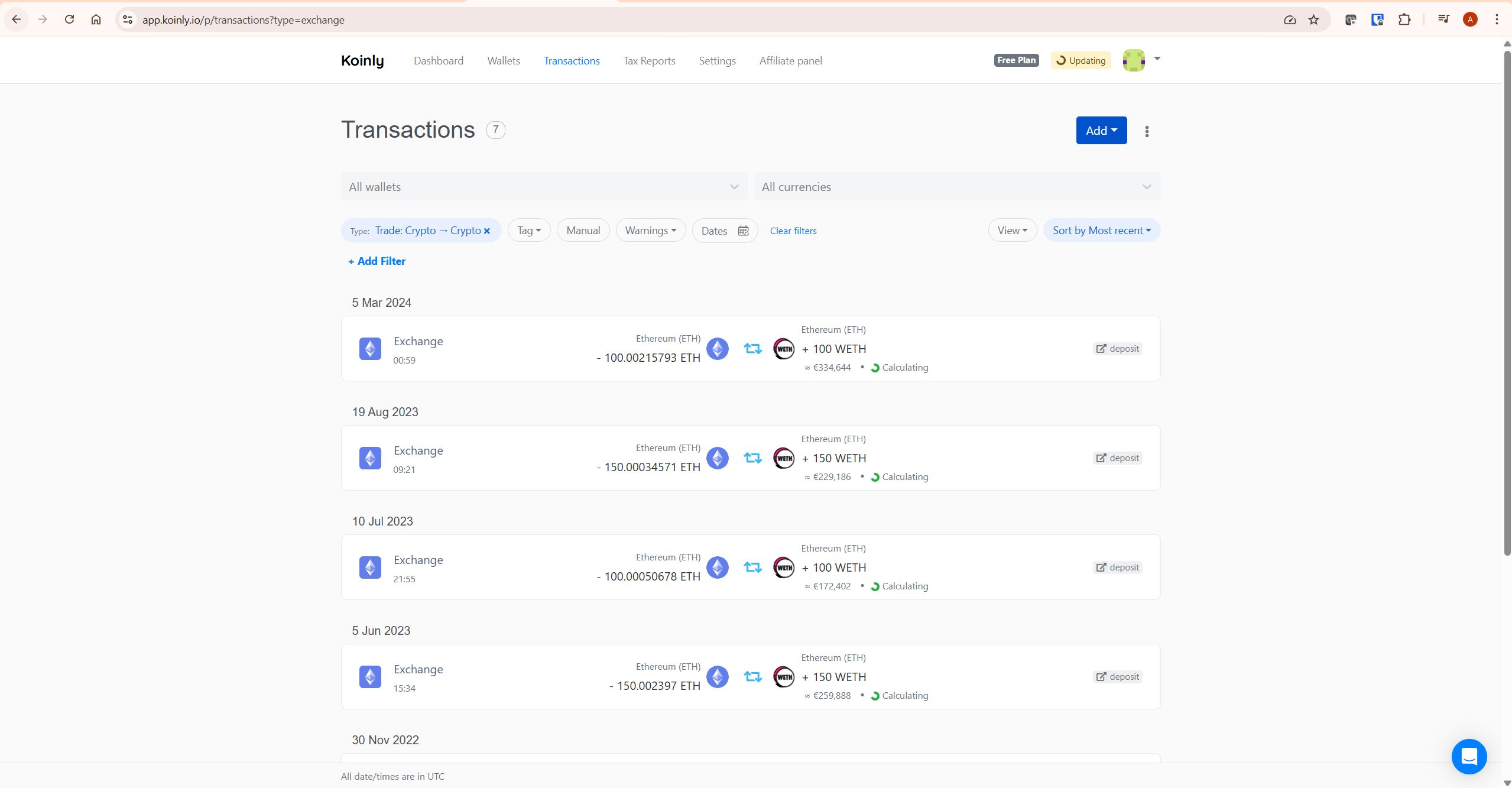
Wrapped token conversions such as ETH to WETH are recognised as non-taxable transfers in most jurisdictions rather than disposals, and the platform handles this correctly for standard wrapping operations. This is a detail that simpler tools frequently get wrong, creating phantom taxable events that inflate your reported gains.
NFT purchases and sales on major marketplaces including OpenSea, Blur, and Magic Eden are imported with acquisition cost, disposal value, and associated gas fees — giving you the complete cost basis picture needed for accurate gain and loss calculation.
Cross-chain bridges for standard bridge operations are supported, with Koinly tracking the asset leaving one chain and arriving on another. More complex bridge interactions may need manual review.
Liquidity Pools and Yield Farming in Koinly DeFi NFTs
Liquidity pools are where Koinly DeFi NFTs handling gets more complex — and where manual review is not optional, it is essential.
When you deposit assets into a liquidity pool, the tax treatment depends on your jurisdiction. In many countries, including the US, depositing into a liquidity pool is treated as a disposal of the deposited assets — meaning a taxable event occurs at deposit, not just at withdrawal. Koinly generally applies this treatment correctly, but you need to verify it matches your specific jurisdiction’s rules before finalising any report.
Yield farming rewards are typically classified as income at the fair market value at receipt. Where things get complicated is auto-compounding protocols — strategies where rewards are automatically reinvested into the pool. Each reinvestment is a separate taxable event in most jurisdictions, and Koinly imports them, but reviewing the classification of each one for a high-frequency compounding strategy takes time.
My clear recommendation for anyone with significant liquidity pool activity: use Koinly to import and organise the data, then work through the liquidity pool section with a crypto-specialist tax professional before filing. The tool handles the volume problem. The professional handles the jurisdictional interpretation problem. Neither alone is sufficient.
NFT Taxation in Koinly DeFi NFTs: Minting, Trading, and Gas Fees
For NFT investors and traders, Koinly DeFi NFTs support covers the full lifecycle of an NFT position — from acquisition through to disposal. Understanding exactly how the platform handles each stage is important for getting your report right.
Minting is treated as an acquisition. The cost basis is the amount of ETH or other cryptocurrency spent on the mint, plus gas fees. Koinly captures both and sets the combined figure as your cost basis. This matters significantly — many NFT investors forget to include gas in their cost basis, which overstates their gains on eventual sale.
Secondary market purchases follow the same logic: purchase price plus gas equals cost basis. the platform tracks these correctly for standard marketplace purchases.
Sales are recorded as disposals at the sale price. The gain or loss is calculated against your cost basis including gas. Platform fees charged by the marketplace are typically deductible against the disposal value, and Koinly generally captures these where they are visible in the on-chain transaction data.
Transfers between your own wallets are not taxable events — and Koinly correctly identifies wallet-to-wallet transfers as non-disposal movements when both wallets are associated with your account. The critical step is making sure you have imported all your wallets. A transfer that looks like a disposal in Koinly is almost always caused by a missing wallet import, not a platform error.
Common Koinly DeFi NFTs Problems — and How to Fix Them
These are the issues that appear most frequently with Koinly DeFi NFTs, with specific fixes for each one.
Transactions marked as “Unknown”. This means Koinly DeFi NFTs imported the transaction but could not confidently classify it. Do not ignore these — unknown transactions can distort your gains significantly if left unresolved. Open each flagged transaction, review what actually happened on-chain using Etherscan, and manually set the transaction type.
Missing cost basis warnings. This almost always means a wallet has not been imported. Import every wallet that has ever held any of your crypto assets — including wallets you no longer actively use. Once all wallets are connected, most cost basis warnings resolve automatically.
Duplicate transactions. These sometimes appear when a transaction is detected both from a wallet import and from an exchange API simultaneously. Review your import sources and remove any that overlap. Koinly has a duplicate detection tool that flags likely duplicates.
Staking rewards classified incorrectly. In some cases, Koinly classifies staking rewards as transfers rather than income. Check your staking reward transactions and verify they are classified as “Staking” or “Income” rather than “Receive” or “Transfer”.
If you are seeing gains figures that look completely wrong after importing your wallets into Koinly, the most common cause is missing transactions rather than a platform calculation error. Our guide on Koinly showing wrong gains walks through exactly how to diagnose and fix this problem step by step.
How to Get the Most Accurate Report from Koinly DeFi NFTs
Follow this sequence for the most accurate result. Skipping steps — especially the first one — is the most common reason DeFi investors end up with inaccurate reports.
Step 1: Import every wallet. Any wallet that has ever held, received, or sent crypto assets involved in your DeFi activity needs to be connected. Missing a single wallet creates missing cost basis errors that cascade through your entire transaction history.
Step 2: Resolve all “Unknown” transactions. Work through every flagged transaction and classify it correctly. This is the foundation of an accurate report. Do not skip ahead to the gains summary until the unknown transaction count is zero.
Step 3: Audit your liquidity pool transactions specifically. Filter by liquidity pool deposits and withdrawals, and verify the classification and values. This is the highest-risk area for errors in any DeFi portfolio.
Step 4: Check every NFT transaction includes gas fees. Filter your NFT transactions and spot-check several against the original on-chain data. If gas is missing from the cost basis on any significant NFT purchase, add it manually in Koinly.
Step 5: Review staking and reward income classifications. Make sure all reward transactions are classified as income rather than transfers in your report.
For a detailed walkthrough of how Koinly calculates gains across all transaction types, our Is Koinly Accurate? guide covers the methodology in depth, including where the platform’s calculations are most reliable and where they need human oversight.
If you are ready to run through this process, Koinly’s free plan lets you import and review your full transaction history before committing to a paid report.
Is Koinly DeFi NFTs the Right Choice for Serious Investors?
For a DeFi investor with 500 or more transactions, Koinly paid plan pays for itself in time saved alone — even before you factor in the cost of getting your tax position wrong. The free plan gives you enough access to validate that your wallets import correctly and that the transaction classification looks reasonable for your specific activity before you pay anything.
Koinly is the right choice if you want visibility and control over complex on-chain activity and are willing to invest time in reviewing your transaction data. It is not the right choice if you are expecting a fully automated, zero-review solution for a portfolio involving exotic DeFi protocols or high-volume NFT trading strategies.
For context on how Koinly compares to its closest competitor, our Koinly vs CoinTracker comparison covers the differences in detail — including which platform handles specific DeFi scenarios more accurately.
Frequently Asked Questions: Koinly DeFi NFTs
Does Koinly DeFi NFTs support all DeFi protocols?
Koinly DeFi NFTs supports the most widely used protocols on major networks including Ethereum, Solana, Polygon, BNB Chain, and Avalanche. For mainstream DeFi activity — Uniswap, Aave, Compound, Curve, and similar protocols — coverage is strong. More obscure or recently launched protocols may not be fully recognised, in which case transactions will be flagged for manual classification.
How does Koinly DeFi NFTs handle gas fees for tax purposes?
Koinly includes gas fees in the cost basis of NFT acquisitions — meaning the gas paid on a mint or purchase is added to the acquisition cost of the NFT, which reduces your taxable gain on eventual sale. This is the correct treatment in most jurisdictions, including the US and UK. Always verify with a tax professional that the treatment matches your jurisdiction’s current rules.
Will Koinly DeFi NFTs automatically fix wrong gains?
No — Koinly provides the tools to fix wrong gains, but the fixing requires your input. The most common cause of wrong gains is missing wallet imports or unresolved unknown transactions. Once you import all wallets and resolve flagged transactions, gains figures typically correct themselves. If your gains figure looks wrong, our Koinly showing wrong gains guide walks through the exact diagnostic steps.
Do I need a paid plan for Koinly DeFi NFTs tax reporting?
The free plan allows you to import all your wallets and review your full transaction history without paying. To generate a tax report you can file or share with an accountant, you need a paid plan. For most DeFi users the number of transactions will exceed the free tier limit. See our Koinly pricing guide for a full breakdown of what each plan covers.
The Bottom Line on Koinly DeFi NFTs
Koinly DeFi NFTs is as comprehensive as any tool at its price point — and better than most on the metrics that actually matter: transparency, manual control, and honest flagging of what it cannot determine automatically. For a DeFi investor or NFT trader who is willing to spend time reviewing their transaction data, the platform provides everything needed to build an accurate, defensible tax report.
For most crypto investors managing more than 100 transactions, Koinly is worth the cost. Explore Koinly’s plans here — and start with the free import to see exactly how it handles your specific wallets before committing.
For a complete picture of the platform across all asset types and use cases, read our full Koinly review.