
Semrush Local SEO: Honest Guide to the Local Toolkit (2026)
Affiliate Disclosure: This site earns revenue through affiliate partnerships with selected platforms. This article does not currently contain affiliate links for Semrush. Any tool recommendations are based on independent evaluation and official Semrush documentation checked in July 2026.
If you searched for Semrush local SEO and found older articles referencing different Local Toolkit plan names or tier structures, be careful. Semrush Local now uses two core plans plus a custom multi-location tier, and some articles still online may not reflect the current setup.
I am Andreas Maratheftis, 30 years in professional finance and founder of InnovateHub Finance, where I use Semrush to plan and prioritise content for a growing affiliate site. This guide covers what the Semrush Local Toolkit actually includes today, what it costs per location, and — just as importantly — an honest assessment of whether it belongs in an affiliate content workflow at all, versus a genuinely local business.
Quick Answer: What Is Semrush Local SEO?
In brief: Semrush’s local SEO capability comes from the Local Toolkit, a per-location add-on covering Google Business Profile optimisation, review management, local directory listings, and Google Maps rank tracking. It is priced per location across two current plans — Local Base at $30/month and Local Pro at $60/month — plus a custom Local Business tier for 20 or more locations. It can be purchased standalone or added to an existing Semrush SEO Toolkit subscription.
The important distinction to make immediately: the Local Toolkit is built for businesses with a physical location or a defined service area — dentists, law firms, gyms, restaurants, home service providers. It is not designed for a content-only affiliate site with no physical premises. If you run an affiliate site, the value of this article is understanding the tool well enough to advise or serve local business clients, not to apply it to your own site.
Semrush Local Toolkit: Current Pricing (2026)
Semrush Local now uses two core plans plus a custom multi-location tier. Some older articles still reference an earlier three-tier structure, so always verify current pricing directly before quoting it to a client.
| Feature | Local Base ($30/location/month) | Local Pro ($60/location/month) |
|---|---|---|
| GBP AI Agent | Included | Included |
| Map Rank Tracker credits | 375 per month | 1,225 per month |
| Listing Management (70+ directories) | Not included | Included |
| Review Management | Limited review tools | Expanded review management |
| Advanced GBP Optimization | Core GBP optimization tools | Expanded GBP optimization tools, including additional reporting and historical context where available |
| AI-generated review reply suggestions | Included | Included, higher daily limit |
| Additional campaign | $10/month | $10/month |
| Additional 1,000 credits | $5/month | $5/month |
For a broader explanation of how the Local Toolkit fits beside Semrush’s SEO, AI Visibility, Content, Social, and Traffic toolkits, see our Semrush Pricing Explained guide. For businesses with 20 or more locations, the Local Business tier requires contacting Semrush sales directly for custom pricing.
Every plan is billed per location — a business with three locations needing Local Pro pays $180/month, not a flat $60. Always verify current pricing and credit allocations directly on Semrush’s official pricing page before quoting a client, as these figures are updated periodically.
What Semrush Local SEO Actually Includes
The Local Toolkit centres on four core workflows, integrated with the broader Semrush SEO Toolkit for a complete local visibility picture.
GBP AI Agent and Optimization. Automates Google Business Profile management — post creation and scheduling, photo uploads, and review replies — to keep a profile consistently active. Keeping a Google Business Profile complete, accurate, and regularly maintained can support local visibility and customer engagement.
Google’s official local ranking guidance focuses on relevance, distance, and prominence, with reviews, ratings, links, and broader web presence contributing to prominence. Advanced Optimization on the Pro plan adds historical performance data unavailable directly inside the standard GBP interface, plus protection against unauthorised edits and suggestions from other users.
Listing Management. Distributes business data automatically across more than 70 directories in the US and 40 or more internationally, keeping name, address, and phone number consistent everywhere. Consistent business information across directories can support local visibility and reduce confusion for users and search engines. Inconsistent name, address, or phone data can weaken trust and create avoidable local SEO issues — this is the tool that prevents that drift at scale. Available on the Pro plan only.
Review Management. Centralises review monitoring across directories from a single dashboard, with automatic AI-generated reply suggestions for the first five unanswered reviews per location. Premium users on the Pro plan can enable AI auto-reply, which automatically responds to incoming reviews using generated suggestions — with settings to control whether auto-reply applies to positive reviews, negative reviews, or both.
Map Rank Tracker. Tracks Google Maps ranking position across a customisable geographic grid, with up to 100 tracked local keywords. Each grid point represents a specific search location, showing exactly where rankings are strong and where they weaken — critical intelligence for a business whose visibility varies significantly across a two- or three-mile service radius, which is common for local businesses even within the same city.
How the Standard SEO Toolkit Supports Local SEO
Before paying for the dedicated Local Toolkit, it is worth knowing that three standard SEO Toolkit features already support local SEO meaningfully — included in any existing Semrush SEO plan.
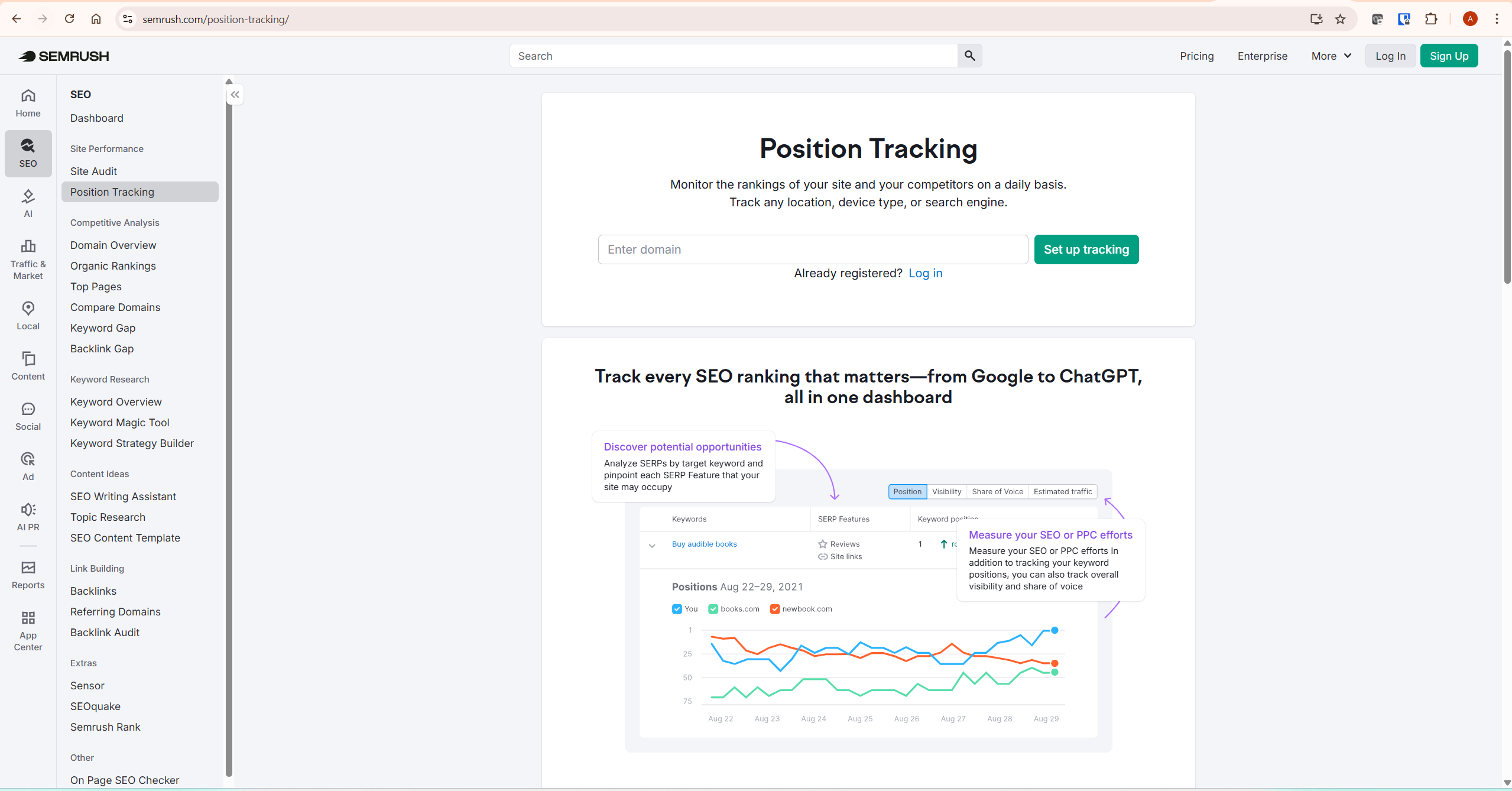
Position Tracking can monitor rankings at specific local levels, including city-level and, where available, ZIP-code-level tracking, alongside local pack visibility. For a business targeting one or two clear locations rather than dozens, this alone may cover ranking visibility needs without the additional Local Toolkit cost. Our guide on Semrush Position Tracking covers the complete setup.
Site Audit identifies technical issues affecting how well Google can crawl and understand a site’s pages — including structured data and schema markup relevant to local business listings. Our Semrush Site Audit guide covers the full technical health workflow.
The On-Page SEO Checker helps optimise individual pages for organic visibility. Stronger organic presence can support local prominence signals, but local pack visibility still depends on relevance, distance, prominence, reviews, business information quality, and the searcher’s location.
Semrush Local SEO Workflow: Step-by-Step
For an agency or consultant managing local business clients, here is the practical sequence for using Semrush’s local capabilities together.
Step 1: Audit current listing consistency. Before subscribing to the Local Toolkit, check how consistent the business’s name, address, and phone number currently are across major directories. Significant inconsistency is the clearest signal that Listing Management on the Pro plan will deliver immediate, measurable value.
Step 2: Set up Map Rank Tracker with a realistic grid. Enter the business name and choose up to 100 local keywords reflecting how real customers search — using local keyword research rather than guesswork. Set the map grid to reflect the actual service area; a grid too large returns meaningless data from locations the business does not realistically serve, while a grid too tight misses genuine expansion opportunities.
Step 3: Run Site Audit for technical local signals. Confirm the site correctly implements LocalBusiness schema markup, has a crawlable and consistent NAP block, and has no technical issues blocking Google from associating the site with the correct location.
Step 4: Activate GBP AI Agent for consistent activity. Keeping a Google Business Profile complete, accurate, and regularly maintained can support local visibility and customer engagement. Schedule consistent posts and ensure new reviews receive timely responses — automated where appropriate, personally handled for anything requiring genuine care.
Step 5: Monitor and compare against competitors. Map Rank Tracker shows competitor Map Pack visibility alongside the client’s own rankings. Use this comparison to identify specific weak zones within the service grid where targeted GBP posts, review generation campaigns, or citation building would have the most impact.
Is Semrush Local SEO Worth It? An Honest Assessment
The honest answer to whether Semrush local SEO is worth it depends entirely on what you actually run, and it is worth being direct about this rather than stretching the tool’s relevance to fit every reader.
If you run a genuinely local business — a single location or a handful of locations with a defined service area — the Local Toolkit is a reasonable, well-scoped investment. At $30-60/month per location, the cost is modest relative to typical local business revenue, and consistent GBP management combined with rank tracking addresses real, measurable ranking factors.
If you manage local SEO for multiple clients as an agency, the per-location pricing scales predictably, and the Listing Management and Review Management automation genuinely reduces manual account management time across a client roster.
If you run a content-only affiliate site with no physical location — the situation most readers of this site are in — the Local Toolkit has essentially no application. Local pack rankings, Google Business Profile optimisation, and directory listings are irrelevant to a site with no physical premises or service area.
The relevant Semrush tools for an affiliate content publisher remain the standard SEO Toolkit: keyword research, content planning, site auditing, and backlink analysis. Our full Semrush review covers the tools that actually matter for content-driven affiliate sites.
Semrush Local vs Dedicated Local SEO Tools
For businesses whose primary need is local SEO specifically, it is worth knowing that dedicated local SEO platforms exist alongside Semrush’s offering, and the honest comparison depends on what matters most.
Semrush’s advantage is integration — Local Toolkit data connects directly with Position Tracking, Site Audit, and the wider SEO Toolkit, giving a genuinely unified view of organic and local performance in one account. For a business or agency already using Semrush for broader SEO work, adding Semrush local SEO capability avoids managing a separate platform and separate login.
Dedicated local-only platforms sometimes offer deeper geo-grid granularity or credit-based pricing models that suit businesses with highly variable tracking needs month to month. For a business whose primary requirement is hyper-precise geographic rank tracking above all else, it is worth comparing options directly rather than assuming the Semrush-integrated approach is automatically the better fit. The right choice depends on whether integration with existing SEO data or specialised local-only depth matters more for the specific business in question.
Common Mistakes When Using Semrush Local SEO
Setting an unrealistic map grid. A grid covering an entire metro area when the actual service radius is five miles produces mostly irrelevant data. Set the grid to reflect where real customers actually search from, then expand deliberately if testing genuine expansion into new areas.
Relying entirely on AI auto-reply for reviews. Automated responses handle volume efficiently, but a negative review describing a genuine service failure deserves a personally written response, not a generated one. Use automation for routine positive reviews and reserve personal attention for anything requiring real acknowledgement.
Ignoring citation consistency before subscribing. Subscribing to Listing Management without first checking existing citation accuracy means paying to fix a problem without first confirming how significant that problem actually is. A quick manual check across the top 10-15 directories a business is likely listed on gives a clearer sense of whether the investment is justified immediately.
Assuming the Local Toolkit applies to non-local businesses. Affiliate content sites, SaaS products, and other location-independent businesses gain nothing from Local Toolkit features. If a business has no physical address or defined service area, the standard SEO Toolkit is the relevant investment, not Local.
What To Do Next
If you manage or advise a genuinely local business, start with the free tools before subscribing. Semrush’s free local SEO tools include a basic SEO checker and Google Business Profile description generator, requiring no sign-up. Use these to assess data quality and relevance before committing to a per-location subscription.
A 7-day free trial of the paid Local Toolkit is also available — use it to run Map Rank Tracker on the client’s actual service grid and confirm the data justifies the ongoing per-location cost.
If you run a content-only affiliate site, this tool is not the priority. Focus instead on the standard SEO Toolkit features covered in our full Semrush review and our guide on whether Semrush is worth it for a content-driven site at your current stage.
Frequently Asked Questions
How much does Semrush Local SEO cost?
Semrush’s Local Toolkit is priced per location across two current plans: Local Base at $30/month per location and Local Pro at $60/month per location. Businesses with 20 or more locations need the custom Local Business tier, requiring direct contact with Semrush sales.
Pricing is per location — a business with five locations on the Pro plan pays $300/month total, not a flat $60. A 7-day free trial is available. Always verify current pricing on Semrush’s official pricing page, as these figures are periodically updated.
Is Semrush good for local SEO?
For a genuinely local business or an agency managing multiple local clients, yes — the Local Toolkit combines Google Business Profile automation, review management, listing distribution, and geo-grid rank tracking in one integrated platform connected to Semrush’s broader SEO data. For a content-only affiliate site or any business with no physical location or defined service area, the Local Toolkit has no meaningful application, and the standard SEO Toolkit is the relevant investment instead.
Do I need the Semrush Local Toolkit if I already have a Semrush SEO subscription?
Not necessarily. The standard SEO Toolkit already includes Position Tracking with ZIP-code and local pack monitoring, plus Site Audit for technical local signals like schema markup. If your only need is rank visibility at a local level, these standard tools may be sufficient. The dedicated Local Toolkit becomes worthwhile when you need Google Business Profile automation, multi-directory listing management, and centralised review management — features not included in the standard SEO Toolkit.
Can I try Semrush Local SEO tools for free?
Yes. Semrush offers free local SEO tools requiring no sign-up, including a website SEO checker and a Google Business Profile description generator. For the full paid Local Toolkit — GBP AI Agent, Listing Management, Review Management, and Map Rank Tracker — a 7-day free trial is available before committing to the per-location monthly cost.
What is the difference between Local Base and Local Pro?
Local Base ($30/month per location) includes the GBP AI Agent and 375 Map Rank Tracker credits per month, with limited review management. Local Pro ($60/month per location) adds Listing Management across 70 or more directories, full review management with a higher AI auto-reply limit, advanced GBP optimisation with historical data, and 1,225 Map Rank Tracker credits per month. Businesses needing directory listing distribution specifically require the Pro plan, as this feature is not available on Base.
Final Thoughts
Semrush local SEO, delivered through the Local Toolkit, is a well-built, genuinely useful product for the audience it is designed for — local businesses and the agencies serving them. The current two-tier structure, Base and Pro, makes the decision relatively clear, and the integration with Position Tracking and Site Audit gives local businesses a unified visibility picture inside one platform.
The honest scope note matters most: this is not a tool for a content-only affiliate site. If that describes your situation, the standard Semrush SEO Toolkit remains the relevant investment, and the Local Toolkit is worth understanding only if you advise, consult for, or manage local business clients as part of your work.
For a complete breakdown of the Semrush tools that matter for an affiliate content site specifically, read our full Semrush review.
- Semrush Position Tracking — including ZIP-code and local pack monitoring included in the standard SEO Toolkit
- Semrush Site Audit — technical local SEO signals like schema markup
- Semrush Pricing Explained — every toolkit and plan tier compared
- Is Semrush Worth It? — cost-benefit framework for content-driven sites
- Semrush Alternatives — verified alternatives at every price point
Local Toolkit features and pricing were checked against Semrush’s official Local documentation and pricing pages in July 2026. Always verify current pricing and plan structure directly on Semrush’s official pages before purchasing, as toolkit packaging can change. For independent context, Backlinko’s Semrush review provides a useful secondary perspective.
