
Semrush vs Moz: Honest Comparison for Affiliate Marketers (2026)
Disclosure: This site earns revenue through affiliate partnerships with other platforms. This article does not currently contain affiliate links for Semrush or Moz. All recommendations are based on independent research and publicly available data.
For affiliate content publishers, Semrush vs Moz is not a close contest — Semrush is the stronger platform for keyword research, content planning, and competitive intelligence at every plan tier. But that does not mean Moz is the wrong choice for every situation. If you are managing a small site on a tight budget, want a simpler tool with a lower learning curve, or primarily need local SEO capabilities, Moz makes a compelling case. This complete Semrush vs Moz comparison gives you the honest breakdown — including the specific scenarios where Moz is genuinely the better option — so you can make the right call for your situation rather than the obvious one.
After 30 years in finance and building an affiliate content site from scratch, I have learned that the right tool is the one that matches your current stage and workflow — not the one with the longest feature list. Both Semrush and Moz are serious SEO platforms. Here is where each one earns its place.
Semrush vs Moz: Quick Verdict
In the Semrush vs Moz decision, choose Semrush if you are building an affiliate content site where keyword research, competitor analysis, content planning, and site auditing are your core workflows. Its database is 22x larger than Moz’s, its AI visibility tracking is market-leading, and its Content Marketing Platform (Guru plan) gives affiliate publishers tools Moz simply does not offer. Choose Moz in the Semrush vs Moz comparison if budget is your primary constraint, you want a 30-day free trial before committing, your focus is local SEO, or you need a simpler interface that your team can use without extensive training. For most affiliate content publishers — Semrush wins clearly.
Semrush vs Moz: Head-to-Head Comparison Table
| Feature | Semrush | Moz Pro | Winner |
|---|---|---|---|
| Keyword Database | 27.9 billion keywords | 1.25 billion keywords | Semrush (22x larger) |
| Backlink Index | 43 trillion links, 390M domains | 45.8 trillion links, 1B domains | Moz (more domains) |
| Site Audit | 140+ checks, AI health score | Core technical checks, clean interface | Semrush |
| Content Marketing Tools | Full platform — briefs, AI writer, templates | Not available | Semrush |
| AI Visibility Tracking | Yes — ChatGPT, Perplexity, Google AIOs | Basic keyword intent only | Semrush |
| Local SEO Tools | Available as add-on | Strong native local SEO suite | Moz |
| Authority Metric | Authority Score (AS) | Domain Authority (DA) — widely cited | Tie (different methodologies) |
| Free Trial | 7 days (card required) | 30 days (card required) | Moz |
| Entry Price (annual) | $117/month (Pro) | $79/month (Standard) | Moz |
| Ease of Use | Complex — steep learning curve | Simpler — faster to navigate | Moz |
| Keyword Difficulty Accuracy | 89% correlation with actual rankings | Solid but lower at scale | Semrush |
| Best For | Affiliate content publishers, agencies | Small businesses, local SEO, beginners | Depends on use case |
What Is Semrush?
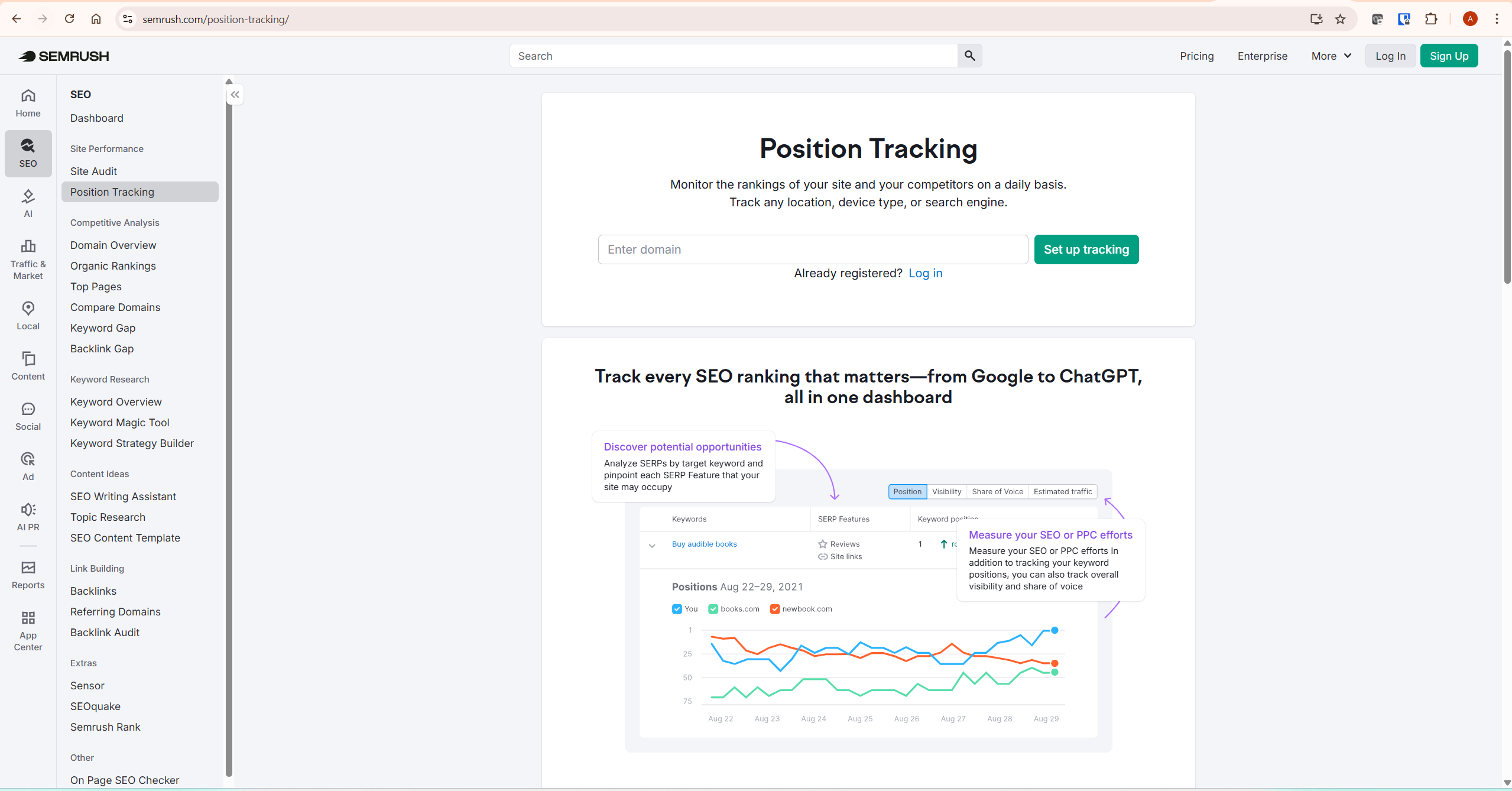
Semrush is a comprehensive digital marketing platform covering SEO, content marketing, competitive intelligence, PPC research, social media, and — since the launch of Semrush One in late 2025 — AI visibility tracking across ChatGPT, Perplexity, and Google AI Overviews. With 27.9 billion keywords in its database and over 10 million registered users, it is the dominant tool for professional SEO operations. For a full breakdown of everything Semrush offers in this Semrush vs Moz context, read our complete Semrush review.
What Is Moz?
On the Moz side of the Semrush vs Moz debate, Moz launched in 2004 as one of the original SEO software platforms and built its reputation around the Domain Authority metric — a proprietary measure of a website’s link-based authority that became widely adopted across the industry. Moz Pro covers keyword research, rank tracking, site auditing, backlink analysis, and local SEO. Its keyword database of 1.25 billion terms is significantly smaller than Semrush’s, but its interface is notably more approachable for users new to SEO tools. Moz also offers a 30-day free trial — one of the most generous evaluation periods in the market.
Semrush vs Moz: Pricing Compared
Pricing is where the Semrush vs Moz comparison tilts toward Moz — the entry point is meaningfully lower and the free trial is significantly longer. For a detailed breakdown of Semrush’s plans specifically, our Semrush pricing guide covers every tier and limit in full.
Semrush Pricing
Semrush Pro starts at $117/month on annual billing ($139.95/month billed monthly). Guru — the plan most affiliate content publishers will need for the Content Marketing Platform — is $208/month annually. Business is $416/month annually. There is no free plan, and the trial period is 7 days with a card required. Annual billing saves approximately 17%.
Moz Pro Pricing
Moz Pro starts at $39/month annually (Starter) — though this plan is extremely limited, tracking only 50 keywords and crawling 20,000 pages per month. The Standard plan at $79/month annually is the realistic entry point for meaningful work. Medium is $143/month annually, and Large is $239/month annually. All plans include a 30-day free trial with full feature access — the most generous trial period in the premium SEO tool market. Always verify current pricing directly on Moz’s website as these figures change.
Pricing Verdict
Moz wins on entry price and trial length. At comparable tiers — Semrush Pro ($117/month) vs Moz Medium ($143/month) — Semrush is actually cheaper for what it delivers. The Moz Standard plan at $79/month is the most affordable option for a content site, though its limits are tight. For a site generating no affiliate income yet, Moz’s 30-day trial gives you four weeks to evaluate whether either tool justifies the subscription.
Semrush vs Moz: Keyword Research
In the Semrush vs Moz keyword research category, Semrush wins decisively — and the margin is larger than most comparisons acknowledge.
Semrush’s Keyword Magic Tool accesses 27.9 billion keywords across 142 locations, with intent classification (informational, navigational, commercial, transactional), topic cluster grouping, and the Keyword Gap tool for side-by-side competitor comparison. In 2026 testing, Semrush’s keyword difficulty scores show 89% correlation with actual Google ranking difficulty — the strongest predictive accuracy in the market for competitive niches. Our Semrush keyword research guide covers the full affiliate content workflow step by step.
On the Moz side of the Semrush vs Moz keyword comparison, Moz’s Keyword Explorer accesses 1.25 billion keywords — a database 22 times smaller than Semrush’s. Results per query are capped at around 1,000 suggestions on lower plans, which becomes a genuine constraint if you are building topic clusters across dozens of subtopics. Moz’s Priority Score is a useful feature that combines search volume, keyword difficulty, and CTR opportunity into a single ranked metric — which reduces decision paralysis for users new to keyword strategy. For a beginner who finds Semrush’s volume of data overwhelming, Moz’s more focused output can actually be an advantage.
According to Moz’s own keyword research documentation, the platform’s strength lies in its Priority Score methodology — synthesising volume, difficulty, and CTR into a single actionable number. For advanced affiliate content publishers who need raw data depth and competitive gap analysis, Semrush is the stronger tool.
Keyword Research Verdict in the Semrush vs Moz Comparison
Semrush wins clearly on database size, filtering depth, and competitive intelligence. Moz is more approachable for beginners but hits data limits quickly on growing content sites.
Semrush vs Moz: Understanding Domain Authority vs Authority Score
One of the most searched questions in any Semrush vs Moz comparison is what Domain Authority actually means. DA is Moz’s proprietary metric — a score from 1 to 100 measuring a website’s link-based authority. It is not a Google ranking factor, but it has become one of the most widely cited third-party metrics in SEO, used by publishers, journalists, and link builders globally to evaluate site quality.
Semrush uses Authority Score (AS), its own equivalent metric combining backlink quality, organic traffic signals, and spam detection. AS and DA often produce different scores for the same domain — a site might show DA 45 and AS 30, or vice versa. Neither metric is “correct” — they measure authority through different lenses and weighting systems.
For practical use: DA remains more widely recognised outside the SEO tool ecosystem. If you are pitching guest posts, evaluating link prospects, or communicating site quality to non-technical stakeholders, DA is the metric most people will understand. If you are working entirely within Semrush, AS serves the same strategic purpose. As noted by Ahrefs in their website authority documentation, no third-party authority score correlates perfectly with Google rankings — all should be treated as directional indicators rather than precise measurements.
The key takeaway for an affiliate content publisher: DA is useful for benchmarking potential link partners, but do not let it drive content decisions. Focus on keyword difficulty and search intent — these are far more reliable inputs to your content strategy.
Semrush vs Moz: Site Audit
In the Semrush vs Moz site audit comparison, Semrush leads on depth — checking over 140 technical factors with thematic reports and plain-language explanations for every issue. Our dedicated guide on how to use Semrush Site Audit covers the full workflow for affiliate content sites.
Moz’s site crawl covers the core technical checks — broken links, missing meta tags, duplicate content, redirect issues, and page speed signals. The interface is cleaner and more intuitive than Semrush’s, which makes it more accessible for users running their first technical audit. Moz’s crawl limits vary significantly by plan: the Starter plan crawls only 20,000 pages per month, while the Medium plan extends to 500,000 — sufficient for most affiliate content sites.
Where Semrush leads: the AI Search Health check added in 2026, which evaluates whether your pages are accessible to AI crawlers including OpenAI’s SearchGPT and Perplexity’s bot. As AI search captures a growing share of information queries, this check is becoming strategically important for content publishers targeting long-term visibility.
Site Audit Verdict: Semrush vs Moz
Semrush wins on depth and AI readiness checks. Moz is more approachable for beginners and sufficient for most affiliate content sites at an early stage.
Semrush vs Moz: Backlink Analysis
Backlinks are the one category in the Semrush vs Moz comparison where Moz holds a genuine technical advantage — though the practical impact for most affiliate content publishers is limited.
Moz’s backlink index covers 45.8 trillion links from 1 billion referring domains — slightly larger than Semrush’s 43 trillion links from 390 million domains on the raw domain count. Moz’s Link Explorer shows referring domains, anchor text, spam score, and discovered/lost link trends. For a content site primarily using backlink data for competitive research rather than active link building, Moz’s Link Explorer covers the fundamentals adequately.
Semrush’s backlink toolset is broader — Backlink Analytics, Backlink Audit with toxic link detection, Backlink Gap, and the Link Building Tool with outreach management. For a publisher planning to run systematic outreach campaigns as their site scales, Semrush’s integrated link building workflow is significantly more developed. Our guide on Semrush backlink analysis covers the full workflow for affiliate content sites.
Backlink Analysis Verdict
Moz wins slightly on raw index size in this Semrush vs Moz category. Semrush wins on workflow breadth and the Semrush vs Moz link building toolset advantage is clear for growing sites and link building tools. For most affiliate content sites at an early stage, the difference is minimal in practice.
Semrush vs Moz: Content Marketing Tools
Semrush wins this Semrush vs Moz category outright — Moz has no equivalent content marketing toolset.
Semrush’s Content Marketing Platform (available from Guru plan upward) includes Topic Research for ideation, the SEO Content Template which analyses top-ranking pages and produces a writing brief, the SEO Writing Assistant integrating with Google Docs and WordPress for real-time scoring, and ContentShake AI for full draft generation. For an affiliate publisher producing two to four articles per week, this toolset provides a structured workflow from keyword to published page that meaningfully reduces the time from research to output.
This is one of the clearest gaps in the Semrush vs Moz comparison. Moz does not offer content marketing tools in any meaningful sense. Its platform is focused on SEO measurement and reporting rather than content production workflows. If content planning and optimisation are central to your affiliate publishing operation, Moz cannot replace that function — you would need separate tools at additional cost.
Content Marketing Verdict: Semrush vs Moz
Semrush wins decisively. Moz has no content marketing toolkit.
Semrush vs Moz: Free Trial — What You Can Actually Test
The free trial comparison is one of the most practical dimensions of the Semrush vs Moz decision — because it determines how much you can evaluate before committing real money.
Moz offers a 30-day free trial with full access to Moz Pro features. That is enough time to run multiple keyword research sessions, complete a site audit, analyse competitor backlink profiles, and develop a genuine sense of whether the tool fits your workflow. You need a card to start but can cancel before the trial ends.
Semrush offers a 7-day trial on paid plans — considerably shorter. Semrush also makes several free tools available without registration: the Keyword Magic Tool with daily search limits, a free backlink checker showing the top 25 links for any domain, and a free site audit for up to 100 pages. These give a meaningful preview of data quality without requiring a card, but the trial window for full feature evaluation is tight.
Practical recommendation: if you are undecided between the two, start with Moz’s 30-day trial. Four weeks is enough to run a genuine evaluation. If Moz’s data depth feels limiting for your keyword research needs — particularly if you are researching competitive niches with large topic clusters — that experience will clarify whether Semrush’s deeper database is worth the higher price. Whether Semrush is worth the investment at your current stage is covered in detail in our guide on Is Semrush Worth It?
When Moz Is the Honest Recommendation
Most Semrush vs Moz comparisons give Moz a token mention before recommending Semrush. Here are the specific scenarios — drawn from a careful reading of both tools — where Moz is genuinely the better Semrush vs Moz choice. Here are the specific scenarios where Moz is genuinely the better choice — not as a consolation prize, but as the right tool for that situation.
You are primarily focused on local SEO. Moz’s local SEO suite is natively integrated and strong. Semrush offers local SEO as a paid add-on. For a business managing citations, local rankings, and Google Business Profile optimisation across multiple locations, Moz’s local toolset is more developed and better value at the entry level.
You are new to SEO and need a simpler starting point. Semrush’s interface is powerful but complex. New users consistently take longer to get productive in Semrush than in Moz. If you are building your first content site and need to learn SEO fundamentals alongside using the tool, Moz’s cleaner interface reduces the cognitive load considerably.
Your budget is genuinely constrained and you need basic SEO coverage. Moz Standard at $79/month covers keyword research, rank tracking, site auditing, and backlink analysis at a level that is sufficient for a site under 30 articles. If Semrush’s $117/month Pro plan is a stretch given your current revenue, Moz Standard is a legitimate alternative — not a compromise.
Domain Authority is important for your outreach workflow. DA is the most widely recognised authority metric outside the SEO tool ecosystem. If you are pitching guest posts or evaluating link partners, many publishers and journalists will understand DA but not Semrush’s Authority Score. Working within Moz gives you DA data natively rather than having to reference third-party tools.
Who Should Choose Semrush vs Moz?
Choose Semrush if you are:
- An affiliate content publisher needing keyword research, content planning, competitor analysis, and site auditing in one platform
- Publishing two or more articles per week and using content tools consistently
- Targeting competitive niches where keyword database depth and difficulty accuracy matter
- Building topical authority clusters that require large-scale keyword gap analysis
- Interested in tracking AI search visibility alongside traditional rankings
- At a stage where SEO is generating or clearly on track to generate consistent revenue
Choose Moz if you are:
- New to SEO and want a simpler interface with a 30-day trial to evaluate properly
- Primarily focused on local SEO for a business with multiple locations
- Running a small site under 30 articles with basic keyword and ranking needs
- Working with a tight budget where Moz Standard at $79/month makes more sense than Semrush Pro at $117/month
- Using DA as a primary metric in your outreach workflow
For a detailed look at how Semrush compares to other alternatives in the market, our guides on Semrush vs Ahrefs and Semrush vs Ubersuggest cover the full competitive landscape.
What To Do Next
If the Semrush vs Moz comparison has you leaning toward Semrush — use the free tools first. The free Keyword Magic Tool and free backlink checker at semrush.com give a meaningful preview of data quality without a card. If the data looks strong for your niche, start with the Pro plan and upgrade to Guru when you are ready to use the Content Marketing Platform consistently.
If the Semrush vs Moz comparison has you leaning toward Moz — start the 30-day trial. Use the first two weeks for keyword research in your niche and run a site audit on your domain. Use the final two weeks for competitor backlink research and rank tracking setup. By the end you will know whether Moz’s data depth is sufficient for your workflow or whether you need Semrush’s larger database. Cancel before day 30 if the tool does not fit.
Frequently Asked Questions
Is Semrush or Moz better for beginners in the Semrush vs Moz choice?
Moz is more approachable for beginners due to its simpler interface and cleaner data presentation. Semrush is more powerful but has a steeper learning curve — new users typically need several weeks before establishing an efficient workflow. If you are new to SEO tools, Moz’s 30-day trial is a good starting point. Move to Semrush when your content operation has grown to a scale where its additional data depth and content tools become necessary.
Does Moz have a free plan?
Moz does not have a permanent free plan, but it offers a 30-day free trial of Moz Pro with full feature access. Moz also provides a free MozBar browser extension that shows DA and PA metrics for any website you visit — useful for quick link prospecting without a subscription. The free trial requires a credit card but can be cancelled before the trial period ends.
In the Semrush vs Moz debate — is Moz Domain Authority a Google ranking factor?
No. Domain Authority is Moz’s proprietary metric and is not used by Google in its ranking algorithm. Google has confirmed it does not use any third-party authority scores. DA is useful as a relative indicator of a site’s link-based strength — higher DA sites generally rank better — but it is a correlation, not a cause. Use DA as a directional benchmark for evaluating link prospects and competitor strength, not as a ranking predictor.
Can I use both tools in the Semrush vs Moz comparison together?
Yes, though the use case is narrow. Some SEO professionals use Semrush for keyword research and content planning while referencing Moz’s DA metric for link prospecting — since DA is more widely understood in outreach contexts. At a combined cost of approximately $196/month annually (Semrush Pro + Moz Standard), the dual-tool approach is only justifiable for an operation billing multiple SEO retainers or with specific outreach workflows requiring DA data natively.
Which has better customer support — Semrush or Moz?
In the Semrush vs Moz customer support comparison, both tools receive strong marks. Moz is particularly noted for response speed, often replying within minutes. Semrush provides 24/7 live chat on paid plans. Moz’s community forum is one of the most active and knowledgeable in the SEO industry — a genuine resource for users working through strategy questions beyond basic tool usage. Both platforms maintain extensive documentation and training academies at no additional cost.
Final Verdict
The final verdict on Semrush vs Moz for affiliate content publishers: Semrush is the stronger platform on keyword database, content tools, competitive intelligence, and AI visibility tracking. The price premium over Moz is justified by the breadth of what is included — particularly the Content Marketing Platform at Guru level, which has no Moz equivalent.
In the Semrush vs Moz comparison, Moz earns its place for specific situations: beginners who need a gentler learning curve, publishers focused on local SEO, sites on tight budgets where Moz Standard covers enough to be useful, and outreach-focused operations where DA is the preferred authority metric. The 30-day trial is a genuine advantage that Semrush does not match.
For a complete breakdown of Semrush’s features, pricing, and whether the investment is justified at your site’s current stage, read our full Semrush review.
- Semrush Pricing Explained — every plan, limit, and add-on
- Semrush vs Ahrefs — how Semrush compares to the other premium SEO tool
- Semrush vs Ubersuggest — the budget alternative compared
- Semrush Competitor Analysis — the 90-minute competitive research workflow
- Is Semrush Worth It? — honest cost-benefit for affiliate content sites
Pricing figures verified from publicly available sources as of April 2026. Always confirm current pricing directly on Semrush’s pricing page and Moz’s pricing page before making a purchase decision.
