
Koinly DAC8 CARF: Best Complete 2026 EU Guide
Affiliate disclosure: InnovateHub Finance may earn a commission if you sign up to Koinly through links on this page, at no extra cost to you.
This article is for informational purposes only and does not constitute professional tax or financial advice. Tax laws vary by country and change frequently. Consult a qualified tax professional for advice specific to your situation.
Last verified: August 2026, using the European Commission’s official DAC8 guidance and OECD CARF documentation.
Koinly DAC8 CARF: What Changed on January 1, 2026
Since January 1, 2026, your crypto exchange has been collecting additional identity, tax-residency, and transaction data about you, and starting in 2027 it will start handing that data to your tax authority automatically. If you use Koinly, you’re probably wondering whether Koinly DAC8 CARF compliance is something you need to configure, or whether this changes what you owe. Neither, as it turns out — but it does change how important it is that your Koinly account reflects your complete transaction history.
I’m Andreas Maratheftis. I spent 30 years as a Finance Director and Group CFO before I started writing about crypto tax tools, and regulatory changes like this one tend to generate a lot of alarm without much clarity.
Let me walk through exactly what DAC8 and CARF require, who they apply to, and what — if anything — you need to do differently in Koinly. For the full picture of what Koinly does well and where it falls short more broadly, my complete Koinly review covers the platform end to end.
Key Takeaways
- DAC8 is the EU’s implementation of the OECD’s global CARF framework — DAC8 applies to EU member states, while CARF is the broader international standard, with 76+ jurisdictions having announced commitments or intentions to implement it.
- The reporting obligation sits with your exchange or wallet provider, not with you directly — you don’t file anything new because of DAC8 or CARF.
- Neither framework creates a new tax or changes what you owe — they only change what tax authorities can see and cross-check.
- Data collection under DAC8 began January 1, 2026. National reporting to EU tax authorities happens during 2027, with cross-border information exchange between EU member states completed by September 30, 2027.
- The UK implemented its own CARF regulations separately from the EU’s DAC8 — if you’re a UK taxpayer, the EU rules don’t directly apply to you, though the underlying reporting standard is the same.
Quick Answer: Do DAC8 and CARF Affect My Koinly Reports?
Koinly DAC8 CARF compliance isn’t something you configure — the reporting obligation belongs to your exchange, not to you or to Koinly. DAC8 and CARF don’t change your tax bill; they change what your tax authority can see. The practical impact is that the underlying transactions in your Koinly account should reconcile with the activity your exchange now reports, even though Koinly’s own calculated figures — cost basis, taxable gains, tax method — will still differ from what your exchange transmits, because those are separate tax calculations Koinly performs, not raw data your exchange reports.
What DAC8 and CARF Actually Require
These two frameworks get talked about together so often that people assume they’re the same thing. They’re closely related, but distinct.
DAC8 (EU) vs. CARF (Global)
CARF — the Crypto-Asset Reporting Framework — is an OECD standard, developed with G20 countries, for the automatic exchange of crypto tax information between countries. DAC8 is the European Union’s specific legal implementation of CARF: Council Directive (EU) 2023/2226, adopted in October 2023, which EU member states had to transpose into national law by December 31, 2025, with provisions applying from January 1, 2026.
In short: CARF is the global standard, DAC8 is how the EU specifically enforces it. Other countries — including the UK, Canada, Japan, and South Korea — have committed to CARF through their own separate domestic legislation rather than through DAC8, since DAC8 only applies within the EU.
Who Actually Has to Report — Not You
The reporting obligation under both frameworks sits with what’s officially called a Reporting Crypto-Asset Service Provider, or RCASP — typically exchanges, brokers, and other crypto-asset service providers that effectuate reportable transactions for users, rather than every wallet provider broadly. You don’t file a DAC8 or CARF form. Your exchange collects your tax residency, identity details, and transaction history, and sends that directly to its national tax authority, which then shares it with your country of tax residence if that differs.
See how Koinly keeps your records aligned with exchange reporting.
Does DAC8 or CARF Change What You Owe in Tax?
No. This is the most common misunderstanding about Koinly DAC8 CARF reporting, and it’s worth stating plainly.
New Visibility, Not New Liability
Koinly DAC8 CARF reporting doesn’t create a new tax, a new rate, or a new taxable event. Your existing tax obligations — capital gains on disposals, income tax on staking or mining, whatever applies in your jurisdiction — are exactly the same as they were before January 1, 2026. What’s changed is that your tax authority now has a far more direct, automatic way to see whether your declared numbers match what your exchange is reporting on your behalf.
Practically, that means the cost of an inaccurate or incomplete Koinly report has gone up under the new Koinly DAC8 CARF reality. It was never advisable to under-report, but the gap between what you file and what your exchange reports is now far easier for a tax authority to spot.
DAC8 and CARF Reporting Timeline
| Jurisdiction | Framework | Data Collection Begins | First Report to Authorities (expected) |
|---|---|---|---|
| EU member states | DAC8 (implements CARF) | January 1, 2026 | By September 30, 2027, covering 2026 data |
| United Kingdom | CARF (separate UK regulations) | January 1, 2026 | By May 31, 2027, covering 2026 data |
| Canada, Japan, South Korea | CARF (domestic legislation) | 2026 (initial committed group) | 2027, timelines vary by country |
| Switzerland, Singapore, UAE, Hong Kong, Turkey | CARF | Targeting 2027 | First exchanges targeted for 2028 |
| United States | Committed to CARF, alongside its separate Form 1099-DA domestic broker regime | 2027 (data collection begins) | First CARF exchanges targeted for 2028 |
Watch for this: these are the dates authorities receive data, not the dates your exchange starts collecting it. Collection is already happening now, in 2026, regardless of when your specific country’s first exchange is scheduled. Assuming you have time before your records need to be accurate is the mistake to avoid.
What This Means If You Use Koinly
Koinly itself doesn’t need any DAC8 or CARF-specific setting, because the reporting obligation never touches Koinly directly — it sits with your exchange. What matters is that your Koinly account accurately reflects the same transaction history your exchange is now formally reporting.
Why Mismatches Are More Likely to Get Noticed Now
If your Koinly report shows different totals than what your exchange transmits under DAC8 or CARF, that discrepancy is now visible to your tax authority in a way it wasn’t before. Common causes include unlinked wallets Koinly never imported, duplicate or missing manual transactions, or an exchange account you stopped syncing partway through the year. None of these are DAC8 problems specifically — they’re ordinary Koinly data-quality issues that simply carry more consequence now.
If you’ve had cost basis or missing transaction issues in the past, it’s worth revisiting my Koinly cost basis guide and my Koinly missing transactions guide, and confirming every wallet you’ve ever used is still connected and syncing correctly.
A Worked Scenario
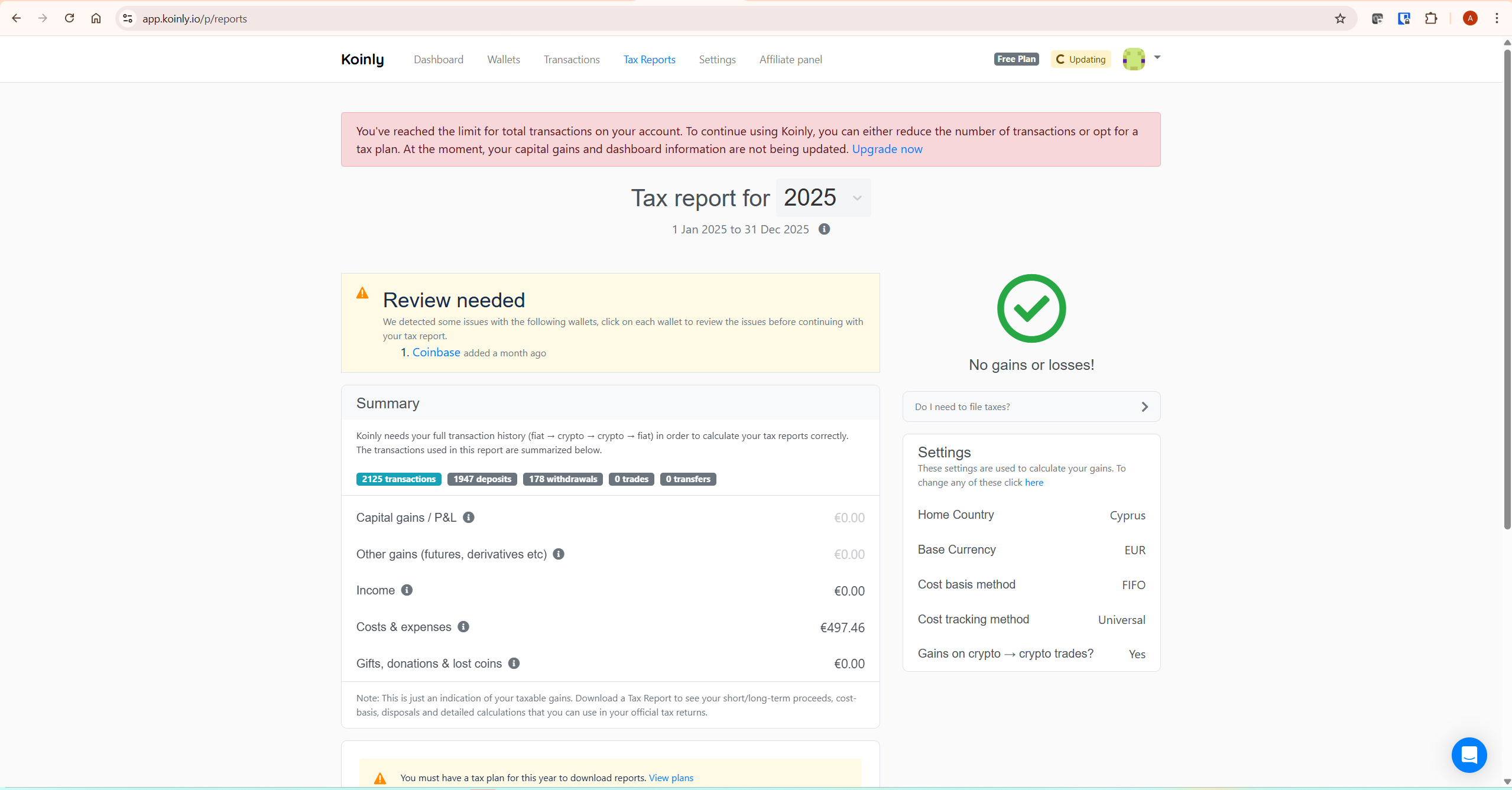
Say you traded on an EU-licensed exchange throughout 2026, then moved to a different platform mid-year without carrying your old wallet connection into Koinly. Your Koinly account only reflects the second exchange, missing the transactions from the first entirely. Under Koinly DAC8 CARF reporting, your first exchange still reports its own transaction data for the months you were active there — creating a gap between the transaction history in your Koinly account and the activity two separate providers have on record for you.
This kind of gap was always a filing risk. What’s changed is that standardized transaction reporting now gives tax authorities more information with which to identify and investigate inconsistencies like this one — not an automatic, guaranteed detection, but a materially easier one than before.
Check that every exchange you’ve used in 2026 is connected to Koinly.
Koinly DAC8 CARF Rules Outside the EU
DAC8 itself is EU-specific — it doesn’t apply if you’re not an EU tax resident. But CARF, the underlying framework, is being adopted separately by dozens of other countries on their own timelines, so “not in the EU” doesn’t mean “not affected.”
The UK adopted CARF through its own domestic regulations rather than through DAC8, with UK reporting providers required to file their first reports with HMRC between January 1 and May 31, 2027, covering 2026 activity. If you’re a UK taxpayer, my Koinly UK tax guide covers HMRC’s specific rules in full, and HMRC’s own CARF reporting guidance has the exact filing requirements for providers. If you’re an EU resident in a country like Germany, DAC8 applies to you directly — see my Koinly Germany tax guide for the country-specific filing details DAC8 doesn’t change.
For the DAC8 directive text itself, the European Commission’s official DAC8 page is the definitive source; for the underlying global standard, the OECD’s CARF page covers the framework DAC8 implements. DAC8’s relationship to MiCA is worth understanding too via ESMA’s MiCA guidance if you’re using an EU-licensed exchange.
One honest limitation: I can’t tell you exactly when your specific country’s first data exchange will happen, because implementation timelines are still being finalized in several jurisdictions and are subject to change. Treat the dates in the table above as best available estimates, not guarantees, and check your national tax authority’s site if the exact date matters for your situation.
What to Do Next
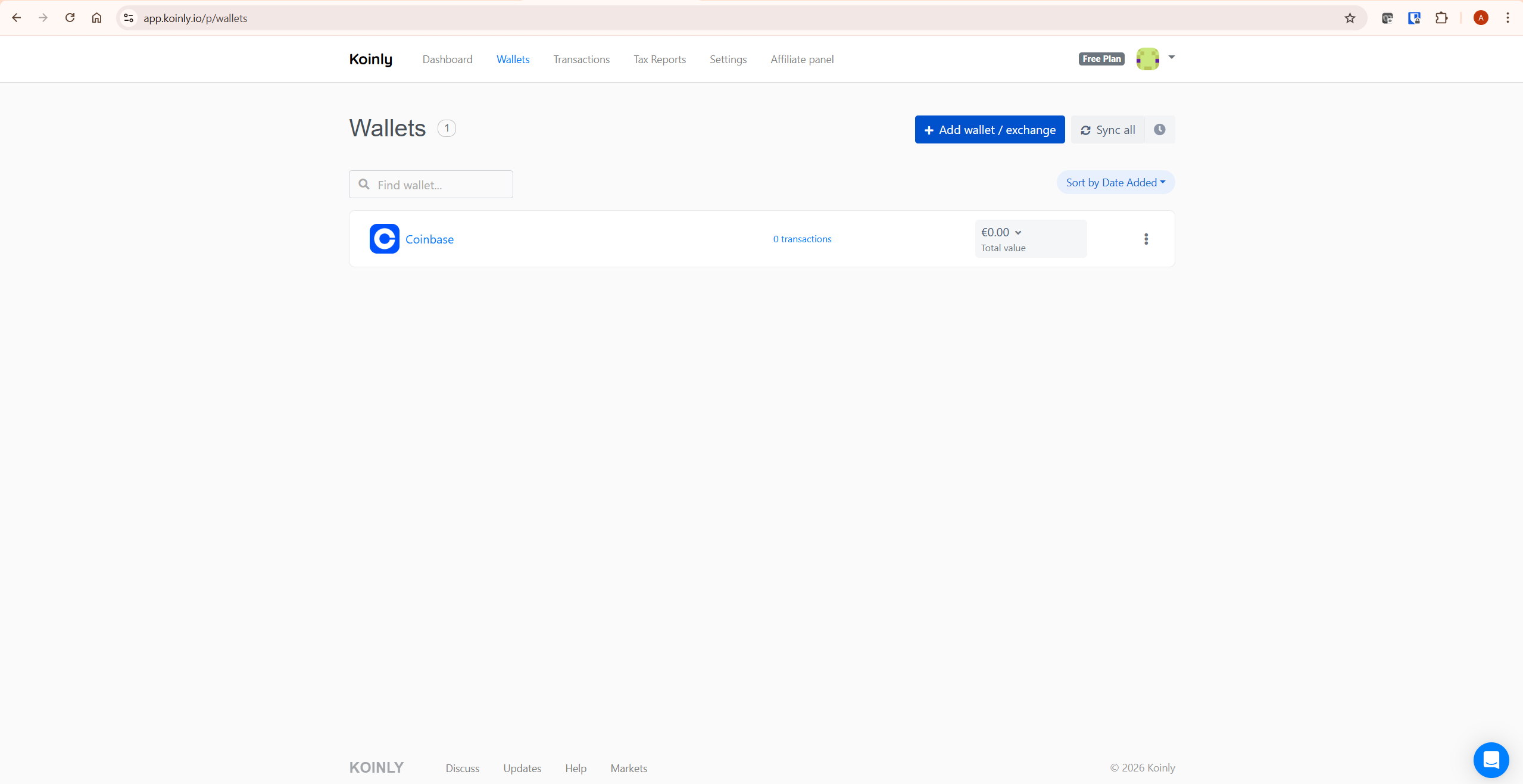
Open Koinly and go to your Wallets page — this is the fastest practical response to Koinly DAC8 CARF reporting. Confirm every exchange and wallet you’ve used in 2026 is still connected and syncing — not just the ones you actively trade on now.
Then check your tax summary against your exchange’s own transaction export for the same period, if your exchange provides one. This takes about 15 minutes and catches the majority of the Koinly DAC8 CARF mismatches that would otherwise surface for you later, at a less convenient time.
Frequently Asked Questions
Do I need to do anything in Koinly because of DAC8 or CARF?
Not specifically. There’s no DAC8 or CARF setting to configure. The only thing worth doing is confirming your Koinly account is complete and accurate, since the consequences of an inaccurate report are now higher.
Does DAC8 apply to me if I’m not in the EU?
DAC8 itself only applies to EU tax residents. However, if you’re outside the EU, your country may still have adopted the underlying CARF framework separately — the UK, Canada, Japan, and South Korea all have, on their own timelines.
Will my exchange tell me what data it’s reporting under DAC8?
Most exchanges are expected to notify users as part of their due diligence obligations, though the exact disclosure process varies by provider. Check your exchange’s own compliance or tax pages for specifics rather than assuming a uniform process across platforms.
Does DAC8 cover DeFi and self-custody wallets?
Pure self-custody activity without an intermediary may fall outside direct RCASP reporting at the wallet level. But transfers into or out of an exchange are still reportable by that exchange, so moving assets to a self-custody wallet doesn’t remove the transfer itself from the reporting trail — only activity that happens entirely off-platform after that point.
What happens if my Koinly numbers don’t match what my exchange reports?
Nothing happens automatically — but under Koinly DAC8 CARF rules, a mismatch is now something a tax authority can more easily identify and query. The safest approach is catching and fixing discrepancies yourself before filing, rather than after a mismatch prompts a question from your tax office.
Is the US part of DAC8 or CARF?
Not DAC8 — that’s EU-only. But the US has committed to CARF, with first exchanges targeted for 2028, while also running its own separate Form 1099-DA domestic broker regime in parallel. If you’re a US taxpayer, my Koinly Form 1099-DA guide covers the US-specific framework in detail.
Final Verdict
If I had to summarise Koinly DAC8 CARF compliance in one sentence: there’s nothing to configure, but there’s more reason than ever to make sure your Koinly account is complete. The frameworks don’t add a cent to what you owe, and they don’t require any action inside Koinly itself.
My honest caveat: “nothing to configure” doesn’t mean “nothing to check.” If your wallet connections have gaps or your records have drifted from reality over the past year, this is the year that gap becomes visible to someone other than you.
Make sure your Koinly records are complete before automatic reporting begins.
