
Koinly vs Blockpit: Honest Comparison (2026)
Affiliate Disclosure: This article contains affiliate links. If you sign up for Koinly through a link on this page, I may earn a commission at no extra cost to you. I only recommend tools I have researched and believe are worth your time.
Tax Disclaimer: This article is for informational purposes only and does not constitute professional tax or financial advice. Consult a qualified tax professional for advice specific to your situation.
Koinly is the better choice for most crypto investors in the Koinly vs Blockpit comparison — particularly for anyone outside the DACH region, anyone needing multiple cost basis methods, or anyone who wants all features included in a single plan without paying a separate monthly subscription. Blockpit has genuine strengths in the German, Austrian, and Swiss markets with country-specific tax compliance and a well-designed interface — but its fragmented pricing model and narrower integration coverage limit its appeal outside of Central Europe.
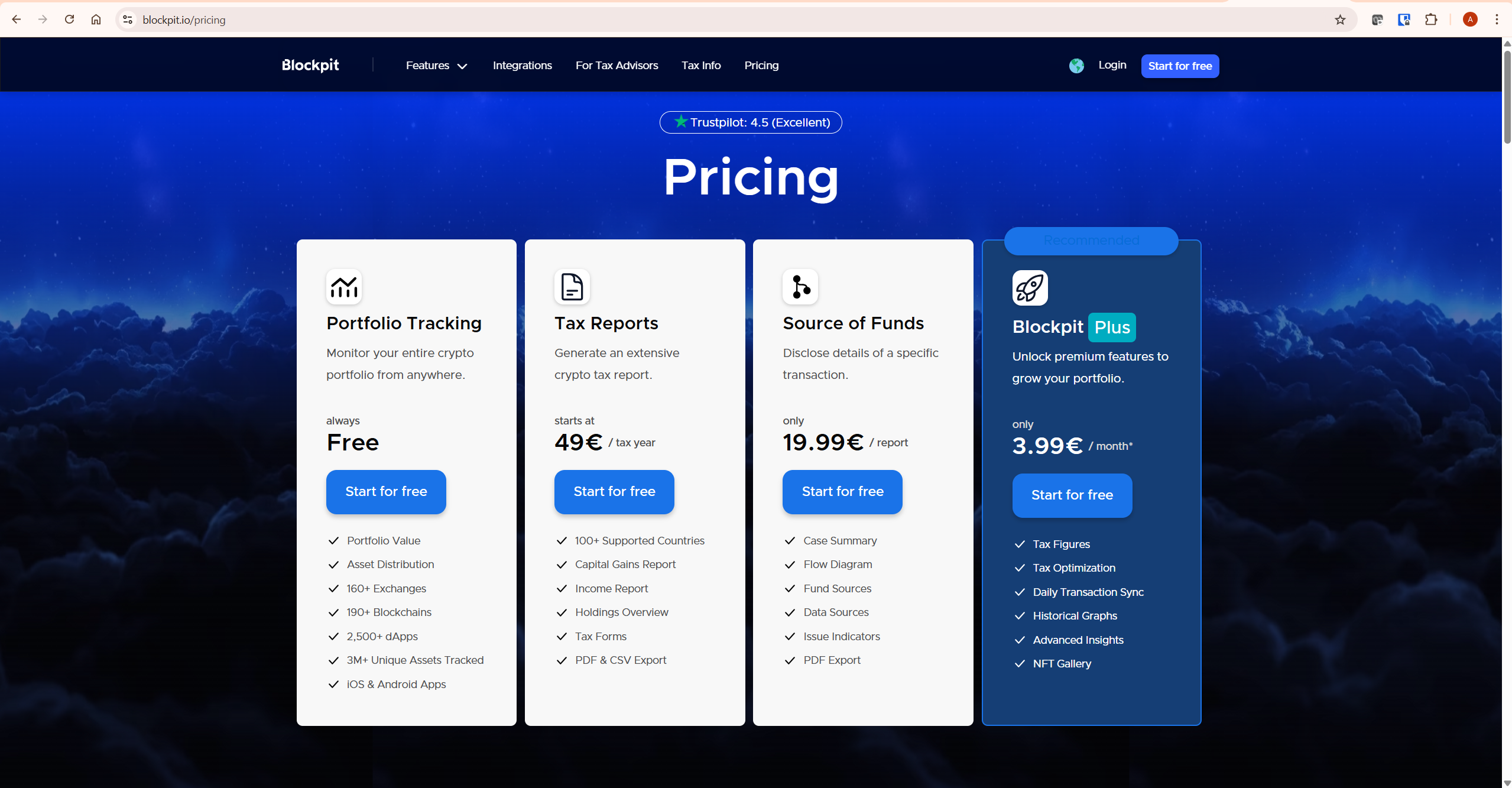
The pricing difference is the most important thing to understand upfront. Blockpit charges separately for tax reports (€49+ per tax year), Source of Funds reports (€19.99 per report), and advanced features like tax optimization and daily sync through a Blockpit Plus subscription at €3.99 per month. Koinly includes everything in a single per-tax-year plan with no additional subscriptions required. That structural difference shapes the entire Koinly vs Blockpit decision for most investors.
After thirty years in finance, I’ve evaluated a lot of software with opaque pricing structures. Blockpit’s model isn’t dishonest — but it requires careful calculation to understand your true annual cost, particularly if you need Source of Funds reports or want tax optimization features. This guide breaks down the Koinly vs Blockpit comparison clearly so you can make an informed decision.
If you want to test Koinly with your own data before deciding, the free plan requires no credit card: try Koinly free here.
Koinly vs Blockpit: Quick Comparison
Here is the head-to-head overview before the detailed analysis.
| Feature | Koinly | Blockpit |
|---|---|---|
| Entry price | $49 / tax year | €49 / tax year |
| Advanced features | Included in plan | €3.99/month extra (Blockpit Plus) |
| Source of Funds report | Included | €19.99 per report |
| Integrations | 1,000+ | 770+ |
| Countries supported | 100+ | 100+ |
| Cost basis methods | FIFO, LIFO, HIFO, Average Cost, Spec ID | Primarily FIFO |
| DeFi support | 8,000+ protocols automated | Good — some manual work |
| Mobile app | iOS and Android | iOS and Android |
| Trustpilot score | 4.6 / 5 (2,245 reviews) | 4.5 / 5 (900+ reviews) |
| Best for | Global investors, multi-method, DeFi | DACH region, compliance-focused |
Koinly vs Blockpit: Pricing — The Critical Difference
The Koinly vs Blockpit pricing comparison is where the decision becomes clearest, and where most comparison articles don’t give you the full picture.
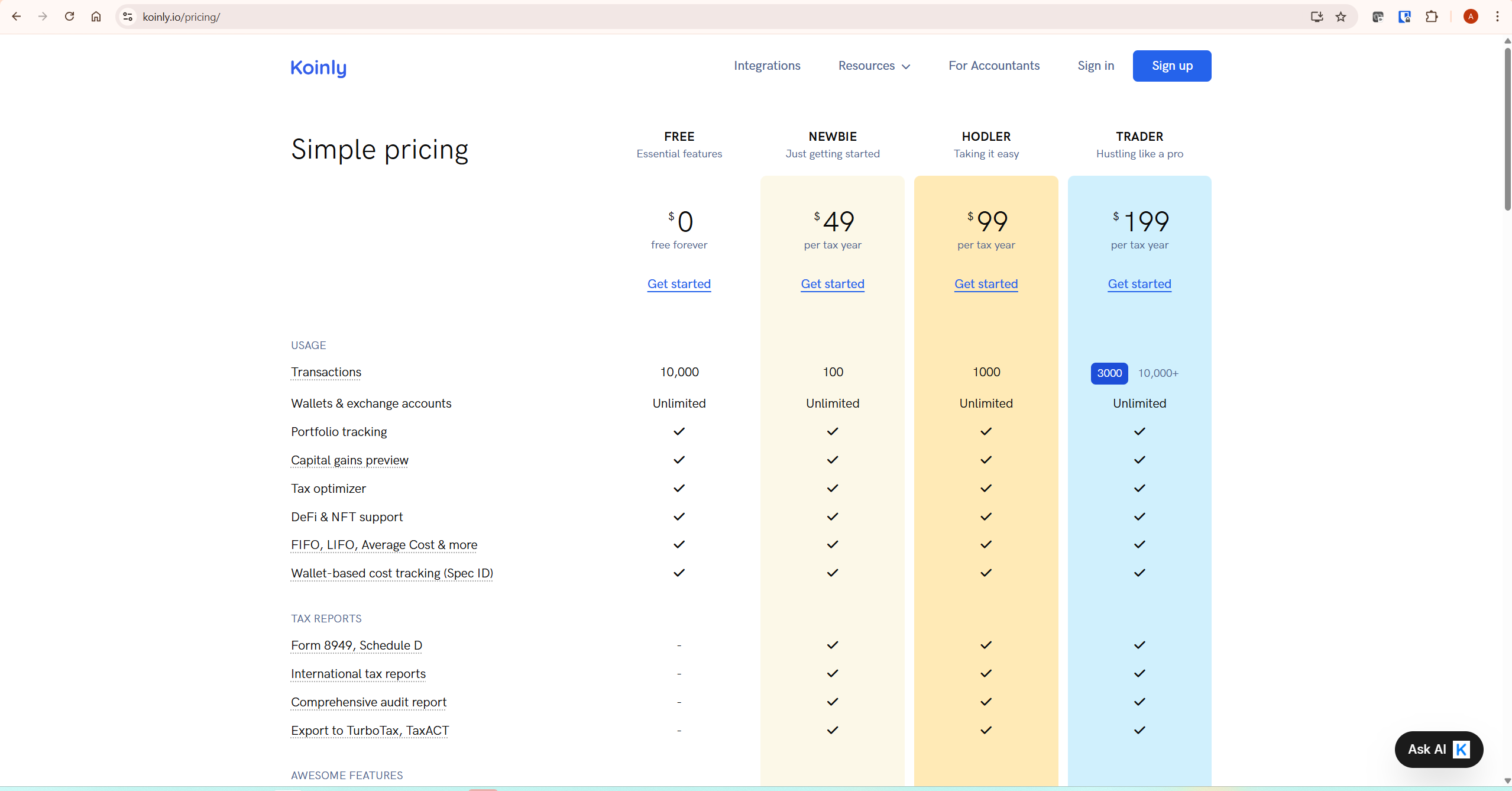
Koinly charges a single fee per tax year. Everything — portfolio tracking, tax optimization, DeFi support, multiple cost basis methods, and all report types — is included in that one payment. No monthly subscriptions, no per-report charges.
Blockpit’s pricing structure is layered:
- Portfolio Tracking: Free — but limited to basic portfolio view
- Tax Reports: From €49 per tax year — generates your crypto tax report
- Source of Funds: €19.99 per report — required for compliance in some jurisdictions
- Blockpit Plus: €3.99 per month — required for tax optimization, daily transaction sync, historical graphs, advanced insights, and NFT gallery
For an investor who wants a tax report plus tax optimization features and daily sync — a reasonable baseline for active investors — the true Blockpit annual cost is approximately €49 (tax report) + €47.88 (Blockpit Plus at €3.99 x 12) = €96.88 per year, before any Source of Funds reports. The comparable Koinly Hodler plan covering 1,000 transactions costs $99 with everything included.
At moderate transaction volumes the total costs are similar. At lower volumes the calculation shifts — an investor needing only 100 transactions who doesn’t want the Plus subscription pays €49 for Blockpit’s basic tax report versus $49 for Koinly’s Newbie plan. Both are comparable. But the moment you want tax optimization — which on Koinly is free — the Blockpit cost increases meaningfully.
Always verify current pricing on Koinly’s pricing page and Blockpit’s pricing page, as figures may be updated.
Koinly vs Blockpit: Integrations and Exchange Support
Koinly supports 1,000+ integrations across exchanges, wallets, and blockchains. Blockpit supports 770+ — a meaningful gap, particularly for investors using regional exchanges, emerging DeFi protocols, or less common Layer 2 networks.
The quality of CSV imports is where the Koinly vs Blockpit comparison shows a practical difference. Koinly’s auto-mapping feature intelligently processes CSV files from exchanges, reducing the manual formatting work required. Blockpit users have consistently reported difficulty with CSV imports — the platform requires more manual intervention when API connections aren’t available, which adds time and increases the risk of import errors.
For major exchanges with direct API support — Binance, Coinbase, Kraken, Bitpanda — both platforms work smoothly. The gap opens when you’re using platforms where CSV is the only import option. In that scenario, Koinly’s auto-mapping produces a noticeably faster and more reliable import experience.
One genuine Blockpit advantage on integrations: the platform has 190+ direct blockchain connections, which is strong for on-chain wallet tracking. Koinly’s blockchain coverage is also extensive but Blockpit’s DACH-region focus means it has particularly deep support for exchanges popular in the German-speaking market.
Koinly vs Blockpit: Cost Basis Methods
This is one of the clearest differentiators in the Koinly vs Blockpit comparison and one that directly affects how much tax you pay.
Koinly supports multiple cost basis accounting methods including FIFO (first in, first out), LIFO (last in, first out), HIFO (highest in, first out), Average Cost, and Spec ID (wallet-based cost tracking). You can change your method and compare results before filing — which lets you legally optimise your tax position by choosing the method that results in the lowest liability for your specific situation.
Blockpit primarily uses FIFO. Some country-specific settings allow limited variation, but this support is not available for the US, UK, or several European countries even where filing with a different cost basis is legally permitted. The practical consequence is that Blockpit users in those jurisdictions cannot use HIFO or Average Cost even when doing so would reduce their tax liability.
For investors who actively manage their tax position — using Specific Identification to choose which lots to sell, or comparing HIFO versus FIFO before deciding — Koinly’s flexibility is a genuine financial advantage, not just a feature checklist item.
Koinly vs Blockpit: DeFi Support
Koinly supports over 8,000 DeFi protocols with automated transaction categorisation — significantly more than Blockpit’s DeFi coverage. For investors active in yield farming, liquidity provision, cross-chain bridging, and automated DeFi strategies, Koinly’s automated handling reduces the manual reconciliation work substantially.
Blockpit handles DeFi on major protocols but requires more manual work for complex or newer protocols. Blockchain transaction data in particular requires more hands-on management in Blockpit — importing wallet addresses and categorising transaction types that Koinly handles automatically.
Both platforms handle standard staking, lending, and NFT transactions adequately. The gap is most pronounced at the complex end of DeFi — multi-step strategies, cross-chain activity, and newer protocol interactions — where Koinly’s automation saves meaningful time.
Koinly vs Blockpit: Tax Optimization
This is where the Koinly vs Blockpit pricing difference has the most direct financial impact.
Koinly’s tax optimizer — which identifies unrealised losses you can harvest to offset capital gains — is available on the free plan. No payment required to access this feature. For investors who use tax-loss harvesting as a year-round strategy, this represents genuine value at zero additional cost.
Blockpit’s tax optimization tools, including its Sales Simulator (which models the tax impact of selling a position before you execute the trade), are locked behind the Blockpit Plus subscription at €3.99 per month. Blockpit claims its optimizer saves users an average of $2,395 — which, if accurate, makes the Plus subscription cost-effective. But accessing those tools requires the additional monthly payment on top of the tax report cost.
Blockpit’s Sales Simulator is a genuinely useful feature — the ability to model the tax impact of a proposed sale before executing it is more sophisticated than Koinly’s current offering. If you’re an active trader who makes frequent sell decisions and wants precise pre-trade tax modelling, Blockpit Plus adds real value. For most investors who want basic tax-loss harvesting identification, Koinly’s free optimizer is sufficient.
For a full walkthrough of Koinly’s tax optimizer in practice, see our dedicated guide on tax-loss harvesting with Koinly.
Koinly vs Blockpit: European and International Coverage
Both platforms claim 100+ country support, but the depth of that coverage differs significantly by region.
Blockpit’s strength is the DACH region — Germany, Austria, and Switzerland. As an Austrian-founded platform that acquired Accointing in 2024, Blockpit has deep country-specific compliance for German-speaking markets. Its tax forms are pre-filled for these jurisdictions, the platform understands the one-year tax-free holding period rule in Germany, and it has specific integrations with Bitpanda — the dominant exchange in that market.
Outside the DACH region, Blockpit’s European coverage becomes thinner. For investors in Cyprus, the Mediterranean, Eastern Europe, or Nordic countries outside its core market, Blockpit often provides generic reports rather than jurisdiction-specific pre-filled forms. Koinly’s broader international engine produces dedicated reports for more countries — including specific treatment for jurisdictions like Cyprus where crypto tax rules are evolving under MiCA and EU regulatory frameworks.
Under DAC8 — the EU directive requiring crypto-asset service providers to report user transaction data to tax authorities from January 2026 — accurate jurisdiction-specific reporting is more important than ever for European investors. Both platforms support DAC8-affected markets, but the depth of country-specific compliance varies.
Koinly vs Blockpit: Free Plan Comparison
Both platforms offer free portfolio tracking, but Koinly’s free tier includes significantly more functionality.
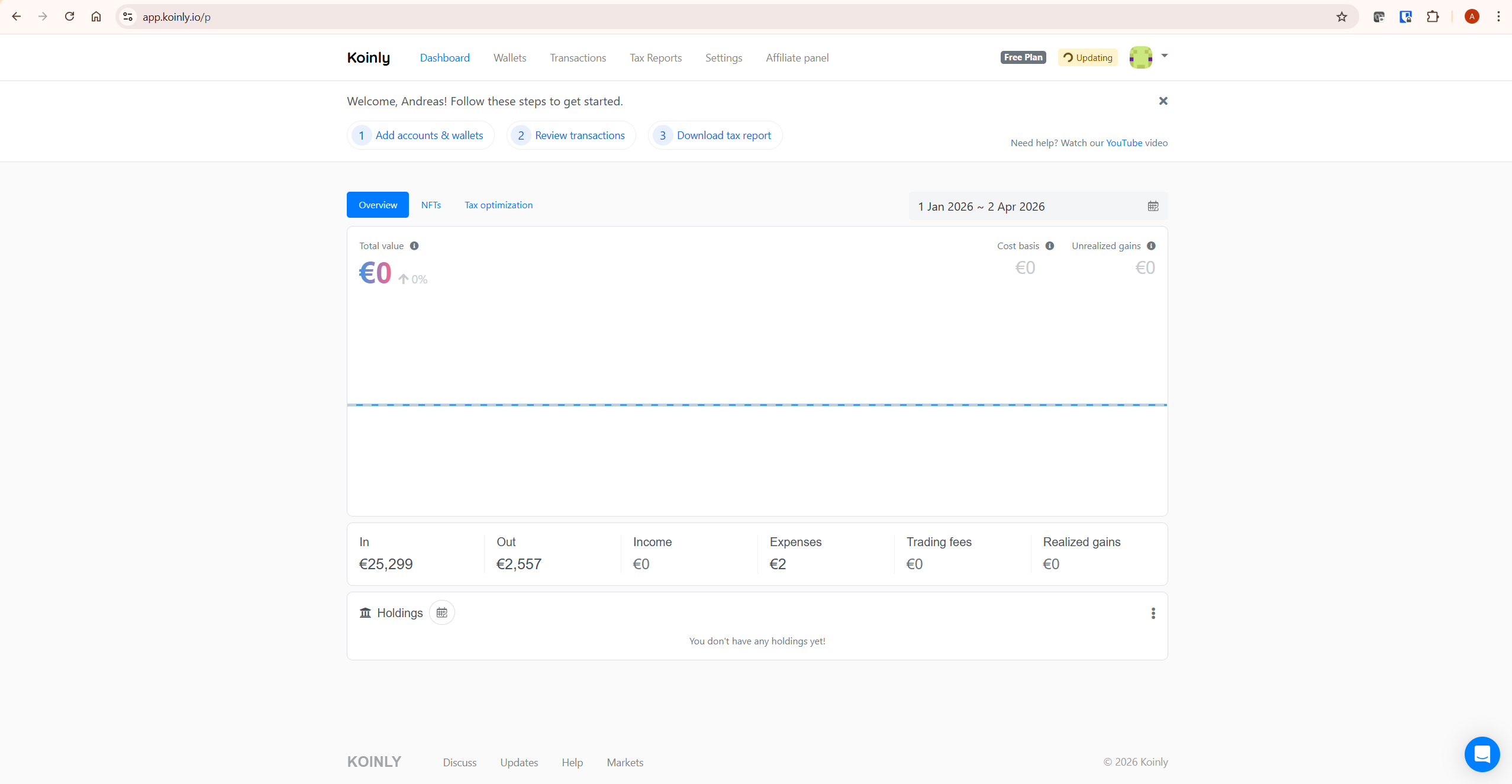
Koinly’s free plan gives you unlimited wallet and exchange connections, up to 10,000 transaction imports, full portfolio tracking, capital gains preview, tax optimizer, DeFi and NFT support, and all cost basis methods. The only restriction is that you cannot download official tax reports without upgrading.
Blockpit’s free plan covers portfolio tracking with basic features — portfolio value, asset distribution, exchange connections, and mobile app access. To see tax figures, capital gains summaries, or use the tax optimization tools, you need either the paid Tax Reports plan or the Blockpit Plus subscription. The free plan is genuinely more limited than Koinly’s in terms of tax-related visibility.
The practical consequence: before purchasing, Koinly lets you see your complete capital gains position and verify the platform handles your transactions correctly. Blockpit requires purchasing at least the basic plan before you can verify the accuracy of its tax calculations. This makes evaluating Blockpit before committing harder than evaluating Koinly.
For a full breakdown of everything Koinly’s free tier includes, see our Koinly free plan guide.
Koinly vs Blockpit: User Experience
Blockpit has a well-designed, modern interface. The platform is clean, the navigation is logical, and the mobile app — available free on iOS and Android — is a genuine strength. For investors who want to monitor their portfolio on the go, Blockpit’s mobile experience is polished.
Koinly’s interface is functional and comprehensive but has more complexity — a natural consequence of its broader feature set. New users sometimes find the volume of options overwhelming initially, though the platform has improved its onboarding experience significantly. Koinly also offers mobile apps for both iOS and Android.
Customer support is comparable on both platforms — email and chat support available, knowledge centres, and community forums. Blockpit adds webinars and an AI tax bot for support. Koinly’s support tier structure means email support is only available from the Trader plan ($199) upward, while Blockpit provides more consistent support access across all paid plans.
Koinly vs Blockpit: Which Is Right for Your Situation?
Choose Koinly If:
You want a single all-inclusive plan with no surprise add-ons. You need multiple cost basis methods — HIFO, LIFO, Average Cost, or Spec ID — to optimise your tax position. You have active DeFi exposure across multiple protocols. You’re filing outside the DACH region, particularly in countries where Blockpit’s compliance depth is thinner. You want to verify your tax position before spending anything, using Koinly’s free capital gains preview.
In the Koinly vs Blockpit comparison, Koinly is the stronger choice for international investors, DeFi users, multi-method tax optimisers, and anyone who values pricing transparency. For a full assessment of Koinly’s capabilities, see our complete Koinly review.
Choose Blockpit If:
You’re based in Germany, Austria, or Switzerland and want the deepest country-specific tax compliance available. You use Bitpanda as your primary exchange. You want the Sales Simulator for pre-trade tax modelling and are willing to pay the Blockpit Plus subscription for it. You trade frequently and want a well-designed mobile app as a central tool in your workflow.
In the Koinly vs Blockpit comparison for DACH-region investors, Blockpit’s country-specific compliance depth is a genuine differentiator. The question is whether that depth justifies the fragmented pricing model for your specific situation.
Frequently Asked Questions
Is Koinly better than Blockpit?
Koinly is better for most investors — particularly those outside Germany, Austria, and Switzerland, those needing multiple cost basis methods, those with active DeFi portfolios, and those who want all features included in a single plan. Blockpit is better for DACH-region investors who need deep country-specific compliance and are comfortable with the layered pricing model.
Which is cheaper — Koinly or Blockpit?
Entry pricing is similar — both start at approximately $49/€49 for basic tax reports. However, Blockpit’s true cost is higher for investors who want tax optimization features, as these require the Blockpit Plus subscription at €3.99 per month on top of the tax report cost. Koinly includes tax optimization in every plan at no extra charge. The Koinly vs Blockpit cost comparison depends entirely on which Blockpit features you need.
Does Blockpit support more countries than Koinly?
Both platforms claim 100+ country support. The difference is depth — Blockpit has particularly strong compliance for Germany, Austria, and Switzerland with pre-filled tax forms and deep local rule support. Outside the DACH region, Koinly’s country-specific report quality is generally stronger. For investors in most countries, Koinly produces more complete jurisdiction-specific reports.
Which platform is better for DeFi?
Koinly is significantly better for DeFi, supporting over 8,000 DeFi protocols with automated categorisation. Blockpit handles major DeFi protocols but requires more manual work for complex or newer protocols, particularly for blockchain transaction data and cross-chain activity.
Can I use HIFO or Average Cost with Blockpit?
Blockpit primarily uses FIFO and has limited support for other cost basis methods. Crucially, this limitation applies to the US, UK, and several European countries even where filing with HIFO or Average Cost is legally permitted. Koinly supports FIFO, LIFO, HIFO, Average Cost, and Spec ID — giving investors the flexibility to choose the method that minimises their tax liability legally.
What is Blockpit Plus and do I need it?
Blockpit Plus is a monthly subscription at €3.99/month that unlocks tax optimization tools, daily transaction sync, historical graphs, advanced insights, and NFT gallery features. Without it, Blockpit’s free and paid plans provide basic portfolio tracking and tax reports but lack active tax planning tools. Whether you need it depends on how actively you manage your tax position. On Koinly, equivalent features are included in every plan without an additional subscription.
Is Blockpit safe?
Yes. Blockpit is a legitimate, established platform founded in Austria in 2017. API connections are read-only. The platform holds security certifications and complies with GDPR. There are no reported data breaches. Koinly is similarly secure — for a full assessment of Koinly’s security posture, see our Koinly security review.
The Verdict: Koinly vs Blockpit
For most crypto investors, Koinly wins the Koinly vs Blockpit comparison on the criteria that matter most: pricing transparency, integration breadth, cost basis flexibility, DeFi automation, and the ability to verify your tax position before spending anything.
Blockpit earns genuine respect for its DACH-region compliance depth and its Sales Simulator for pre-trade tax modelling. If you’re based in Germany, Austria, or Switzerland and want the most country-specific compliance available in that market, Blockpit is worth the layered pricing. Outside the DACH region, that advantage largely disappears — and the fragmented pricing model becomes a disadvantage rather than a trade-off.
The Koinly vs Blockpit decision is straightforward for most investors: Koinly offers more for less, with a free tier that lets you verify everything before purchasing. Blockpit is a strong regional specialist that becomes harder to justify outside its home market.
Ready to see where you stand? Start with Koinly’s free plan here — import your wallets, preview your capital gains, and decide from a position of actual information.
Related reading:
- Koinly Review: Is It the Best Crypto Tax Software in 2026?
- Koinly vs CoinTracker: Which Is Better in 2026?
- Koinly vs CoinLedger: Honest Comparison (2026)
- Koinly Pricing: Plans, Limits & Which One You Actually Need
- Is Koinly Worth It in 2026? Honest Verdict
