
Koinly vs CoinLedger: Honest Comparison (2026)
Affiliate Disclosure: This article contains affiliate links. If you sign up for Koinly through a link on this page, I may earn a commission at no extra cost to you. I only recommend tools I have researched and believe are worth your time.
Tax Disclaimer: This article is for informational purposes only and does not constitute professional tax or financial advice. Consult a qualified tax professional for advice specific to your situation.
Koinly is the better choice for most active crypto investors — particularly anyone outside the US, anyone with DeFi activity, or anyone using more than a handful of exchanges. CoinLedger has a genuine edge in one specific area: beginner-friendly onboarding and US-focused filing for investors with straightforward portfolios. That’s the honest verdict on Koinly vs CoinLedger, and the rest of this article explains exactly why.
Both platforms launched in 2018, both use transaction-based pricing, and both offer a free tier that lets you preview your tax position before paying. The differences that matter are in integration breadth, international coverage, DeFi handling, and the user experience for first-time filers. After thirty years in finance evaluating software for complex financial workflows, the Koinly vs CoinLedger comparison is clear — but the right choice genuinely depends on your situation.
If you want to test Koinly with your own data before deciding, the free plan requires no credit card: try Koinly free here.
Koinly vs CoinLedger: Quick Comparison
Here is the head-to-head breakdown before the detailed analysis.
| Feature | Koinly | CoinLedger |
|---|---|---|
| Entry price | $49 / tax year | $49 / tax year |
| Transaction tiers | 100 / 1,000 / 3,000 / 10,000+ | 100 / 1,000 / 3,000+ |
| Integrations | 1,000+ | 700+ |
| Countries supported | 100+ | 10+ |
| DeFi support | Extensive — automated | Good — some manual work |
| Free plan | Yes — full feature access | Yes — unlimited tracking |
| Money back guarantee | No | 14 days |
| Trustpilot score | 4.6 / 5 (2,245 reviews) | 4.7 / 5 (1,200+ reviews) |
| Best for | International investors, DeFi, multi-exchange | US beginners, simple portfolios |
Koinly vs CoinLedger: Pricing Compared
Both platforms use identical entry-level pricing — $49 for 100 transactions — but the structures diverge at higher tiers. Understanding where each platform is more expensive matters for investors with larger transaction volumes.
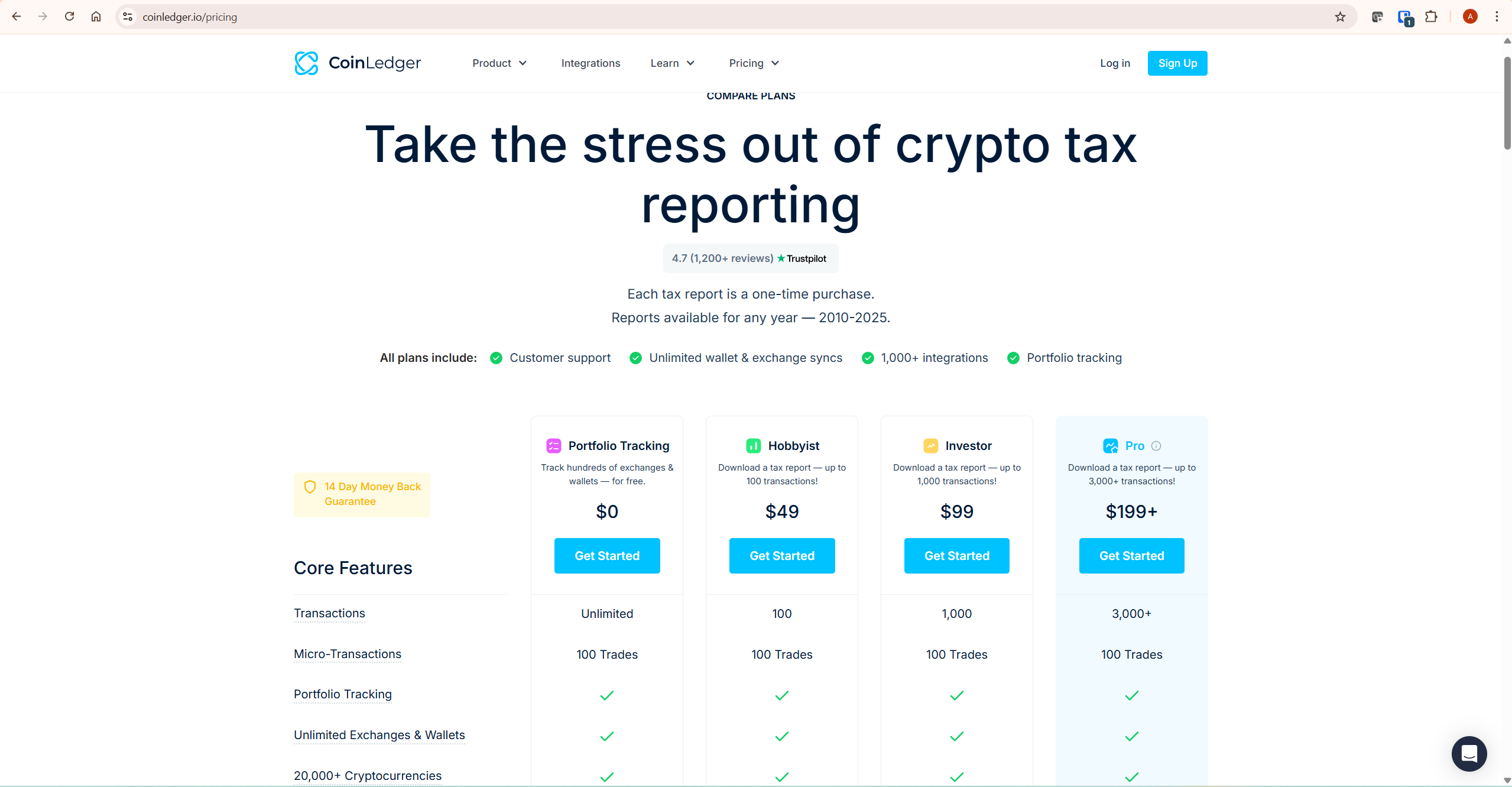
| Transactions | Koinly | CoinLedger | Cheaper Option |
|---|---|---|---|
| Up to 100 | $49 | $49 | Tied |
| Up to 1,000 | $99 | $99 | Tied |
| Up to 3,000 | $199 | $199+ | Tied |
| Up to 10,000 | $279 | Custom pricing | Koinly |
One meaningful difference: CoinLedger offers a 14-day money-back guarantee on paid plans. Koinly does not. For investors who are uncertain whether the platform handles their specific situation correctly, this reduces the financial risk of purchasing. Koinly’s free plan mitigates this — you can verify everything before paying — but the CoinLedger guarantee is a genuine advantage worth noting.
Always verify current pricing directly on Koinly’s pricing page and CoinLedger’s pricing page, as figures may be updated.
Koinly vs CoinLedger: Integrations and Exchange Support
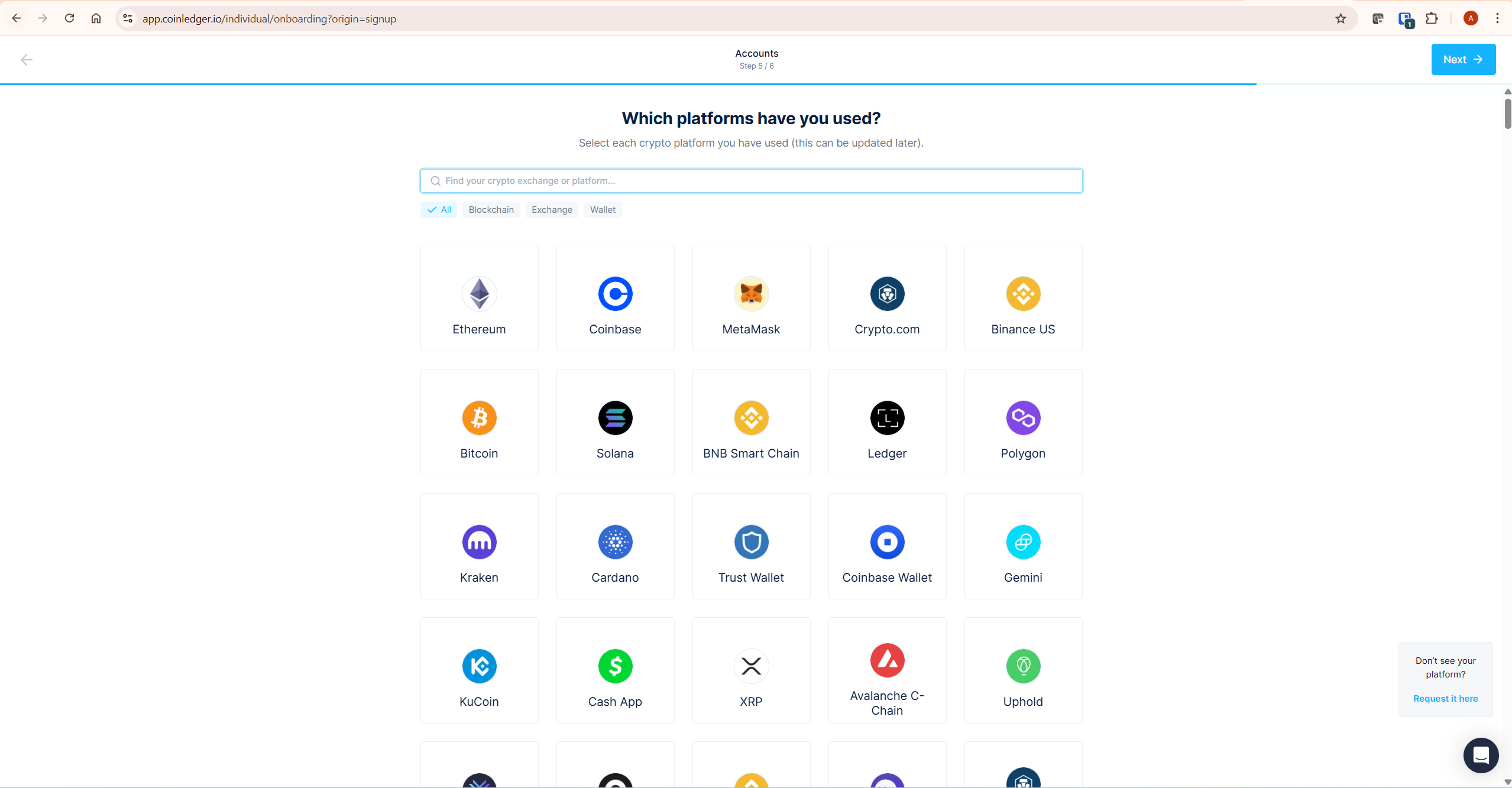
Koinly has a clear advantage on integration breadth. With 1,000+ supported exchanges, wallets, and blockchains versus CoinLedger’s 700+, Koinly covers more platforms — particularly for less common exchanges, regional platforms, and newer blockchain networks.
The more important distinction is the quality of those integrations. Koinly offers direct API connections for the majority of its supported platforms, which means automatic transaction syncing without manual file uploads. CoinLedger relies more heavily on CSV imports for some platforms, which requires more manual work on the investor’s side — downloading export files, formatting them correctly, and re-uploading when data changes.
For investors using mainstream exchanges like Coinbase, Binance, Kraken, and Gemini, both platforms handle imports well. The gap becomes apparent when you’re using regional exchanges, newer DeFi protocols, or less common Layer 2 networks — where Koinly’s broader API coverage produces a noticeably smoother experience.
Koinly vs CoinLedger: DeFi and Complex Transaction Support
This is where the Koinly vs CoinLedger comparison has its clearest winner. Koinly’s DeFi support is substantially more comprehensive than CoinLedger’s, and for active DeFi investors the difference is significant.
Koinly automatically handles futures, margin trading, yield farming, liquidity mining, staking, and lending across most supported protocols with minimal manual reconciliation needed. NFT transactions are automatically imported for EVM-based blockchains including Ethereum, Polygon, BSC, and Arbitrum.
CoinLedger handles DeFi activity on major protocols but struggles with more complex scenarios. Margin trading automatic import is limited to Kraken only — all other exchanges require manual CSV import. Futures and loan transactions are not automatically supported on most platforms. For complex DeFi activity spanning multiple chains, CoinLedger often requires significant manual categorisation work that Koinly handles automatically.
A practical example illustrates the difference well. An investor running a yield farming strategy across Ethereum and Polygon — providing liquidity, claiming rewards, and bridging assets between chains — generates dozens of transaction types per week. In the Koinly vs CoinLedger comparison for this investor, Koinly categorises the majority of these automatically. CoinLedger requires manual CSV uploads for most of the bridge and liquidity transactions, adding significant reconciliation work before a report can be generated accurately.
For straightforward spot trading on major centralised exchanges, this distinction doesn’t matter much. For anyone using DeFi protocols, yield farming, or complex derivatives, Koinly handles it significantly better.
Koinly vs CoinLedger: International Coverage
Koinly supports 100+ countries with jurisdiction-specific tax reports. This includes the US, UK, Australia, Canada, Germany, Norway, Denmark, Sweden, and dozens of other jurisdictions. CoinLedger supports approximately 10 countries — primarily the US, Canada, UK, Australia, Germany, Japan, Austria, Switzerland, Denmark, Spain, and France.
For investors based in the US, this distinction is irrelevant — both platforms generate IRS Form 8949, Schedule D, and TurboTax-compatible exports. For investors outside the US or filing in multiple jurisdictions, Koinly’s international coverage is a decisive advantage. CoinLedger simply does not produce compliant reports for the majority of countries Koinly supports.
Under CARF and DAC8 — the global crypto reporting frameworks active across 40+ countries since 2026 — accurate multi-jurisdictional reporting has become more important than ever. Koinly’s international reach aligns directly with this regulatory environment in a way CoinLedger does not match.
Koinly vs CoinLedger: User Experience and Interface
CoinLedger has a genuine edge here. The platform is designed with beginners in mind — the onboarding process is guided and intuitive, the dashboard is clean, and the workflow from import to report generation is straightforward for investors who don’t need complex features. Customer support via live chat and email is available on all plans and is consistently praised in user reviews for responsiveness.
Koinly’s interface is functional and well-organised but has a steeper learning curve for new users. The platform exposes more functionality — which is useful for experienced investors but can feel overwhelming for first-time crypto tax filers. Koinly’s support is available via help centre on lower tiers, with email support from the Trader plan upward.

For a beginner filing crypto taxes for the first time with a simple US-based portfolio, CoinLedger’s UX may feel less intimidating than Koinly’s. For experienced investors who want full control over their data and calculations, Koinly’s depth is an advantage rather than a drawback.
Koinly vs CoinLedger: Free Plan Comparison
Both platforms offer a free tier, but with meaningful differences in what’s accessible at no cost.
Koinly’s free plan includes unlimited wallet and exchange connections, up to 10,000 transaction imports, full portfolio tracking, capital gains preview, tax optimizer, DeFi and NFT support, and all cost basis accounting methods. The only restriction is that you cannot download official tax reports without a paid plan.
CoinLedger’s free plan includes unlimited transaction imports for portfolio tracking, capital gains and income summaries, and portfolio monitoring. Like Koinly, downloading official tax reports requires a paid plan.
Both free plans serve the same primary purpose — letting you verify the platform handles your data correctly before purchasing. Koinly’s free plan includes the tax optimizer tool which CoinLedger does not offer on the free tier, giving it a slight edge for investors who want to use year-round tax planning features without paying.
For a detailed breakdown of Koinly’s free tier, see our Koinly free plan guide.
Koinly vs CoinLedger: Security and Trust
Both platforms use read-only API connections — neither can execute trades, move funds, or access withdrawal functions. Both hold SOC 2 and ISO 27001 security certifications and comply with GDPR.
One historical incident warrants disclosure: in 2020, approximately 1,000 CoinLedger customers had their data compromised in a security breach. CoinLedger’s CEO publicly confirmed the incident. There have been no reported incidents since then, and the platform has made security investments in the intervening years. This does not make CoinLedger an unsafe choice today — but investors deserve to know about it when making their decision.
Koinly has no reported data breaches. Both platforms lack two-factor authentication, which is a shared limitation worth noting for a service that holds complete financial transaction histories.
Koinly vs CoinLedger: Which Is Right for Your Investor Profile?
The Koinly vs CoinLedger decision comes down to investor type more than any individual feature. Here is a clear framework by profile.
The US-Based Casual Investor
You bought Bitcoin and Ethereum on Coinbase, held most of it, and made fewer than 100 trades last year. You want a clean, simple experience and live chat support if something goes wrong. In the Koinly vs CoinLedger comparison for this profile, CoinLedger is the better fit. The guided onboarding, responsive support, and 14-day money-back guarantee reduce the friction of filing crypto taxes for the first time.
The Active Multi-Exchange Investor
You trade across three or more exchanges, hold assets in self-custody wallets, and have staking rewards and some DeFi activity. Your transaction count is in the hundreds to low thousands. For this profile, the Koinly vs CoinLedger comparison favours Koinly clearly. The broader API integrations, automated DeFi categorisation, and tax optimizer for year-round planning make Koinly the more capable tool for this level of activity.
The International Investor
You’re filing crypto taxes outside the US — whether in Cyprus, the UAE, Singapore, or any of the dozens of countries CoinLedger doesn’t support. The Koinly vs CoinLedger comparison here is straightforward: only Koinly produces a compliant report for your jurisdiction. CoinLedger isn’t a viable option.
The DeFi Power User
You’re active across multiple DeFi protocols — yield farming, liquidity pools, cross-chain bridging, lending, and borrowing. Your transaction count is high and the transaction types are complex. In the Koinly vs CoinLedger comparison for this profile, Koinly is the only realistic choice. CoinLedger’s limited automated DeFi support would require hours of manual work to reconcile what Koinly handles automatically.
Who Should Choose Koinly?
International Investors Outside the US
If you’re filing crypto taxes in any country other than the ten CoinLedger supports, Koinly is the only viable option between the two. Koinly’s 100+ country coverage includes jurisdiction-specific report formats for markets where CoinLedger simply doesn’t operate. For investors in Cyprus, the Middle East, Asia, Latin America, or across most of Europe outside CoinLedger’s supported markets, this is a straightforward decision.
Active DeFi Users
If you use DeFi protocols beyond basic staking on major platforms, Koinly handles the complexity significantly better. Yield farming, liquidity provision, cross-chain bridging, and automated strategies generate transaction types that CoinLedger often requires manual categorisation for. Koinly’s automated DeFi handling saves hours of manual work for active DeFi investors.
High-Volume Traders
Koinly’s Pro plan at $279 for 10,000+ transactions provides a clear pricing ceiling for high-volume traders. CoinLedger’s pricing above 3,000 transactions moves into custom territory, which can be more expensive depending on volume. For traders with very large transaction counts, Koinly’s pricing is more transparent and often more cost-effective.
Investors Using Niche or Regional Exchanges
Koinly’s broader integration library means it’s more likely to support the specific exchanges, wallets, and blockchains you use — particularly if you’re active on regional platforms, emerging Layer 2 networks, or newer DeFi protocols that CoinLedger hasn’t yet added to its supported list.
Who Should Choose CoinLedger?
US-Based Beginners With Simple Portfolios
If you’re based in the US, hold crypto on one or two major exchanges, and have straightforward spot trading activity with no DeFi exposure, CoinLedger’s beginner-friendly interface and excellent customer support make it a strong choice. The guided onboarding, clean dashboard, and responsive live chat support reduce the friction of filing crypto taxes for the first time.
Investors Who Want a Money-Back Guarantee
CoinLedger’s 14-day money-back guarantee on paid plans provides a safety net that Koinly doesn’t offer. For investors who aren’t sure whether the platform will handle their specific situation correctly and want the option to get a refund if it doesn’t, CoinLedger reduces the financial risk of the initial purchase.
Investors Who Prioritise Customer Support
CoinLedger offers live chat and email support on all paid plans — including the entry-level Hobbyist tier. Koinly’s email support only begins at the Trader plan ($199). For investors on the Newbie or Hodler plan who anticipate needing direct support to resolve import issues, CoinLedger’s support availability is a meaningful advantage.
Frequently Asked Questions
Is Koinly better than CoinLedger?
Koinly is better for most active crypto investors — particularly those outside the US, those with DeFi activity, or those using multiple exchanges across different blockchains. CoinLedger is better for US-based beginners with simple portfolios who value an intuitive interface and responsive live chat support. The Koinly vs CoinLedger decision depends on your specific situation.
Do Koinly and CoinLedger cost the same?
Entry-level pricing is identical — $49 for 100 transactions on both platforms. The pricing remains comparable across the main tiers up to 3,000 transactions. Koinly has a transparent Pro plan at $279 for 10,000+ transactions, while CoinLedger moves to custom pricing above 3,000 transactions. CoinLedger also offers a 14-day money-back guarantee which Koinly does not.
Which is better for DeFi — Koinly or CoinLedger?
Koinly is significantly better for DeFi. It automatically handles futures, margin trading, yield farming, liquidity mining, staking, and lending across most supported protocols. CoinLedger’s DeFi support requires more manual work — margin trading automatic import is limited to Kraken, and futures and loan transactions are not automatically supported on most platforms.
Which platform supports more countries?
Koinly supports 100+ countries with jurisdiction-specific reports. CoinLedger supports approximately 10 countries. For investors outside CoinLedger’s supported markets, Koinly is the only viable option in the Koinly vs CoinLedger comparison.
Does CoinLedger have a free plan?
Yes. CoinLedger’s free plan includes unlimited transaction imports for portfolio tracking and capital gains summaries. Downloading official tax reports requires a paid plan starting at $49. Koinly’s free plan similarly restricts report downloads to paid tiers but additionally includes a tax optimizer tool not available on CoinLedger’s free tier.
Is CoinLedger safe to use?
Yes — CoinLedger is a legitimate platform with SOC 2 and ISO 27001 certifications. API connections are read-only. One historical incident worth noting: approximately 1,000 customer records were compromised in a 2020 security breach, publicly confirmed by the company’s CEO. There have been no reported incidents since. For a full assessment of Koinly’s security, see our Koinly security review.
Can I switch from CoinLedger to Koinly?
Yes. Both platforms import transaction data directly from exchanges and wallets via API or CSV. If you’ve been using CoinLedger and want to switch to Koinly, simply connect your wallets and exchanges to Koinly and let it reimport your history. You don’t need to export anything from CoinLedger — Koinly pulls the data from source.
The Verdict: Koinly vs CoinLedger
For most active crypto investors, Koinly is the stronger platform. Its integration breadth, international coverage, DeFi support, and transparent pricing at high transaction volumes make it the more capable tool across the majority of use cases. The free plan’s tax optimizer and capital gains preview give it additional value for year-round tax planning that CoinLedger’s free tier doesn’t match.
CoinLedger earns its place as a genuine alternative for a specific type of investor: US-based, using mainstream centralised exchanges, with no DeFi exposure, and who values a guided beginner experience with responsive customer support from day one. If that describes you, CoinLedger’s 14-day money-back guarantee makes it a lower-risk first purchase.
For everyone else — international investors, DeFi users, multi-exchange investors, and anyone filing outside the US — Koinly wins the Koinly vs CoinLedger comparison clearly.
Ready to test Koinly with your own data? Start with the free plan here — import your wallets, check your transaction count, and verify the platform works for your situation before spending anything.
If you’re also comparing Koinly against CryptoTaxCalculator (now rebranded as Summ), see our Koinly vs CryptoTaxCalculator honest comparison.Related reading:
- Koinly Review: Is It the Best Crypto Tax Software in 2026?
- Koinly vs CoinTracker: Which Is Better in 2026?
- Koinly Pricing: Plans, Limits & Which One You Actually Need
- Is Koinly Worth It in 2026? Honest Verdict
- Koinly Free Plan: What Can You Actually Do Without Paying?
