
Koinly vs CryptoTaxCalculator: Best Honest Comparison (2026)
Affiliate Disclosure: This article contains affiliate links. If you sign up for Koinly through a link on this page, I may earn a commission at no extra cost to you. I only recommend tools I have researched and believe are worth your time.
Tax Disclaimer: This article is for informational purposes only and does not constitute professional tax or financial advice. Tax laws vary by country and change frequently. Consult a qualified tax professional for advice specific to your situation.
In most cases, Koinly is the better choice in the Koinly vs CryptoTaxCalculator comparison — broader international coverage, a more generous free plan, and significantly lower pricing at mid and high transaction volumes. CryptoTaxCalculator — now rebranded as Summ since October 2025 — has one genuine area of superiority: its smart contract analysis engine for complex DeFi portfolios is more powerful than Koinly’s. For the majority of crypto investors, that advantage doesn’t apply. For serious DeFi power users, it matters significantly.
There is also one structural difference in how these platforms price their plans that most comparison articles miss entirely. Summ’s transaction limits are cumulative across all tax years — not reset annually. Koinly resets its transaction limits at the start of each new tax year. For investors with a few hundred transactions per year, this distinction is irrelevant. For anyone with a growing transaction history, the long-term cost implications of Summ’s cumulative model are meaningful.
I am Andreas Maratheftis — thirty years in professional finance — and the investors I see make the wrong platform choice in this comparison are those who choose Summ for its DeFi reputation without checking whether their actual portfolio needs that level of complexity. This guide covers the complete Koinly vs CryptoTaxCalculator comparison with verified pricing, verified features, and an honest verdict for each investor profile.
If you want to test Koinly with your own data before deciding, the free plan requires no credit card: try Koinly free here.
Koinly vs CryptoTaxCalculator: Quick Comparison
Here is the head-to-head overview before the detailed analysis.
| Feature | Koinly | Summ (CryptoTaxCalculator) |
|---|---|---|
| Entry price | $49 / tax year | $49 / tax year |
| Transaction limit model | Resets each tax year | Cumulative across all years |
| Mid-tier pricing | $99 / 1,000 tx | $99 / 1,000 tx |
| Active trader tier | $199 / 3,000 tx | $249 / 10,000 tx |
| High volume tier | $279 / 10,000+ tx | $499 / 100,000 tx |
| Free plan | Full features — tax optimizer included | Portfolio tracking only — limited features |
| Tax loss harvesting | Free plan — all users | Investor plan ($249) and above only |
| Smart contract / DeFi | Strong — 7,000+ protocols automated | Widely regarded as one of the strongest smart contract engines available |
| Integrations | 1,000+ | 3,500+ (majority are DeFi protocols) |
| Countries supported | 100+ | 180+ |
| Security certifications | SOC 2, ISO 27001 — no breaches | SOC 2 Type 2, ISO 27001 — prior breach |
| Trustpilot score | 4.6 / 5 (2,000+ reviews) | 4.6 / 5 (700+ reviews) |
| Best for | International investors, self-filers, most portfolios | Complex DeFi portfolios, high-volume traders |
Koinly vs CryptoTaxCalculator: The Rebrand You Need to Know About
CryptoTaxCalculator officially rebranded to Summ in October 2025. The platform’s core product, mission, and team remain the same — the name change reflects a broader positioning shift as the company expands beyond pure tax calculation. If you are searching for “Koinly vs CryptoTaxCalculator,” you are looking at the same product now called Summ. Throughout this article, both names are used interchangeably.
The rebrand is recent enough that many comparison articles and review sites still use the old name — which means most search results for this comparison are working from outdated information. This article uses current verified pricing and features from both platforms’ official pages.
Koinly vs CryptoTaxCalculator: Pricing — The Critical Structural Difference
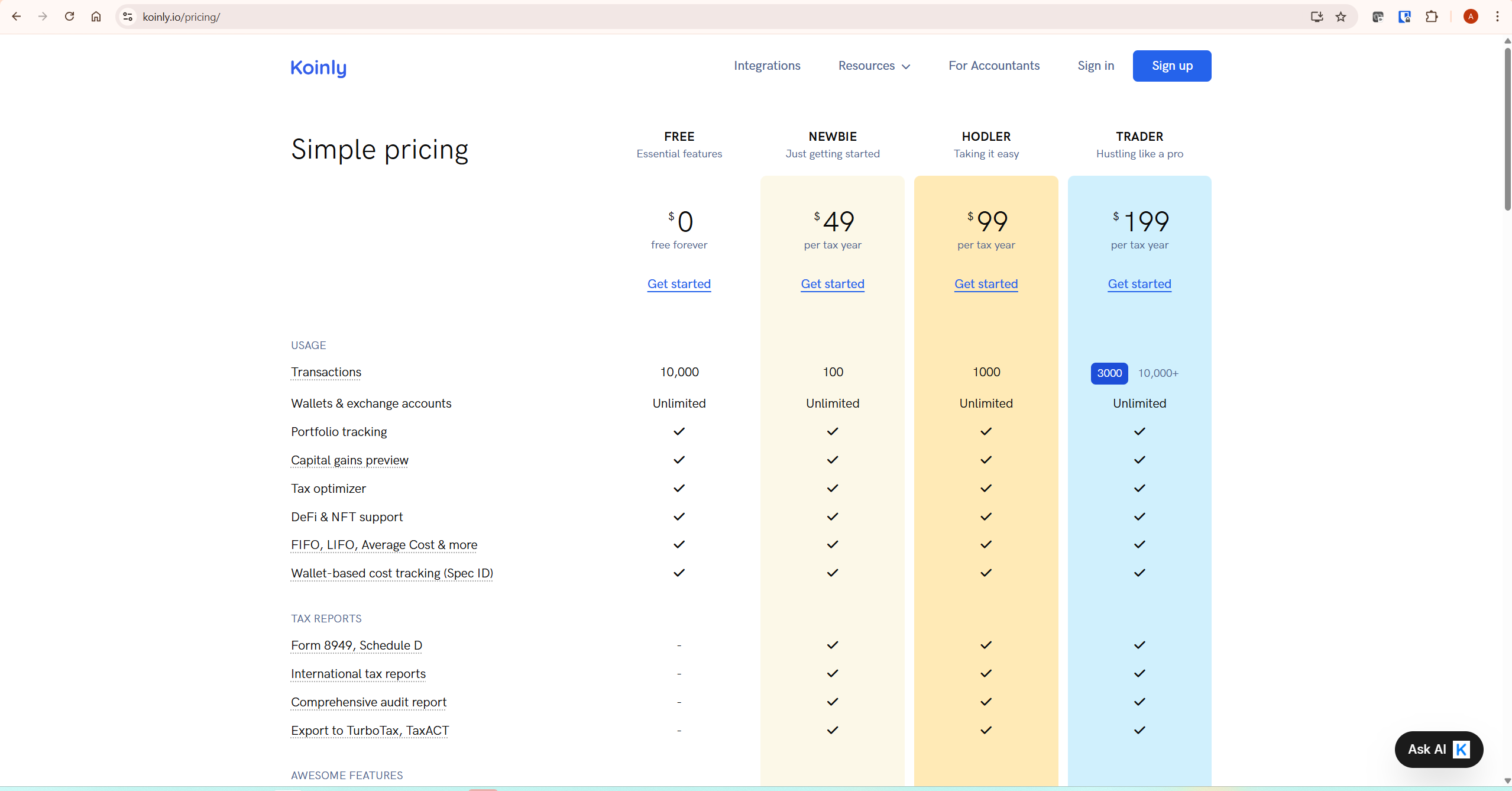
The headline pricing looks nearly identical at entry level — both platforms charge $49 for 100 transactions. The real difference is in the structure, not just the numbers.

| Plan | Koinly | Summ (CryptoTaxCalculator) | Better Value |
|---|---|---|---|
| Entry | $49 / 100 tx (per year) | $49 / 100 tx (cumulative) | Koinly — resets annually |
| Mid-tier | $99 / 1,000 tx (per year) | $99 / 1,000 tx (cumulative) | Koinly — resets annually |
| Active trader | $199 / 3,000 tx (per year) | $249 / 10,000 tx (cumulative) | Depends on volume |
| High volume | $279 / 10,000+ tx (per year) | $499 / 100,000 tx (cumulative) | Koinly — cheaper and resets |
The cumulative model is Summ’s most important pricing distinction. If you made 80 transactions in 2023, 70 in 2024, and 60 in 2025, Koinly charges you $49 per year for each of those years — three separate $49 payments. Summ counts all 210 transactions cumulatively, pushing you to the Hobbyist plan at $99. For investors with growing transaction histories, this makes Summ progressively more expensive over time relative to Koinly.
The one scenario where Summ’s pricing is genuinely better: very high transaction volumes in a single tax year. At $249 for 10,000 cumulative transactions, Summ covers far more volume than Koinly’s $199 plan (3,000 per year). For an investor with 8,000 transactions in one tax year, Summ is significantly cheaper at that tier.
Always verify current pricing on Koinly’s pricing page and Summ’s pricing page, as figures may be updated.
Koinly vs CryptoTaxCalculator: Free Plan Comparison
This is one of the clearest differentiators in the Koinly vs CryptoTaxCalculator comparison and one that directly affects how much risk you take when evaluating either platform.
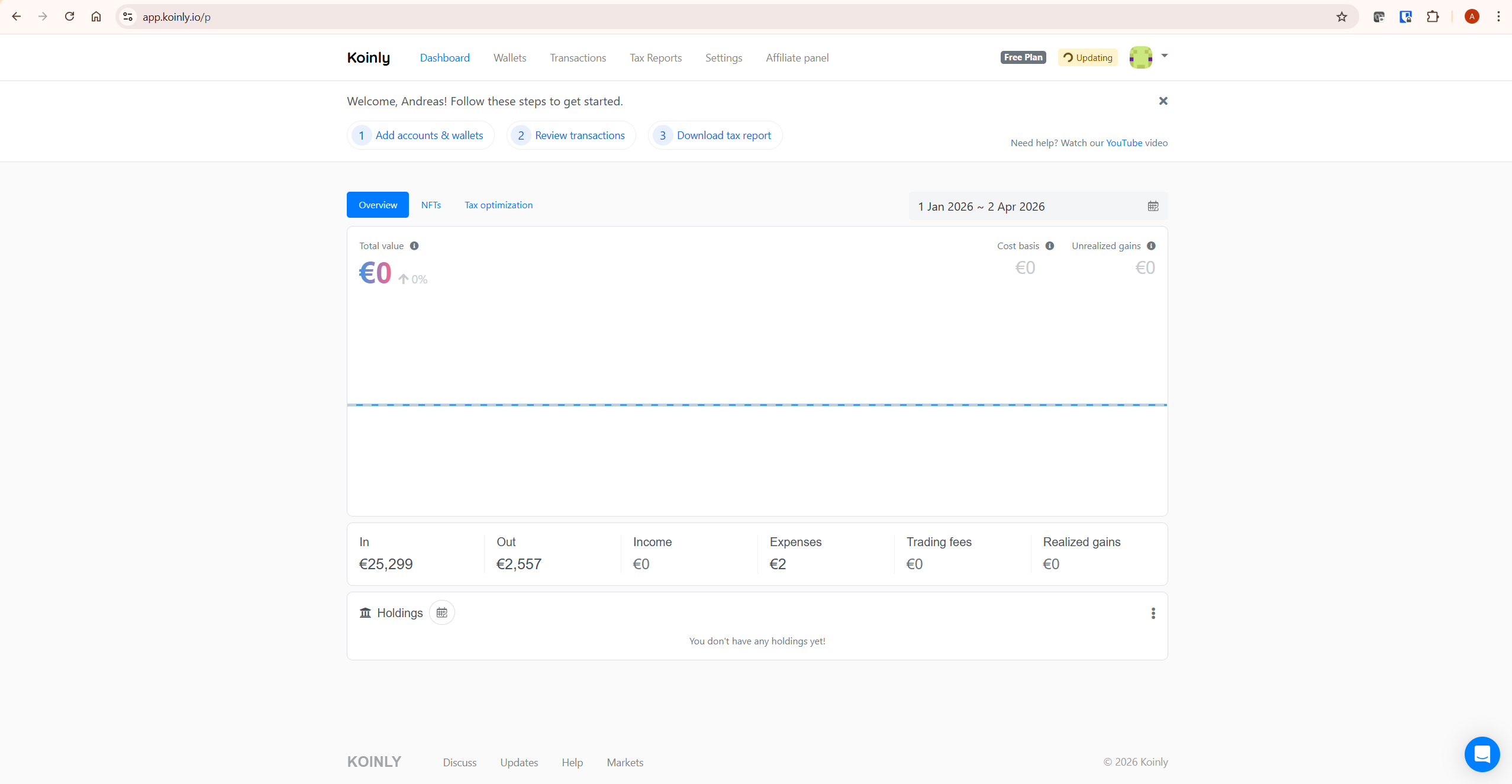
Koinly’s free plan includes unlimited wallet and exchange connections, up to 10,000 transaction imports, full portfolio tracking, capital gains preview, tax optimizer, DeFi and NFT support, and all cost basis methods. You can verify the platform handles your complete situation correctly before spending anything.
Summ’s free plan includes portfolio tracking, transaction imports, smart contract support, and a tax liability preview. However, tax reports, the tax loss harvesting tool, and advanced features require a paid plan. The free plan is more limited than Koinly’s in terms of what you can verify before purchasing.
For investors evaluating both platforms, the practical advice is to start with Koinly’s free plan. Import your data, verify the calculations, check your transaction count. If Koinly handles everything correctly, the decision is straightforward. For a full breakdown of Koinly’s free tier, see our Koinly free plan guide.
Koinly vs CryptoTaxCalculator: DeFi and Smart Contract Support
This is the one category where Summ (CryptoTaxCalculator) has a clear and acknowledged advantage. Summ’s smart contract analysis engine is widely regarded as one of the strongest available for complex on-chain activity — it automatically categorises multi-step DeFi interactions including liquidity provision, yield farming, cross-chain bridging, complex NFT minting, gas fee accounting on failed transactions, and automated strategies across hundreds of protocols.
Koinly supports over 7,000 DeFi protocols with strong automated categorisation and handles the vast majority of DeFi activity well. For most investors with DeFi exposure — standard staking, swapping on major DEXs, basic liquidity provision — Koinly’s automation is entirely sufficient. The gap appears at the complex end: multi-step strategies, unusual protocol interactions, and high-volume on-chain activity where Summ’s deeper smart contract parsing produces more accurate automatic categorisation with less manual reconciliation.
One important caveat: Summ’s smart contract support requires the Hobbyist plan ($99) or higher. On the Rookie plan ($49), smart contract and on-chain transaction support is not included. Koinly includes DeFi support from the free plan with no upgrade required.
Koinly vs CryptoTaxCalculator: Integrations
Summ claims 3,500+ integrations versus Koinly’s 1,000+. This headline number requires context. The majority of Summ’s 3,500 integrations are DeFi protocols — individual smart contracts and protocol-level connections that are already covered by standard blockchain integrations on other platforms. In practice, both platforms cover all major centralised exchanges, hardware wallets, and mainstream DeFi protocols. The meaningful integration difference is at the fringes — newer protocols, regional exchanges, and emerging Layer 2 networks — where both platforms have gaps but Koinly’s broader API coverage handles more mainstream platforms via automatic sync rather than CSV.
Koinly vs CryptoTaxCalculator: International Coverage
Summ claims 180+ country support versus Koinly’s 100+. Both cover all major markets — US, UK, Australia, Canada, Germany, and dozens of others. The depth of jurisdiction-specific reporting is where the comparison is more nuanced. Koinly has particularly strong dedicated report formats for its supported countries — including HMRC Capital Gains Summary for the UK, ATO myTax report for Australia, and ELSTER-compatible reports for Germany. Summ’s international coverage is broad but its depth in non-English-speaking European markets is less consistent.
For investors in the US, UK, Australia, or Canada — the four markets both platforms cover most deeply — the international coverage difference is minimal. For investors in less common jurisdictions, verify directly on each platform’s supported countries page before purchasing.
Koinly vs CryptoTaxCalculator: Security and Trust
Both platforms use read-only API connections — neither can execute trades, move funds, or access withdrawal functions. Both hold SOC 2 and ISO 27001 certifications and comply with GDPR.
One historical incident warrants disclosure: Summ (then CryptoTaxCalculator) suffered a data breach caused by unauthorised third-party access. Summ disclosed the incident on its official blog — the breach exposed user IDs, email addresses, password hashes, public blockchain wallet addresses, and exchange names. Summ confirmed on its official blog that no funds were accessible — API connections are read-only — and that no further illegal activity was detected after the incident. The platform has since reinforced its security systems and achieved SOC 2 Type 2 certification, which involves ongoing independent auditing rather than a one-time assessment.
Koinly has no reported data breaches. For a full assessment of Koinly’s security posture, see our Koinly security review.
Koinly vs CryptoTaxCalculator: Who Should Choose Each Platform
Choose Koinly If:
You want to verify your tax position before spending anything — Koinly’s free plan with full capital gains preview and tax optimizer is genuinely more useful than Summ’s. Your transaction count is moderate — under a few thousand per year — and Koinly’s per-year reset structure makes it cheaper over time. You are filing outside the US with jurisdiction-specific reports needed for the UK, Australia, Germany, or similar markets. You want tax loss harvesting without paying $249 — Koinly includes it free. You prefer a cleaner, more established interface with a larger user base and review history.
In the Koinly vs CryptoTaxCalculator comparison for most investors, Koinly is the stronger default choice. For a full picture of what Koinly offers, see our complete Koinly review.
Choose Summ (CryptoTaxCalculator) If:
Your portfolio is genuinely complex — multi-protocol DeFi strategies, yield farming across multiple chains, high-frequency on-chain activity — and you need a particularly strong smart contract analysis engine. You have very high transaction volumes in a single year where Summ’s cumulative tier pricing is cheaper than Koinly’s per-year equivalent. You use Coinbase or MetaMask as primary platforms — Summ has worked with both as tax integration partners, meaning those integrations are particularly smooth. Verify current partnership status on Summ’s site before this influences your decision.
Frequently Asked Questions
Is Koinly better than CryptoTaxCalculator?
Koinly is better for most investors — it has a more useful free plan, lower pricing for moderate transaction volumes, a per-year reset structure that saves money over time, and stronger dedicated reports for international jurisdictions. CryptoTaxCalculator (now Summ) is better for investors with genuinely complex DeFi portfolios who need the most advanced smart contract analysis available, and for very high-volume traders where Summ’s $249 tier covering 10,000 cumulative transactions is cheaper than the Koinly equivalent.
What is the difference between CryptoTaxCalculator and Summ?
They are the same product. CryptoTaxCalculator rebranded to Summ in October 2025. The platform’s core features, team, and mission remain the same — the name change reflects a broader company positioning shift. All current pricing, features, and integrations under the Summ name apply directly to what was previously called CryptoTaxCalculator.
How does Summ’s transaction limit model differ from Koinly’s?
Summ’s transaction limits are cumulative across all tax years — your total lifetime transaction count across every year you use the platform determines your plan tier. Koinly resets its transaction limits at the start of each new tax year. For investors with a consistent moderate transaction volume, Koinly’s per-year reset structure is more cost-effective over time. For investors with a very high volume in a single year, Summ’s cumulative tiers may be cheaper at that specific volume point.
Which is better for DeFi — Koinly or CryptoTaxCalculator?
For complex DeFi portfolios, Summ (CryptoTaxCalculator) has the strongest smart contract analysis engine on the market. It automatically categorises multi-step DeFi interactions with greater precision than Koinly for edge cases involving unusual protocols, failed transactions, and high-frequency on-chain activity. For most investors with standard DeFi exposure — staking, swapping on major DEXs, basic liquidity provision — Koinly’s DeFi support is entirely sufficient and available from the free plan without upgrade.
Does Koinly or CryptoTaxCalculator have a better free plan?
Koinly’s free plan is significantly more useful. It includes full capital gains preview, tax optimizer, DeFi support, and all cost basis methods — letting you verify the platform works for your situation before spending anything. Summ’s free plan covers portfolio tracking and transaction imports but restricts tax reports and the tax loss harvesting tool to paid plans. For investors evaluating both, starting with Koinly’s free plan is the lower-risk approach.
Is CryptoTaxCalculator (Summ) safe after the data breach?
Summ confirmed a historical data breach on its official blog — user IDs, email addresses, password hashes, public wallet addresses, and exchange names were exposed through unauthorised third-party access. No funds were accessible as API connections are read-only. Summ has since reinforced its systems, achieved SOC 2 Type 2 certification with ongoing independent auditing, and no further incidents have been reported. Both platforms use read-only connections and neither can access or move your funds.
Can I switch from CryptoTaxCalculator to Koinly?
Yes. Connect your original exchange and wallet sources directly to Koinly — it reimports from source rather than requiring data migration from your previous platform. Alternatively, export your transaction history from Summ and import via CSV. See our Koinly setup guide for the full import workflow.
Koinly vs CryptoTaxCalculator: Which One Is Better For Most Investors?
For most investors, Koinly is the better choice. It offers a more useful free plan, annual transaction-limit resets that save money over time, lower long-term costs for moderate portfolios, and strong dedicated international tax reporting. Summ is the better choice for a specific minority — investors with genuinely complex DeFi portfolios who need the most advanced smart contract analysis available.
Here is a quick scenario-based decision framework:
| Your Situation | Better Choice | Reason |
|---|---|---|
| Mostly centralised exchanges, under 3,000 tx/year | Koinly | Cheaper per year, better free plan |
| Long-term holder with few trades | Koinly | Per-year reset, tax optimizer free |
| UK, Australian, or German taxpayer | Koinly | Deeper jurisdiction-specific reports |
| NFT collector on major chains | Either | Both handle standard NFT activity well |
| Active yield farmer across multiple chains | Summ | Stronger smart contract analysis |
| Multi-chain DeFi power user | Summ | Most advanced on-chain categorisation |
| Very high volume — 8,000+ tx in one year | Summ | $249 covers 10,000 cumulative vs Koinly $279 |
The Verdict: Koinly vs CryptoTaxCalculator
For most crypto investors, Koinly wins the Koinly vs CryptoTaxCalculator comparison. The more useful free plan, the per-year transaction reset structure, the lower pricing at moderate volumes, the tax optimizer available at no cost, and the stronger dedicated international reports make Koinly the better default choice for the majority of use cases.
Summ (CryptoTaxCalculator) earns its place for a specific investor profile: those with genuinely complex DeFi portfolios who need the most powerful smart contract analysis engine available, and very high-volume traders where Summ’s cumulative tier pricing is cheaper at extreme volumes. If that describes you, Summ is worth serious consideration. If it doesn’t, Koinly handles your situation better at a lower cost with more risk-free evaluation options.
The right starting point is always Koinly’s free plan. Import your data, verify the calculations, check your transaction count. If Koinly handles your situation accurately — and for most investors it will — you have your answer before spending anything. If you’re unsure which platform fits your situation, import your wallets into Koinly’s free plan first and verify your gains before paying for any report.
Ready to check? Start with Koinly free here — no credit card required.
Related reading:
- Koinly Review: Is It the Best Crypto Tax Software in 2026?
- Koinly vs CoinLedger: Honest Comparison (2026)
- Koinly vs Blockpit: Honest Comparison (2026)
- Koinly vs TokenTax: Honest Comparison (2026)
- Koinly Pricing: Plans, Limits & Which One You Actually Need
