
Koinly vs TokenTax: Best Honest Comparison (2026)
Affiliate Disclosure: This article contains affiliate links. If you sign up for Koinly through a link on this page, I may earn a commission at no extra cost to you. I only recommend tools I have researched and believe are worth your time.
Tax Disclaimer: This article is for informational purposes only and does not constitute professional tax or financial advice. Consult a qualified tax professional for advice specific to your situation.
In most cases, Koinly is the better choice for crypto investors in the Koinly vs TokenTax comparison — but the answer depends on your situation. Koinly offers better pricing at most tiers, a free plan that lets you verify your data before spending anything, and broader integration coverage with 1,000+ supported platforms versus TokenTax’s 100+. TokenTax has one genuine advantage that Koinly cannot match: a full CPA filing service where a crypto-specialist accountant handles your entire tax return for you. That distinction defines exactly who each platform is right for.
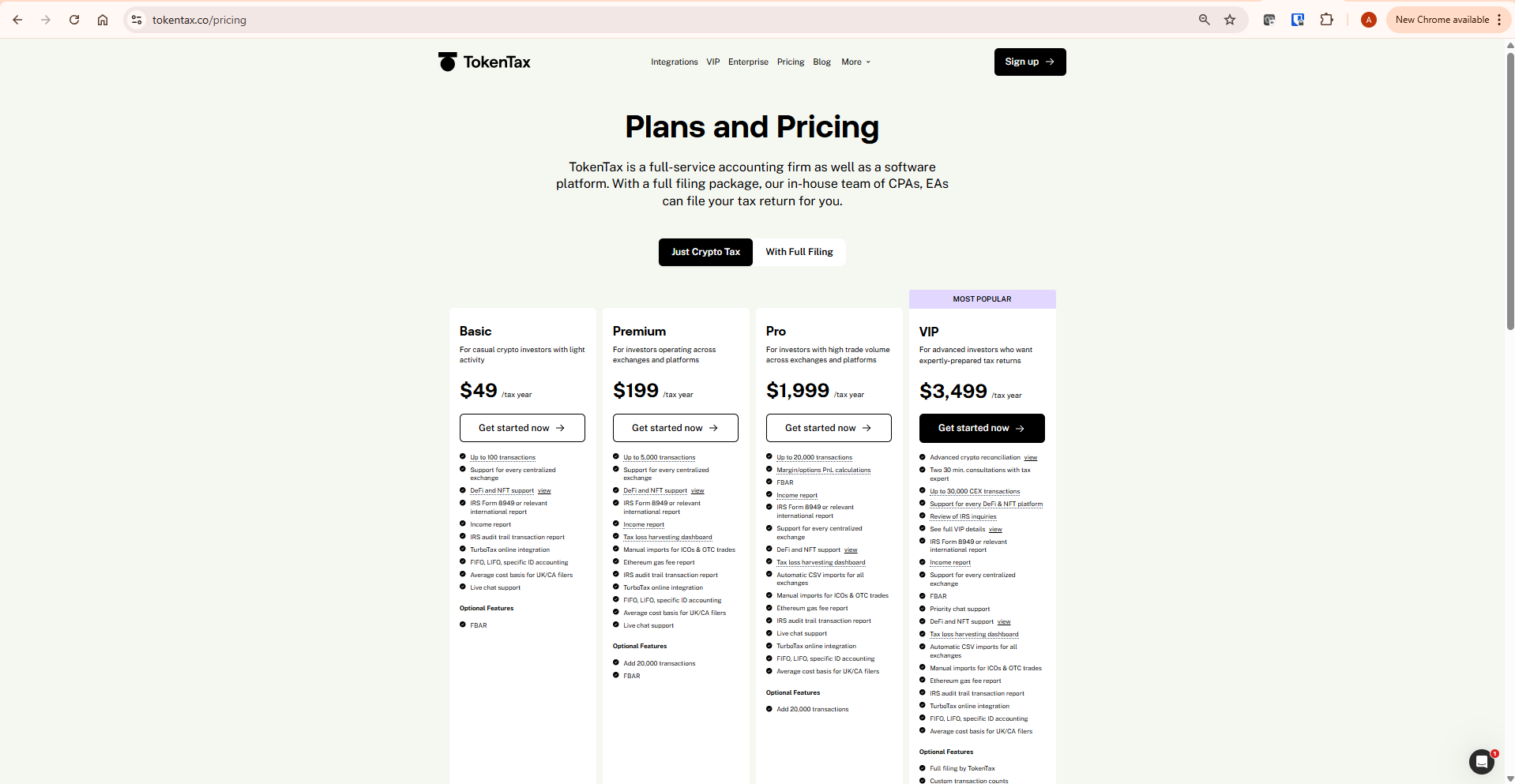
The pricing picture in the Koinly vs TokenTax comparison is more nuanced than most reviews suggest. At entry level, Koinly charges $49 for 100 transactions versus TokenTax’s $49 for 100 transactions — identical. At $199, TokenTax’s Premium plan covers 5,000 transactions versus Koinly’s 3,000 — a genuine advantage for moderate-to-high volume traders at that specific price point. Above $199, TokenTax scales sharply to $1,999 and $3,499, while Koinly’s highest plan sits at $279. The platforms serve different markets at the higher end.
After thirty years in finance, I’ve seen investors pay for professional services they didn’t need and DIY their way into expensive mistakes in equal measure. The Koinly vs TokenTax decision comes down to a single question: do you need a CPA to file for you, or do you need reliable software to generate accurate reports you can file yourself? This guide answers that clearly.
If you want to test Koinly with your own data before committing to anything, the free plan requires no credit card: try Koinly free here.
Koinly vs TokenTax: Quick Comparison
Here is the head-to-head overview before the detailed analysis.
| Feature | Koinly | TokenTax |
|---|---|---|
| Entry price | $49 / tax year | $49 / tax year |
| Free plan | Yes — full feature access before paying | No — must purchase to upload data |
| Integrations | 1,000+ | 100+ |
| Countries supported | 100+ with jurisdiction-specific reports | Any country — results in chosen currency |
| CPA filing service | No | Yes — VIP plan at $3,499 |
| Cost basis methods | FIFO, LIFO, HIFO, Average Cost, Spec ID | FIFO, LIFO, HIFO, Minimization algorithm |
| DeFi and NFT support | From free plan — 8,000+ protocols | Yes — staking, LPs, bridges, mints, royalties |
| Best for | Self-filers, international investors, DeFi | Investors wanting CPA support or 3,000–5,000 tx value |
Koinly vs TokenTax: Pricing Compared
The Koinly vs TokenTax pricing comparison requires careful attention — the headline numbers look similar at entry level but diverge significantly at higher tiers.
| Transactions | Koinly | TokenTax | Better Value |
|---|---|---|---|
| Up to 100 | $49 | $49 | Tied — Koinly has free plan advantage |
| Up to 1,000 | $99 | $199 (5,000 tx) | Koinly cheaper for under 1,000 tx |
| Up to 3,000 | $199 | $199 (5,000 tx) | TokenTax — more transactions at same price |
| Up to 5,000 | $279 | $199 | TokenTax — covers 5,000 for $80 less |
| Up to 10,000+ | $279 | $1,999 | Koinly — dramatically cheaper |
The most important insight in the Koinly vs TokenTax pricing comparison: at $199, TokenTax covers 5,000 transactions while Koinly covers 3,000. For investors with transaction counts between 3,001 and 5,000, TokenTax’s Premium plan is the better value at that specific price point. This is a genuine advantage that most comparison articles miss entirely.
Above 5,000 transactions, the comparison shifts dramatically in Koinly’s favour. Koinly’s Pro plan at $279 covers 10,000+ transactions. TokenTax’s equivalent is $1,999 for 20,000 transactions — more than seven times the price. For high-volume traders who don’t need CPA support, Koinly is substantially cheaper.
One critical difference: TokenTax has no free plan. You must purchase a plan before uploading any transaction data. Koinly’s free plan lets you import all your wallets and exchanges, preview your complete capital gains position, and verify accuracy before spending anything. That risk difference matters for investors evaluating a new platform for the first time.
Always verify current pricing on Koinly’s pricing page and TokenTax’s pricing page, as figures may be updated.
Not sure which tier you need? You can check your exact transaction count using Koinly’s free plan before committing to any purchase.
Koinly vs TokenTax: The CPA Filing Service
TokenTax’s VIP plan at $3,499 includes something Koinly cannot offer: a full tax filing service by crypto-specialist CPAs and Enrolled Agents. This is not just software support — TokenTax’s in-house team reviews your reconciliation, handles complex transaction classification, files your complete tax return, and deals with IRS inquiries on your behalf.
The VIP plan includes two 30-minute consultations with a tax expert, review of IRS inquiries, advanced crypto reconciliation, and up to 30,000 transactions. TokenTax also offers a full filing add-on for clients who purchase any crypto tax plan — meaning you can start with a lower tier and add full CPA filing separately if needed.
TokenTax describes this service as best suited for “high-net-worth individuals, DeFi power users, founders, funds, and anyone who wants zero hassle.” For investors with genuinely complex situations — high-volume trading across dozens of platforms, complex DeFi strategies, or ongoing IRS correspondence — the $3,499 cost can be justified relative to hiring a crypto-specialist CPA independently at market rates.
For most investors, this is not what they need. If you have a moderately active portfolio and can generate accurate reports to file independently through TurboTax, paying $3,499 when a $99 Koinly plan covers your situation is not justified. The Koinly vs TokenTax decision on this point is straightforward: CPA service needed — consider TokenTax VIP. CPA service not needed — Koinly wins on price and features at most tiers.
If you’re concerned about whether Koinly’s calculations are reliable enough to file with confidence, see our detailed breakdown of how accurate Koinly really is. And if you have questions about Koinly’s reporting obligations to tax authorities, see does Koinly report to the IRS.
Koinly vs TokenTax: Integrations
Koinly supports 1,000+ integrations across exchanges, wallets, and blockchains. TokenTax supports 100+ — a significant gap. TokenTax’s approach to unsupported exchanges is to allow CSV upload with manual formatting, with their team assisting VIP clients specifically. For self-service users on lower tiers who need an unsupported exchange, manual CSV preparation is required.
For mainstream exchanges — Binance, Coinbase, Kraken, BitMEX — both platforms work via API or CSV. The gap appears with regional exchanges, newer DeFi protocols, and less common wallets where Koinly’s broader integration library produces a faster, more automated import experience.
Koinly vs TokenTax: DeFi and NFT Support
Both platforms support DeFi and NFT activity. TokenTax’s homepage confirms support for “staking, LPs, bridges, mints, royalties, and complex on-chain activity.” Koinly supports 8,000+ DeFi protocols with automated categorisation.
The key difference in the Koinly vs TokenTax comparison for DeFi is access and automation. Koinly’s DeFi support is available from the free plan with automated categorisation across most supported protocols. TokenTax includes DeFi support across its plans but the depth of automation varies — for highly complex or unusual protocol interactions, TokenTax’s manual editing capabilities allow granular transaction decomposition that can be useful for advanced DeFi users dealing with edge cases no automated system handles perfectly.
For most DeFi investors, Koinly’s automated handling is faster and available without paying anything first. For power users with extremely complex cross-chain strategies involving unsupported protocols, TokenTax’s manual override capability adds flexibility.
Koinly vs TokenTax: Cost Basis Methods
Both platforms support FIFO, LIFO, HIFO, and Specific Identification. TokenTax additionally offers its own “Minimization algorithm” which automatically identifies the lot combination that produces the lowest tax liability — effectively an optimised version of HIFO. Koinly supports Average Cost as well, which TokenTax does not list as a standard method.
On cost basis flexibility, the Koinly vs TokenTax comparison is broadly comparable. Both give investors the tools to optimise their tax position legally. TokenTax’s Minimization algorithm is a genuine differentiator for investors who want automated lot optimisation rather than manually comparing methods.
Koinly vs TokenTax: International Coverage
Both platforms support international investors. TokenTax states it “calculates capital gains and losses for any country and provides results in your chosen currency.” Koinly supports 100+ countries with dedicated jurisdiction-specific report formats.
The distinction is in the depth of country-specific compliance. Koinly generates dedicated pre-formatted reports for specific jurisdictions — IRS Form 8949 for the US, ATO-compliant reports for Australia, HMRC-formatted reports for the UK, and similar formats for dozens of other markets. TokenTax calculates gains for any country but its primary focus and deepest compliance depth is the US market. For investors in major English-speaking markets, both platforms are adequate. For investors in markets where local tax form formatting is critical, Koinly’s dedicated jurisdiction-specific reports provide more complete compliance documentation.
Koinly vs TokenTax: Free Plan and Evaluation Risk
This is the most practically important difference in the Koinly vs TokenTax comparison for first-time users of either platform.
Koinly’s free plan lets you import all transactions, connect all wallets and exchanges, preview your complete capital gains position, and use the tax optimizer — before spending anything. You verify the platform handles your specific situation accurately before committing. This eliminates evaluation risk entirely.
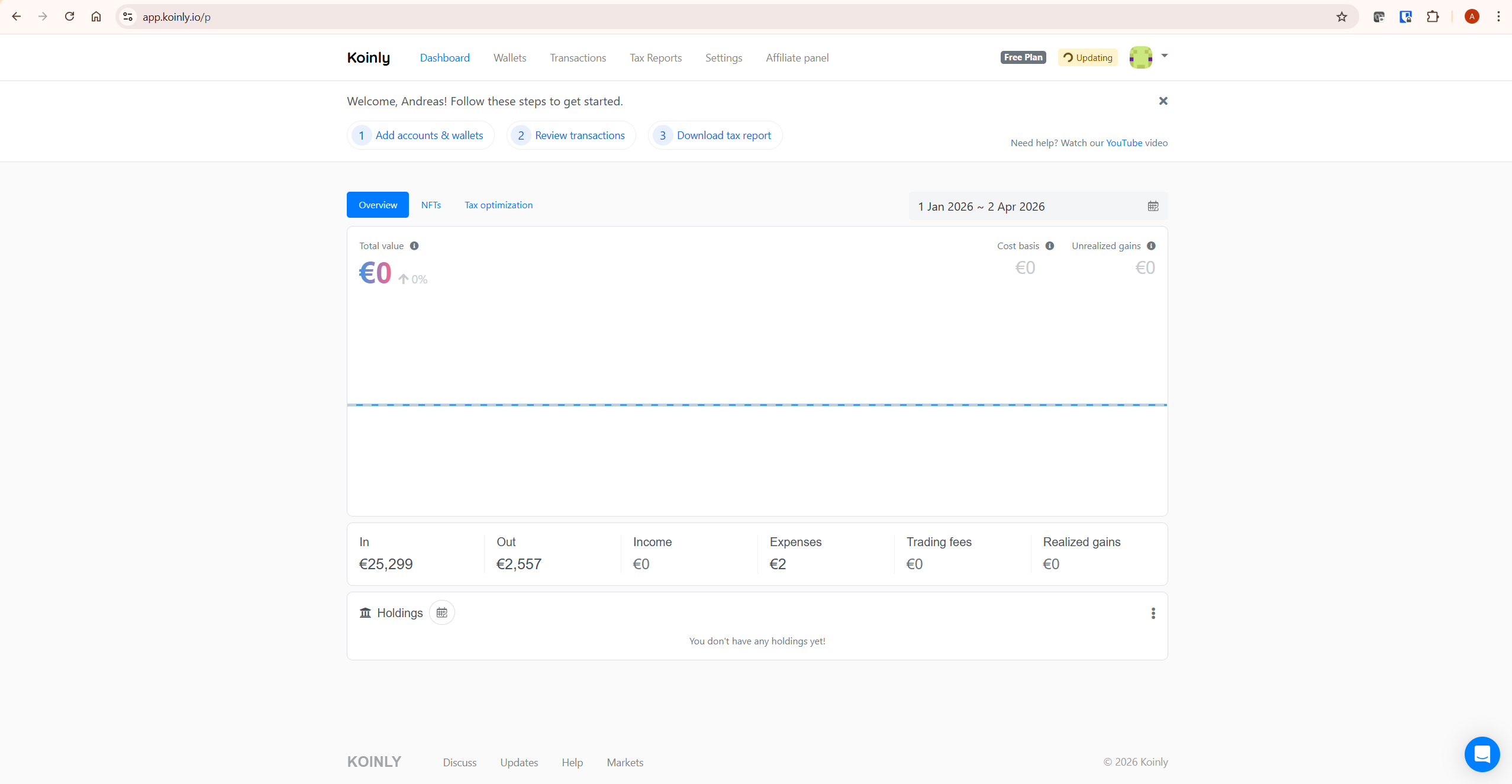
TokenTax has no free plan. To upload your first transaction, you must purchase a plan. If the platform doesn’t handle a key exchange or transaction type correctly, you cannot recover that cost. For a $49 Basic plan this risk is modest. For a $199 Premium plan or higher it is more meaningful — particularly given that Koinly’s free plan would have let you discover the same issue at zero cost.
For a full breakdown of everything Koinly’s free tier includes, see our Koinly free plan guide.
Koinly vs TokenTax: Who Should Choose Each Platform
Choose Koinly If:
You want to verify your tax position before spending anything. You have a transaction count under 3,000 — Koinly is cheaper at every tier below that threshold. You have over 5,000 transactions and don’t need CPA filing — Koinly’s $279 Pro plan is far cheaper than TokenTax’s $1,999 tier. You use exchanges or wallets outside TokenTax’s 100+ integrations. You need dedicated jurisdiction-specific tax reports for non-US markets.
In the Koinly vs TokenTax comparison for the majority of self-filing investors, Koinly is the stronger choice. For a full picture of Koinly’s capabilities, see our complete Koinly review.
Choose TokenTax If:
You need a CPA to file your complete tax return and want a crypto-specialist firm. Your transaction count is between 3,001 and 5,000 — TokenTax’s $199 Premium plan covering 5,000 transactions is better value than Koinly at that specific range. You want TokenTax’s Minimization algorithm for automated lot optimisation. Your portfolio is genuinely complex and you want expert professional oversight rather than self-service software.
Frequently Asked Questions
Is Koinly better than TokenTax?
Koinly is better for most self-filing investors — it has a free evaluation plan, broader integration coverage with 1,000+ platforms versus TokenTax’s 100+, and is significantly cheaper at transaction volumes above 5,000. TokenTax is better for investors who need CPA-assisted filing, and offers better per-transaction value at the $199 price point for investors with 3,001–5,000 annual transactions.
Does TokenTax have a free plan?
No. TokenTax requires purchasing a plan before you can upload any transaction data. Koinly’s free plan allows you to import all your transactions, preview your complete capital gains, and use the tax optimizer before spending anything. This makes evaluating Koinly risk-free in a way that TokenTax is not.
Which is cheaper — Koinly or TokenTax?
It depends on your transaction volume. For under 3,000 transactions, Koinly is cheaper. For 3,001–5,000 transactions, TokenTax’s $199 Premium plan covering 5,000 transactions is better value than Koinly’s $199 plan covering 3,000. For over 5,000 transactions without CPA needs, Koinly is dramatically cheaper — $279 versus $1,999.
Does TokenTax support HIFO?
Yes. TokenTax supports FIFO, LIFO, HIFO, and Specific Identification, plus its own Minimization algorithm that automatically identifies the lot combination producing the lowest tax liability. Koinly also supports HIFO plus Average Cost. Both platforms give investors flexibility to legally optimise their tax position through cost basis method selection.
Can TokenTax file my taxes for me?
Yes — on the VIP plan at $3,499 or via a full filing add-on available to any plan purchaser. TokenTax’s in-house CPAs and Enrolled Agents review your reconciliation, classify complex transactions, and file your complete return. This includes two 30-minute expert consultations and IRS inquiry support. Koinly generates reports for you to file yourself — it does not offer a CPA filing service.
Which platform supports more countries?
Both support international investors. TokenTax calculates gains for any country in your chosen currency. Koinly generates dedicated jurisdiction-specific formatted reports for 100+ countries. For investors in major markets like the US, UK, Australia, and Canada, both are adequate. For investors needing specific pre-formatted local tax forms, Koinly’s dedicated international reports provide more complete documentation.
Is Koinly easier to use than TokenTax?
Yes, for most users. Koinly is designed for self-service use with automated imports, a clear dashboard, and a free plan that lets you explore the platform before spending anything. TokenTax is more service-oriented — particularly at higher tiers where CPA support is included. For investors who want to handle their own taxes with minimal friction, Koinly’s interface is more accessible. For investors who want expert hand-holding or full filing support, TokenTax’s higher tiers provide that service layer.
What happens if I need to switch from TokenTax to Koinly?
Switching is straightforward. Connect your original exchange and wallet sources directly to Koinly — it reimports from source. Alternatively, export your transaction history from TokenTax and import via CSV. See our Koinly setup guide for the full import workflow.
The Verdict: Koinly vs TokenTax
For most crypto investors, Koinly wins the Koinly vs TokenTax comparison. The free evaluation plan, broader integrations, dedicated international report formats, and significantly lower pricing at high transaction volumes make it the stronger default choice for self-filing investors.
TokenTax earns its place for two specific profiles: investors who need full CPA filing, and investors with 3,001–5,000 annual transactions who want maximum value at the $199 tier. TokenTax’s Minimization algorithm is also a genuine differentiator for investors who want automated lot optimisation without manually comparing methods.
The right starting point in the Koinly vs TokenTax decision is always Koinly’s free plan. Import your data, verify the calculations, check your transaction count. If Koinly handles your situation — and for most investors it will — you have your answer without spending anything.
Ready to see where you stand? Start with Koinly free here — no credit card required.
Related reading:
- Koinly Review: Is It the Best Crypto Tax Software in 2026?
- Koinly vs CoinTracker: Which Is Better in 2026?
- Koinly vs CoinLedger: Honest Comparison (2026)
- Koinly vs Blockpit: Honest Comparison (2026)
- Koinly Pricing: Plans, Limits & Which One You Actually Need
