
Semrush Competitor Analysis: Honest Step-by-Step Guide (2026)
Disclosure: This site earns revenue through affiliate partnerships with other platforms. This article does not currently contain affiliate links for Semrush. Any tool recommendations are based on independent evaluation.
Your content site is publishing consistently. The articles are researched, the keywords are targeted, and the internal links are in place. But somewhere out there, a competitor is quietly ranking for dozens of keywords you have not written about yet — pulling traffic from readers who would otherwise find your site. Semrush competitor analysis is how you find those gaps before they compound. This guide gives you a complete, sequenced workflow specifically for affiliate content publishers — not a generic business overview, but a step-by-step process that ends with a prioritised content plan you can act on today.
After 30 years in finance and building an affiliate content site from scratch, what I have learned about competitive analysis is this: the data is only useful if it tells you what to write next. Most competitor analysis guides stop at “here is what the tool shows you.” This one goes further — to the decision framework that turns the data into your next three months of content.
Quick Answer: Semrush Competitor Analysis in 90 Minutes
For an affiliate content site, a complete Semrush competitor analysis runs five tools in sequence: Domain Overview to benchmark your position, Organic Research to see exactly what a competitor ranks for, Keyword Gap to find what they rank for that you do not, Backlink Gap to identify link opportunities, and Position Tracking to monitor ongoing rank changes.
Run them in that order. The entire workflow takes approximately 90 minutes the first time and 30 minutes for each subsequent monthly check. The output is a ranked list of content gaps — keywords your competitors are winning on that you have not targeted yet.
Why Semrush Competitor Analysis Matters for Affiliate Content Sites
Semrush competitor analysis matters because your competitors have already proven what works — and that proof is visible in their rankings. Starting a content plan from scratch ignores freely available evidence that the Keyword Gap tool surfaces in minutes.
Most affiliate content publishers research keywords by starting from scratch — entering seed terms, filtering by volume and difficulty, and building a content plan from the results. That approach works. But it misses something important.
A competitor who has been publishing in your niche for two or three years has already done the hard work of discovering which keywords convert, which article angles resonate with readers, and which topics have enough search volume to be worth the effort. Their published articles — and the rankings those articles hold — are a tested map of what works in your niche. Semrush competitor analysis lets you read that map directly. That is why running a structured Semrush competitor analysis quarterly is one of the highest-return activities for a growing affiliate content site. No other workflow delivers a ready-made content brief as efficiently as a properly executed Semrush competitor analysis.
The goal is not to copy competitors. It is to identify where they are winning, where they have left gaps, and where your 30 years of finance expertise can produce a better, more authoritative article than anything currently ranking. That combination — confirmed demand plus a credibility advantage — is how affiliate content sites build sustainable organic traffic.
For a deeper understanding of how keyword research fits into this workflow, our guide on keyword research with Semrush covers the full process from seed keyword to content brief.
Step 1: Identify Your Real Competitors (Not Who You Think They Are)
Start by entering your own domain into Semrush’s Domain Overview tool and scrolling to the Organic Competitors section. This immediately shows you the sites sharing the most keyword overlap with yours — which are often different from the businesses you consider your industry competitors.
The first step in Semrush competitor analysis is identifying who you are actually competing with in search — which is often different from who you consider your industry competitors.
Go to Semrush’s Domain Overview tool and enter your own domain. Scroll down to the Organic Competitors section. Semrush will show you the sites that share the most keyword overlap with yours — ranked by the number of keywords you both compete for. These are your real search competitors, regardless of whether you think of them that way.
What you will often find: large authority sites like Forbes, Investopedia, or NerdWallet competing for broad keywords you rank for. These are not actionable competitors — their domain authority makes direct competition impractical at an early stage. Look instead for mid-tier sites with Authority Scores in the 30-60 range that are ranking for the same specific keyword clusters you target. These are the sites worth analysing in depth.
Select 2-3 genuine competitors for your Semrush competitor analysis. More than that produces data overload. Fewer than two misses meaningful variation. Two or three gives you enough to spot patterns without losing focus.
Step 2: Organic Research — What Is Actually Ranking for Your Competitor
Enter a competitor’s domain into the Organic Research tool and sort the Positions tab by Traffic. This shows you exactly which keywords are driving real visitors to their site — not just what they rank for, but what is actually working for them.
Once you have identified your target competitors, open the Organic Research tool and enter the first competitor’s domain. This is the core of Semrush competitor analysis — a complete picture of every keyword a domain ranks for, with position, estimated traffic, keyword difficulty, and search intent.
The data you are looking for: navigate to the Positions tab and sort by Traffic to see which keywords are actually driving visitors to the competitor’s site. This immediately shows you their highest-value content — the pages generating real organic traffic, not just rankings in positions too low to matter.
Filter the results to show only keywords ranked in positions 1-20 with commercial or informational intent relevant to your niche. Export this list. Then repeat for your second and third competitors. You now have a verified map of what is already working in your niche — built from confirmed ranking data rather than keyword tool estimates.
What to do with this data: scan the top 30-40 keywords from each competitor and mark any that you have not yet covered on your own site. These are your first content gap candidates. Do not act on them yet — the Keyword Gap tool in Step 3 will make this process significantly faster and more systematic.
Step 3: Keyword Gap — Find What They Rank for That You Do Not
The Keyword Gap tool is the fastest way to find content opportunities. Enter your domain alongside up to four competitors and Semrush immediately shows you every keyword they rank for that you do not — filtered by Missing, Weak, and Untapped categories.
The Keyword Gap tool is where Semrush competitor analysis delivers its highest value for affiliate content publishers. Enter your domain alongside up to four competitor domains and click Compare. Semrush immediately shows you the keywords each competitor ranks for, filtered into categories that make prioritisation straightforward.
The categories to focus on:
- Missing — keywords your competitors rank for that your site has no ranking for at all. These are your content gap opportunities. A competitor ranking in position 3 for a keyword you have never written about is a clear signal to consider that topic.
- Weak — keywords where both you and a competitor rank, but they rank significantly higher. These are your optimisation opportunities — existing articles that could be improved to close the gap.
- Untapped — keywords where at least one competitor ranks but you do not. Similar to Missing but often includes longer-tail variations worth examining.
For an affiliate content site, the Missing category is where to start. Sort by Search Volume to see the highest-traffic opportunities first, then filter by Keyword Difficulty to find terms where competition is achievable. Our guide on Semrush pricing explains which plan tiers give you full access to the Keyword Gap tool without restrictions.
A practical filter for affiliate content sites running a Semrush competitor analysis: look for keywords with search intent classified as “commercial” or “informational” — these align with the buying research and educational content that drives affiliate conversions. Filter out purely navigational keywords (brand searches) and purely transactional keywords (direct purchase intent) unless you have a specific reason to target them.
Step 4: Turning the Gap Data Into a Content Plan
Filter your Missing keywords by difficulty below 40, volume above 500, and commercial or informational intent. What remains is your Tier 1 content plan — the articles worth writing first because the demand is confirmed and the competition is manageable.
This is the step that most Semrush competitor analysis guides skip entirely. Finding the gaps is half the work. Deciding which ones to write about — and in what order — is what actually moves your traffic.
Apply this prioritisation framework to your exported Missing keywords:
Tier 1 — Write immediately: Keywords with search volume above 500/month, keyword difficulty below 40, commercial or informational intent, and a clear match to your 30 years finance expertise. These are your highest-probability wins — confirmed demand, manageable competition, and a credibility advantage you can exploit.
Tier 2 — Plan for next quarter: Keywords with search volume above 1,000/month but difficulty between 40-60. These require stronger articles — more depth, better internal linking, and possibly some external links — but they are worth targeting once your Tier 1 articles are published and indexed.
Tier 3 — Monitor and revisit: High-volume keywords above difficulty 60. These are aspirational targets — worth knowing about but not worth investing writing time in until your site’s authority has grown enough to be competitive.
The output of this step should be a content plan with 5-10 Tier 1 articles ranked by priority. That is your Semrush competitor analysis translated into a publishing schedule — which is the only form competitive intelligence is actually useful in.
Step 5: Backlink Gap — Find Link Building Opportunities
The Backlink Gap tool identifies websites already linking to your competitors but not to you. These are your highest-probability outreach targets — sites that have demonstrated willingness to link to content in your niche.
The Backlink Gap tool runs the same concept as the Keyword Gap but for backlinks. Enter your domain and your competitors’ domains, and Semrush identifies websites that link to your competitors but not to you. These sites have already demonstrated willingness to link to content in your niche — making them higher-probability outreach targets than cold prospecting.
For an affiliate content site at an early to mid stage, backlink gap analysis is most useful for identifying high-authority sites in your niche that you should be building relationships with. Filter the results by Authority Score to prioritise high-quality referring domains over low-quality link farms. A handful of strong links from relevant sites is worth far more than dozens of weak ones.
Note: systematic link building requires time and a dedicated outreach workflow. At this stage, the Backlink Gap portion of your Semrush competitor analysis is best used for awareness — knowing which sites are linking to competitors in your niche and beginning to consider what linkable content you could create that would earn similar links naturally. The full Semrush review covers the Link Building Tool that connects to this workflow when you are ready to operationalise outreach.
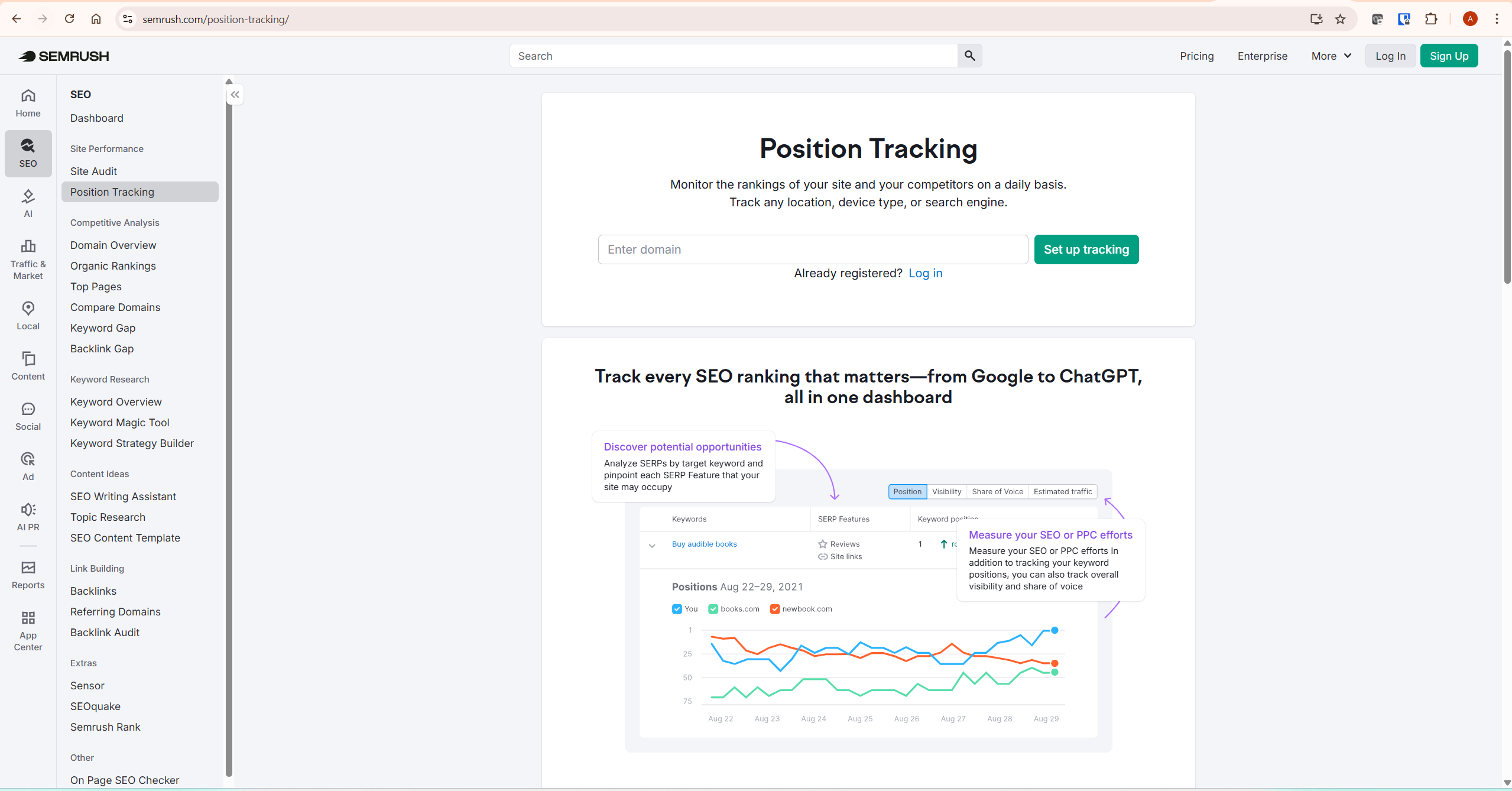
Step 6: Position Tracking — Monitor Ongoing Competitor Movements
Set up Position Tracking with your 2-3 key competitors added to the campaign. Semrush updates daily and alerts you when significant ranking changes occur — giving you an early warning system for competitor movements before they affect your traffic.
A Semrush competitor analysis is not a one-time exercise. Rankings shift. Competitors publish new content. Articles that were outside the top 20 six months ago may be threatening your positions today. Position Tracking gives you an ongoing monitoring layer so you are never caught by surprise.
Set up a Position Tracking campaign for your domain and add your 2-3 key competitors. Add the keywords you are tracking — your existing article targets and the Tier 1 gap keywords you identified in Step 3. Semrush updates rankings daily and alerts you when significant changes occur.
The two signals your Semrush competitor analysis Position Tracking will surface worth acting on immediately: a competitor gaining significant ground on a keyword where you currently rank well (a signal to strengthen that article), and a competitor falling in rankings for a keyword you have not yet targeted (a signal that the space may be opening up for a well-timed new article). Our step-by-step setup guide for Semrush Position Tracking covers the full configuration process.
Free vs Paid: What You Can Do Without a Subscription
The free Semrush tools give you enough data for basic competitor awareness. For a systematic gap analysis producing an exportable content plan, the Pro plan at $117/month (annual) is the practical minimum.
Not every aspect of Semrush competitor analysis requires a paid account. Here is an honest breakdown of what is accessible at each level — because spending $140/month before your site is generating income is a decision that needs justification.
Free (no account required): The free Domain Overview gives you a limited snapshot of any domain’s organic traffic, top keywords, and Authority Score. The free Keyword Magic Tool provides keyword data with daily search limits. These are sufficient for basic competitor awareness but not for systematic gap analysis.
Free account (registered): More daily searches, access to limited Keyword Gap results, and basic Organic Research data. Enough to run a partial competitor analysis and get a directional sense of the opportunity.
Pro plan ($117/month annual): Full access to all the tools in this guide — Domain Overview, Organic Research, Keyword Gap, Backlink Gap, and Position Tracking — with meaningful data depth. Sufficient for a site under 50 articles doing monthly competitive checks.
Guru plan ($208/month annual): Adds historical data, the Content Marketing Platform, and higher usage limits. Worth considering when you are publishing consistently enough to use the Content Marketing tools alongside the competitive analysis workflow.
The practical recommendation: if your site is generating consistent organic traffic and you are publishing at least two articles per week, the Pro plan pays for itself through better content decisions. If you are earlier than that, start with the free tools and Google Search Console. For a full breakdown, our Is Semrush Worth It? guide covers the cost-benefit decision directly.
Common Mistakes Affiliate Sites Make With Competitor Analysis
The most common mistake is analysing competitors who are too large. Focus on mid-tier sites with Authority Scores 10-20 points above yours — not sites like Forbes or Investopedia that rank for everything in your niche regardless of content quality.
Analysing competitors who are too large. Running a Semrush competitor analysis on Forbes or Investopedia when you have a 40-article site produces data that is accurate but useless. Their domain authority means they rank for everything in your niche. Focus on sites with Authority Scores 10-20 points above yours, not 60 points above.
Chasing every keyword in the gap list. The Keyword Gap tool will surface hundreds of missing keywords. Writing about all of them is not a strategy — it is a content treadmill. Apply the prioritisation framework. Publish 5-10 Tier 1 articles and wait for them to index and rank before expanding the list.
Running the analysis once and forgetting it. A competitor analysis done six months ago is stale. Rankings shift constantly. Build a monthly 30-minute competitor check into your workflow — Domain Overview for a quick pulse, Keyword Gap for new gaps, Position Tracking alerts for anything unexpected.
Treating competitor traffic estimates as precise numbers. Semrush’s traffic data for competitor domains is directional, not exact. A site showing 15,000 monthly visits in Semrush could be generating 8,000 or 25,000 in actual Google Analytics. Use the data to understand relative performance and trends — not as a precise benchmark.
Skipping the “what to do next” step. The analysis has no value until it becomes a publishing decision. Every Semrush competitor analysis session should end with a written list of the next 3-5 articles to publish, in priority order. If it does not, the time was spent on data collection rather than strategy.
What To Do Next: Your 90-Minute Competitor Analysis Action Plan
Open Semrush now and run these six steps in sequence. The entire workflow takes 90 minutes and ends with a written list of your next 5 articles ranked by priority.
Here is the complete sequence to run right now:
- Domain Overview (10 minutes) — enter your own domain, identify 2-3 mid-tier competitors from the Organic Competitors section
- Organic Research (20 minutes) — enter each competitor’s domain, sort by Traffic, export the top 40 keywords per competitor
- Keyword Gap (25 minutes) — enter your domain + all competitors, filter to Missing keywords, sort by Volume, apply difficulty and intent filters
- Prioritisation (20 minutes) — apply the Tier 1/2/3 framework, identify your top 5-10 content gap opportunities
- Backlink Gap (10 minutes) — identify the top 10 highest-authority sites linking to competitors but not you
- Position Tracking setup (5 minutes) — add competitors to your existing campaign or create a new one with your gap keywords added
End the session with a written list of your next 5 articles, ranked by Tier 1 priority. That list is the output that makes the 90 minutes worth spending.
Frequently Asked Questions
How often should I run a Semrush competitor analysis?
For an active affiliate content site, run a full competitor analysis quarterly — approximately every 3 months. Between full analyses, use Position Tracking alerts and a monthly 30-minute Keyword Gap check to catch significant changes. Rankings in competitive niches can shift meaningfully within 6-8 weeks, so quarterly is the minimum frequency for staying informed.
How many competitors should I analyse with Semrush?
Two to three is the practical number for an affiliate content site. The Keyword Gap tool supports up to five domains simultaneously, but more competitors means more data to filter and a harder prioritisation decision. Start with two direct competitors — sites covering the same niche, at a similar authority level, publishing similar content types. Add a third if the first two do not surface enough gap opportunities.
Can I do competitor analysis with the free Semrush plan?
Yes, partially. The free plan and free tools give you limited access to Domain Overview and Keyword Gap data — enough to get a directional sense of competitor keyword coverage. For a systematic analysis producing an exportable content gap list, the Pro plan is the practical minimum. The free tools are a useful starting point for evaluating whether the paid plan is worth the investment for your specific niche.
What is the difference between Organic Research and Keyword Gap in Semrush?
Organic Research shows you everything a single competitor ranks for — their complete keyword portfolio. Keyword Gap compares your domain directly against competitors and shows you only the keywords where a gap exists between you. For competitor analysis, run Organic Research first to understand a competitor’s overall strategy, then use Keyword Gap to identify your specific content opportunities efficiently.
Is Semrush competitor analysis accurate?
The keyword ranking data — which keywords a competitor ranks for and at what position — is reliable and sourced from Semrush’s crawler crawling search results. The traffic estimates are directional rather than precise; actual traffic for a competitor domain can differ meaningfully from the Semrush estimate. Use ranking data as your primary signal. Treat traffic estimates as relative indicators — useful for understanding a site’s scale, not for precise measurement.
Final Thoughts
A well-executed Semrush competitor analysis is the fastest way to build a content plan grounded in confirmed demand. Done quarterly, Semrush competitor analysis compounds — each round surfaces new gaps opened by competitor activity and algorithm changes.
Your competitors have already tested which topics attract organic traffic in your niche. The Keyword Gap tool surfaces exactly where they are winning and you are not — turning months of guesswork into a prioritised list of content opportunities in under two hours. For an affiliate content publisher with limited time and a finite publishing capacity, that prioritisation is not optional. It is how you make sure the articles you do publish are targeting the right keywords rather than the ones that seemed interesting when you were staring at a blank content calendar.
For a complete breakdown of Semrush’s features and whether the subscription makes sense at your site’s current stage, read our full Semrush review.
More guides in this cluster:
- How to Do Keyword Research with Semrush — the full affiliate content workflow
- How to Use Semrush Site Audit — fix critical SEO errors step by step
- How to Use Semrush Position Tracking — monitor rankings and competitor movements
- Semrush Pricing Explained — every plan, limit, and add-on
- Is Semrush Worth It? — honest cost-benefit for affiliate content sites
- Semrush vs Ahrefs — which tool fits your budget and workflow
Feature details and tool availability change with Semrush plan updates. Always verify current access levels at Semrush’s official knowledge base. For a comparison of Semrush with alternatives, Search Engine Journal’s Semrush review provides an independent third-party perspective.