
Semrush Free Trial 2026: How to Get 14 Days and What to Test
Affiliate Disclosure: This site earns revenue through affiliate partnerships with other platforms. This article does not currently contain affiliate links for Semrush. Any tool recommendations are based on independent research and publicly available data.
Last verified: July 2026, using Semrush’s official pricing page and documentation.
The Semrush free trial gives you 14 days of full access to one of the most comprehensive SEO platforms available — and if you use those 14 days deliberately, you will know exactly whether Semrush is worth the subscription cost before you spend a pound or dollar. At the time of writing, the standard trial is available on the Pro, Guru, and Semrush One Starter plans — it requires a credit card and will not charge you if cancelled before day 14. This guide covers exactly how to activate it, what the free trial includes versus the permanent free account, and — most importantly — what an affiliate content publisher should specifically test to make a well-informed subscription decision.
After 30 years in finance and building an affiliate content site from scratch, I have evaluated more tools than I can count. The principle is always the same: use the trial period with a clear testing plan, not as a general browse. A well-planned Semrush free trial used deliberately gives you enough data to make a confident call. A 14-day trial spent clicking around at random tells you nothing useful.
- The Semrush free trial is 14 days — Semrush discontinued its 30-day trial in May 2023. Any article claiming 30 days is outdated.
- A credit card is required to activate the trial — if you want Semrush access without a card, use the permanent free account instead
- The free trial and the free account are completely different things — the trial gives full unrestricted access for 14 days; the free account gives limited access indefinitely
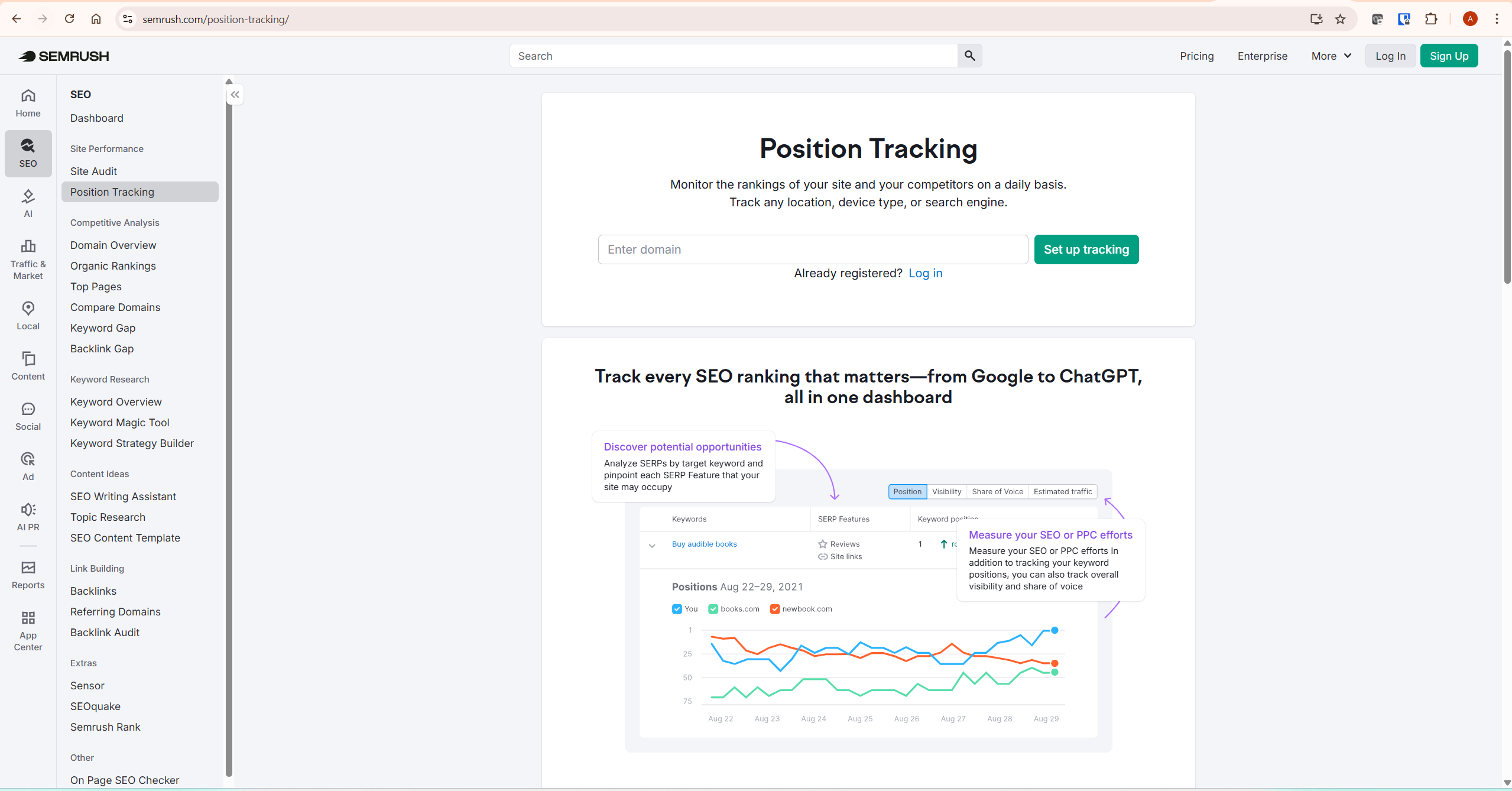
- Set up Position Tracking on day one — it needs several days to build meaningful data and is useless if set up late in the trial
- Export everything valuable during the trial — keyword research, competitor gap lists, and backlink data remain yours after the trial ends even if you do not subscribe
Quick Answer: What Is the Semrush Free Trial?
The Semrush free trial gives you 14 days of full access to all features on your chosen plan — Pro, Guru, or Semrush One Starter. A credit card is required to activate it, but you will not be charged if you cancel before the trial ends. The standard trial length is 14 days. Semrush discontinued its 30-day trial in May 2023 — any article claiming 30 days is outdated. After the trial ends, your account converts to a paid subscription unless you cancel. The permanent free account (no trial, no card required) is a separate option giving limited access indefinitely.
Semrush Free Trial vs Free Account: What Is the Difference?
These are two completely different things and most articles treat them as interchangeable — they are not. Understanding the distinction is essential before you decide which option to use.
The Semrush free account is permanent — you can use it indefinitely without ever paying. It requires only an email address, no credit card. What you get is limited but genuinely useful: 10 keyword searches per day in the Keyword Magic Tool, Domain Overview access with partial data, Position Tracking for up to 3 domains with 10 keywords each, 5 Backlink Audit requests per 7 days, and one project. For an affiliate site just starting out, the free account is enough to cover basic keyword checking and site monitoring without spending anything.
The Semrush free trial is time-limited — 14 days of full, unrestricted access to every feature on your chosen plan. It requires a credit card. Data export is fully unlocked. The Keyword Gap tool, Backlink Gap, Content Marketing Platform (Guru plan), Position Tracking for hundreds of keywords, and the full Site Audit suite are all available without restriction. This is the option for a serious evaluation before committing to a subscription.
| Feature | Free Account (Permanent) | Free Trial (14 Days) |
|---|---|---|
| Credit card required | No | Yes |
| Duration | Indefinite | 14 days |
| Keyword searches/day | 10 | Unlimited (plan limits) |
| Keyword Gap tool | Limited | Full access |
| Backlink Gap tool | No | Full access |
| Content Marketing Platform | No | Yes (Guru/One plan) |
| Position Tracking | 3 domains, 10 keywords | Plan limits (500–1,500) |
| Data export | No | Full export |
| Site Audit pages/month | 100 | Up to 100,000 |
| Best for | Early-stage sites, basic checks | Serious evaluation before subscribing |
How to Activate the Semrush Free Trial: Step-by-Step
Activating the Semrush free trial takes under five minutes. Follow these steps exactly to avoid accidentally signing up for a paid plan instead of the trial.
Step 1: Go to semrush.com/pricing and choose your plan. For most affiliate content publishers evaluating the platform, Pro is the starting point. If you want to test the Content Marketing Platform — the SEO Content Template, Writing Assistant, and Topic Research tools — choose Guru, as these features are not available on Pro.
Step 2: Click “Try for free” on your chosen plan. You will be directed to the account creation page. Enter your email address and create a password.
Step 3: Enter your credit card details. Semrush requires card information to activate the trial but will not charge you until the 14-day period ends. Set a calendar reminder for day 12 — two days before the trial ends — to give yourself time to decide and cancel if needed.
Step 4: Complete the onboarding questions. These are market research questions for Semrush — your answers do not affect trial access or features. Click through them without concern.
Step 5: You now have full trial access. Do not start browsing randomly — follow the structured testing plan below to make the most of your 14 days.
Which Plan Should You Trial: Pro, Guru, or Semrush One?
The plan you choose for your Semrush free trial determines what features you can evaluate — and the right choice depends on what you actually need to test.
Trial Pro ($117/month annual) if: your primary needs are keyword research, site auditing, rank tracking, backlink analysis, and competitor intelligence. Pro covers all of these fully. It does not include the Content Marketing Platform — if content planning and optimisation tools are important to your workflow, Pro will not give you a complete picture.
Trial Guru ($208/month annual) if: you publish content consistently and want to evaluate the SEO Content Template, Writing Assistant, and Topic Research tools alongside the core SEO toolkit. For an affiliate content publisher producing two or more articles per week, Guru is the realistic plan for sustained use — trialling Pro and then upgrading to Guru means you never evaluate the most relevant features for your workflow.
Trial Semrush One ($199/month) if: you want to evaluate AI visibility tracking — how your brand appears in ChatGPT, Perplexity, and Google AI Overviews responses — alongside the classic SEO toolkit. Semrush One Starter actually costs less than Guru ($199 vs $249.95/month) while adding the AI Visibility Toolkit. For a content publisher building long-term authority in 2026, this is worth evaluating.
What to Test During Your Semrush Free Trial: A 14-Day Plan
Most people waste their Semrush free trial browsing the interface without a clear testing objective. This plan gives you a structured workflow specifically designed for an affiliate content publisher to evaluate whether Semrush delivers genuine value for their situation.
Days 1–2: Baseline and Setup
Create a project for your domain immediately on day one of your Semrush free trial. Run the Site Audit — this crawls your site and identifies technical SEO issues broken down by severity. Note your Site Health Score as your baseline. Set up Position Tracking for your 20–30 most important target keywords. These need to run for several days to build trend data, so setting them up on day one is essential. My guide on how to use Semrush Position Tracking covers the setup in detail.
Days 3–5: Competitor Research
Run the Keyword Gap tool comparing your domain against 2–3 competitors. Export the Missing keywords — those your competitors rank for that you do not. This is the most immediately actionable output of the entire Semrush free trial for a content publisher. Filter by difficulty below 40 and volume above 500. The result is a verified content gap list you can act on regardless of whether you subscribe. My competitor analysis guide covers this workflow in full.
Days 6–8: Keyword Research Deep Dive
Use the Keyword Magic Tool without restriction — this is one of the most valuable parts of the Semrush free trial for affiliate publishers. Research your core topic clusters — enter 5–10 seed keywords relevant to your niche and explore the full results. Pay attention to the intent classification and the question-based keyword variants. Export everything. This data remains useful after the trial ends even if you do not subscribe. My guide on keyword research with Semrush covers the full workflow step by step.
Days 9–11: Backlink Research
Run the Backlink Gap tool against your top competitors. Export the list of high-authority sites linking to them but not to you. Run the Backlink Analytics Indexed Pages report on each competitor to identify which of their articles earn the most links — and what content types they are. This data shapes your content and outreach strategy for months. My guide on Semrush backlink analysis covers the full process.
Days 12–13: Content Tools and Decision
If you are trialling Guru or Semrush One: use the SEO Content Template on 3–5 of your planned articles. Enter the target keyword and review the recommendations — word count targets, semantic keywords to include, readability targets, and sites to consider for links. Use the SEO Writing Assistant on one article draft. Assess honestly: does this change how you write, or does it replicate what you already do? Day 13 is also your decision day — apply the framework below before day 14 to avoid an accidental charge.
Day 14: Cancel or Subscribe
Make your Semrush free trial subscription decision using the framework in the next section. To cancel: log into Semrush, click your profile icon in the top right corner, select Subscription Info, and follow the cancellation process. Semrush support responds within 24–48 hours. Submit your cancellation before day 14 ends — not on day 14 itself — to ensure it processes in time.
How to Decide Whether to Subscribe After the Trial
Every other Semrush free trial article ends with “subscribe now.” This one gives you an honest framework for making the right decision for your situation.
Subscribe if all three of these are true:
- The Keyword Gap export from days 3–5 gave you a content plan with at least 10 articles you are confident about writing — this proves the data depth is genuinely useful for your niche
- You are publishing at least one article per week consistently — at lower publishing frequency, you will not use the tool enough to justify the subscription cost
- The monthly subscription cost is less than 20% of your current or projected monthly affiliate income — if it is not, the tool is not yet financially justified regardless of its quality
Do not subscribe yet if:
- Your site has fewer than 20 published articles — the competitive intelligence tools are most powerful when you have a content base to build on and compare against
- The keyword gap export produced fewer than 10 actionable opportunities — this suggests either a very narrow niche or that the data does not have strong coverage in your topic area
- You found yourself using primarily the free tool features during the trial — this is a signal that the free account covers your current needs adequately
For a detailed cost-benefit analysis of whether Semrush is worth the investment at different site stages, my dedicated guide on Is Semrush Worth It? covers this decision framework in full. The Semrush pricing guide breaks down exactly what each plan includes so you can compare against your actual workflow needs.
What the Semrush Free Trial Does Not Include
Being clear about Semrush free trial limitations prevents disappointment and ensures you evaluate the right plan for your needs.
White-label reporting is locked to Business plan and above — not available on any trial. Agency-level features including client portal access, extended project limits (40+ projects), and API access require the Business plan. The Semrush One AI Visibility Toolkit is only accessible on the Semrush One Starter plan trial — it is not included in Pro or Guru trials. Some add-on toolkits (Local SEO, Social Media, Advertising) have separate 7-day trials and are not included in the standard 14-day SEO toolkit trial.
One practical limitation worth knowing: data you export during the trial is yours to keep. Keyword research exports, competitor analysis spreadsheets, and backlink lists downloaded during the trial remain accessible after the trial ends even if you do not subscribe. Building a deliberate export strategy during the 14 days maximises the value you extract regardless of your subscription decision.
Common Mistakes to Avoid During the Semrush Free Trial
Not setting up Position Tracking on day one. Position Tracking needs several days to build meaningful trend data. Setting it up on day 10 gives you four days of data — not enough to evaluate whether the tool is useful for your ranking monitoring workflow.
Trialling the wrong plan. If you are an affiliate content publisher who needs content planning tools, trialling Pro and discovering the Content Marketing Platform is not included is a wasted 14 days. Choose your trial plan based on what you actually need to evaluate, not the lowest price.
Not exporting data during the trial. All the keyword research, competitor gap analysis, and backlink data you generate during the Semrush free trial can be exported and used indefinitely. Not exporting before the trial ends leaves significant value on the table regardless of whether you subscribe.
Cancelling on day 14 itself. Semrush processes cancellations within 24–48 hours. Submitting on day 14 risks the trial converting to a paid plan before the cancellation processes. Cancel by the end of day 12 if you have decided not to subscribe.
Treating the trial as a general browse. The Semrush interface is extensive. Without a structured testing plan, 14 days disappears into navigation rather than evaluation. Follow the day-by-day plan above — or at minimum, complete the Keyword Gap analysis and Site Audit before anything else.
What To Do Next
Before activating your Semrush free trial, do two things. First, identify your top 2–3 competitors — the sites ranking for the same keywords you are targeting in your niche. Second, prepare a list of 5–10 seed keywords you want to research. Having this preparation done before you start the trial means you can run the Keyword Gap and Keyword Magic Tool immediately on day one rather than spending your first two days on setup.
If you are not yet ready for the full trial, start with the Semrush free tools — no card required, no time limit. The free keyword checker and backlink checker give a meaningful preview of data quality in your niche before you commit to a trial.
Frequently Asked Questions
How long is the Semrush free trial in 2026?
The standard Semrush free trial is 14 days in 2026, available on Pro, Guru, and Semrush One Starter plans. Semrush discontinued its 30-day trial in May 2023. Any article or website advertising a 30-day Semrush free trial is outdated. A credit card is required to activate the 14-day trial, but no charge is made until the trial period ends.
Can I get a Semrush free trial without a credit card?
No — the 14-day Semrush free trial requires a credit card to activate. If you want to access Semrush without a card, use the permanent free account instead. The free account gives you 10 keyword searches per day, Domain Overview access, basic Position Tracking, and limited Backlink Audit access — indefinitely, with no card required. It is more limited than the trial but has no time constraint.
What happens when the Semrush free trial ends?
When the Semrush free trial ends, your account automatically converts to a paid subscription and your card is charged for the first month or year depending on the billing cycle you selected. To avoid being charged, cancel before the trial period ends — ideally by day 12 to allow processing time. Any data you exported during the trial remains yours after cancellation.
Is there a Semrush free trial for the Guru plan?
Yes — the 14-day free trial is available on the Guru plan. For an affiliate content publisher who needs the Content Marketing Platform (SEO Content Template, Writing Assistant, Topic Research), the Guru trial is the right choice over the Pro trial. The Pro trial does not include these content tools, so evaluating Pro when your intended plan is Guru means you never test the features most relevant to your workflow.
Can I use the Semrush free trial more than once?
No — the Semrush free trial is available once per email address. Creating a new account with a different email to access a second trial violates Semrush’s terms of service. If you used a trial previously and want to re-evaluate the platform, use the free account (permanent, limited access) or contact Semrush support to ask about any current promotional offers for returning users.
Final Thoughts
Used correctly, the Semrush free trial is one of the most useful evaluation periods available in the SEO tool market — 14 days of full, unrestricted access is enough time to make a well-informed subscription decision if you use it deliberately. The key is going in with a structured plan: set up Position Tracking on day one, run the Keyword Gap analysis in the first few days, export everything valuable, and apply an honest decision framework before the trial ends.
The Semrush free trial earns its value most clearly when you already have a content site with at least 20 articles and a clear competitor landscape to analyse. If you are earlier than that, the permanent free account is a more appropriate starting point — it costs nothing and covers the basics until your site reaches a stage where the subscription investment is justified.
For a complete breakdown of Semrush’s features and whether the full subscription delivers value at your site’s current stage, read my full Semrush review.
Trial terms, duration, and plan features change frequently. Always verify current trial availability directly at semrush.com/pricing. For an independent overview of Semrush’s trial and features, Search Engine Journal’s Semrush review provides a useful third-party perspective.
