
Semrush Keyword Difficulty: Best Guide for Affiliates (2026)
Disclosure: This site earns revenue through affiliate partnerships with other platforms. This article does not currently contain affiliate links for Semrush. Any tool recommendations are based on independent evaluation.
Understanding Semrush keyword difficulty is the difference between choosing keywords your site can realistically rank for and wasting months publishing content that never moves.
Most guides explain what the metric means. This one tells you what to do with it at each stage of your site’s growth — because a KD score of 45 means something very different for a 10-article site than it does for a 100-article site with growing authority.
I am Andreas Maratheftis, 30 years in professional finance and the founder of InnovateHub Finance, where I use Semrush to plan and prioritise content for a growing affiliate site. Here is the honest, stage-specific framework for using Semrush keyword difficulty to make better content decisions.
Quick Answer: What Is Semrush Keyword Difficulty?
In brief: Semrush Keyword Difficulty (KD%) estimates how difficult it is to rank in Google’s top 10 results for a keyword. For most new affiliate sites, targeting KD scores under 30 is the safest approach because it balances ranking potential with realistic competition.
Semrush keyword difficulty (KD%) is a metric scored from 0 to 100 that estimates how much SEO effort it would take for your content to rank in Google’s top 10 results for a given keyword. The higher the score, the harder it is to rank.
It is calculated based on the authority of the domains currently ranking for that keyword — not simply keyword search volume. A keyword with high search volume can have low difficulty if the pages currently ranking for it are from low-authority sites. A keyword with modest volume can have high difficulty if it is dominated by established domains.
KD% is available across Semrush’s keyword research tools, including the Keyword Magic Tool, Keyword Overview, and Keyword Gap tool.
How Semrush Calculates Keyword Difficulty
Semrush keyword difficulty is calculated primarily from the Authority Scores of the domains currently ranking in the top 10 Google results for that keyword. The median authority of those ranking domains determines how competitive the keyword is to enter.
This is an important distinction from older keyword difficulty models.
KD% does not measure how many times a keyword is searched, how much competition exists in paid advertising, or how many total pages mention the keyword. It measures specifically how authoritative the sites you would need to outrank actually are. A keyword ranking on the first page with several low-authority affiliate blogs is far more accessible than one dominated by established media outlets — even if both show similar search volumes.
The calculation also factors in the number of referring domains pointing to the top-ranking pages and the overall competitive density of the SERP. Semrush updates KD% scores as ranking pages change, so a keyword that was competitive six months ago may have become more accessible if the dominant pages have lost authority links. For a deeper understanding of how this connects to your overall competitive research workflow, our guide on Semrush competitor analysis covers the full picture.
Semrush Keyword Difficulty Scale: What Each Range Means
Semrush keyword difficulty uses a 0-100 scale with defined ranges. Here is what each range means in practice for an affiliate content publisher — not just the textbook definition.
| KD% Range | Semrush Label | What It Means in Practice | Best For |
|---|---|---|---|
| 0–14 | Very Easy | Minimal competition — low-authority sites ranking, often thin content | Brand new sites, first 10-20 articles |
| 15–29 | Easy | Accessible with quality content and basic on-page SEO — a realistic target for growing sites | Sites under 50 articles, building authority |
| 30–49 | Possible | Requires solid content, some backlinks, and established topical authority in the niche | Sites with 50-100 articles and growing link profiles |
| 50–69 | Difficult | Competitive SERPs — established sites with strong authority dominate, backlinks needed | Established sites with 100+ articles and active link building |
| 70–84 | Hard | Dominated by high-authority domains — requires significant domain authority and link campaigns | High-authority sites pursuing competitive commercial terms |
| 85–100 | Very Hard | Top-tier competition — national publishers, established brands, dedicated SEO investment required | Rarely worth targeting for affiliate content sites |
The strategic rule that consistently holds: target keywords with KD under 30 when starting out. You will rank faster, generate traffic sooner, and build the domain authority needed to pursue harder keywords later. Chasing high-KD keywords before your site has the authority to compete wastes content investment and delays revenue.
Where to Find Keyword Difficulty in Semrush
Semrush keyword difficulty appears in four main places — each useful for a different stage of your research workflow.
Keyword Overview. Enter any keyword at semrush.com/analytics/keywordoverview and the KD% score appears immediately alongside search volume, intent, and CPC. No account required for basic data — the free keyword checker shows KD% for any term without signing in. This is the fastest way to validate a single keyword before adding it to your research list.
Keyword Magic Tool. The primary research environment for building keyword lists. KD% is displayed as a column for every keyword in the results, filterable by range. The most useful filter for an early-stage affiliate site: set KD% maximum to 30 and minimum volume to 100. Every keyword that appears is theoretically accessible with quality content and proper on-page SEO. Our step-by-step Semrush keyword research guide covers the full Keyword Magic Tool workflow.
Keyword Gap. When comparing your domain against competitors, the Keyword Gap tool shows KD% for every gap opportunity — keywords your competitors rank for that you do not. Sorting by KD% ascending gives you the most accessible content opportunities from competitor analysis in one view. This is the most efficient use of KD% for content planning at scale.
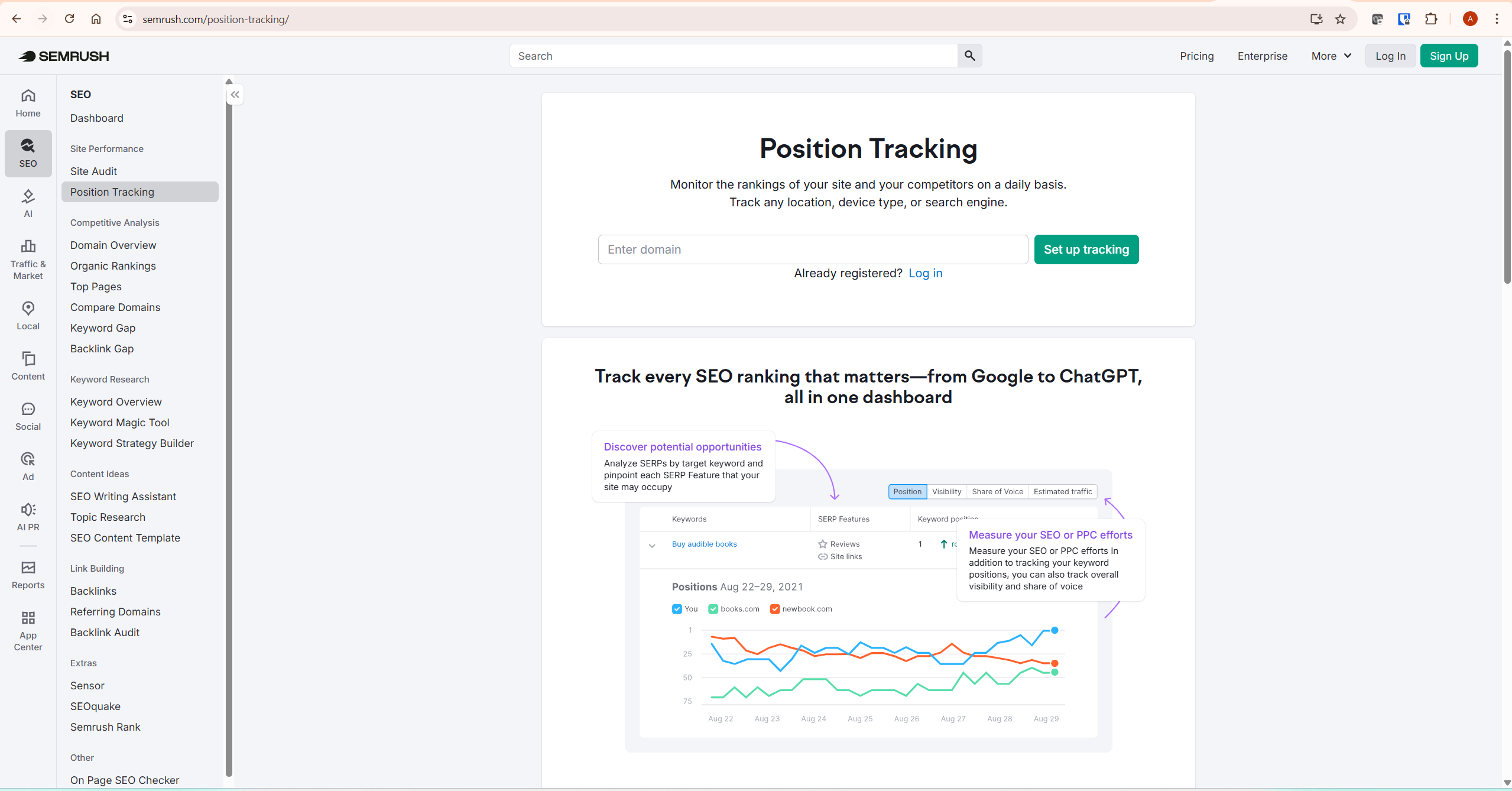
Position Tracking. Once you are tracking your own rankings, Semrush displays KD% alongside your current position for each tracked keyword — helping you prioritise which low-ranking articles deserve optimisation effort versus which are simply too competitive for your current authority level. Our guide on Semrush Position Tracking covers the full monitoring workflow.
Semrush Keyword Difficulty by Site Stage: A Practical Framework
The most important thing Semrush keyword difficulty guides get wrong is treating KD% as an absolute rule rather than a stage-relative one. Here is the framework that actually reflects how affiliate content sites grow.
Stage 1 — New site, 0-20 articles. Target KD 0-20 exclusively. At this stage your domain has minimal authority and zero established topical signals. Even well-written content targeting KD 30+ keywords will struggle to rank because Google has no evidence of your site’s expertise yet. Focus entirely on the lowest-competition keywords in your niche — these are often long-tail question-based terms that larger sites consider too small to target. They are not too small for you.
They build the authority foundation that makes everything else possible.
Stage 2 — Growing site, 20-50 articles. Target KD 15-35. By this point you have demonstrated topical consistency, accumulated some natural links from content distribution, and GSC data is showing real impressions.
You can begin targeting moderately competitive terms — particularly within your established topic clusters where you have published multiple supporting articles. Topical authority within a cluster allows you to rank for slightly higher KD terms than your domain authority alone would suggest.
Stage 3 — Established site, 50-100 articles. Target KD 25-50, selectively up to 60 for your strongest topic clusters. Active link building, consistent publishing, and GSC positions in the 10-30 range signal that your site is ready for more competitive targets. At this stage the Keyword Gap tool becomes particularly valuable — you are now competing with identifiable peers, and their vulnerable high-traffic keywords are realistic acquisition targets.
Stage 4 — Authority site, 100+ articles. KD 50+ is accessible, with selective targets up to 70 for commercially important keywords worth significant investment.
At this stage your domain authority, backlink profile, and topical coverage give you genuine competitive standing against established sites. The KD% score remains a useful filter, but the decision to pursue high-KD terms should be made on commercial value — the affiliate commission potential of ranking — not just feasibility.
Keyword Difficulty vs Search Volume: Which Matters More?
Both matter — but KD% matters more for an early-stage affiliate site, and this is one of the most consequential decisions in content strategy.
A keyword with 5,000 monthly searches and KD 65 is effectively useless for a site with 30 articles. The ranking difficulty means you will not appear on page one regardless of content quality, which means zero traffic regardless of demand.
A keyword with 400 monthly searches and KD 15 is genuinely valuable — you can rank, generate consistent traffic, and build topical authority that makes the harder keywords accessible later.
The original data calculation that makes this concrete: if a KD 15 keyword with 400 monthly searches ranks you in position 3, you capture approximately 15% of that traffic — 60 monthly visits. At a 2% affiliate conversion rate and a £30 average commission, that single article generates approximately £36/month.
Across 20 such articles, that is £720/month from keywords most publishers ignore because the volume looks unimpressive. The compounding effect of correctly targeted low-KD content is the core of how affiliate sites scale from zero to sustainable income.
If you want to test this workflow yourself, Semrush’s free keyword tools let you check KD% for any term before committing to a paid plan. The free Keyword Overview at semrush.com/analytics/keywordoverview requires no account.
How to Use Keyword Difficulty in the Keyword Magic Tool: Step-by-Step
Here is the exact workflow for using Semrush keyword difficulty to build a targeted content plan for an affiliate site.
Step 1: Open the Keyword Magic Tool. Enter your seed keyword — the broad topic you want to build content around. Set your target country.
Step 2: Apply the KD% filter. Set the maximum to match your site stage — 20 for a new site, 30-35 for a growing site. This immediately removes the keywords you cannot realistically rank for and focuses your research on actionable opportunities.
Step 3: Set a minimum volume filter. For most affiliate niches, 100 monthly searches is a reasonable floor — low enough to capture long-tail opportunities, high enough to filter out near-zero traffic terms. In some niches with high commission values (finance, software, B2B), even 50 monthly searches can justify a dedicated article.
Step 4: Filter by intent. For affiliate content, Commercial and Informational intent keywords are the priority. Commercial intent keywords drive direct conversion; informational keywords build topical authority and capture readers earlier in the decision process.
Step 5: Sort by volume descending within your KD% range. The keywords at the top of this filtered list are your highest-opportunity targets — maximum accessible demand within your current authority constraints. Export the list and map each keyword to a planned article. This is your content calendar grounded in data rather than intuition.
Common Mistakes With Semrush Keyword Difficulty
Treating KD% as the only filter. KD% tells you how hard it is to rank. It does not tell you whether ranking is worth the effort. Always evaluate KD% alongside search volume, commercial intent, and affiliate commission potential before committing to an article.
A KD 10 keyword with 50 monthly searches and no commercial intent is less valuable than a KD 25 keyword with 300 monthly searches and strong buyer intent.
Ignoring SERP analysis for borderline keywords. A KD score of 35 is a signal, not a verdict. Always check the actual SERP for any keyword near your threshold. If the top-ranking pages are thin affiliate articles from mid-authority sites, the real difficulty may be lower than the score suggests. If the top three results are from established publishers with thousands of backlinks, even a KD 25 score may overstate your realistic chances at this stage.
Not updating KD% filters as the site grows. The KD% range you target at 20 articles should not be the same range you target at 80 articles. Revisit your keyword strategy every 3-6 months and expand your KD% ceiling as your domain authority and topical coverage grow. Many publishers leave significant traffic on the table by continuing to target only very-low-KD terms long after their site has the authority to rank for more competitive keywords.
Confusing KD% with ranking guarantee.
A low KD% score increases the probability of ranking — it does not guarantee it. Content quality, on-page optimisation, internal linking, and topical authority all contribute to ranking outcomes that KD% cannot fully predict.
Use it as a filter and a planning tool, not as a ranking promise. For a broader view of how Semrush’s tools support ranking decisions without guaranteeing outcomes, our full Semrush review covers this honestly.
What To Do Next
Open the Semrush Keyword Magic Tool now and run this exercise in 15 minutes. Enter your primary niche topic. Set KD% maximum to match your site stage. Set minimum volume to 100. Filter for Commercial and Informational intent. Sort by volume descending. The top 10-15 results on that filtered list are often strong candidates for your next content priorities — keywords with confirmed demand that your site can realistically rank for.
If you do not yet have a Semrush account, the free Keyword Overview at semrush.com/analytics/keywordoverview shows KD% for any keyword without registration. Use it to validate 5-10 target keywords before deciding whether the full subscription is justified for your stage. Our guide on whether Semrush is worth it covers that decision in detail.
Frequently Asked Questions
What is a good keyword difficulty score in Semrush?
For a new or growing affiliate site, a good keyword difficulty score is under 30. KD 0-14 (Very Easy) and KD 15-29 (Easy) represent the most accessible opportunities for sites building authority. As your site grows past 50 articles with an established backlink profile, KD up to 50 becomes a realistic target. There is no universally “good” KD% — what matters is whether the score is appropriate for your current domain authority and topical coverage.
Is Semrush keyword difficulty accurate?
Semrush keyword difficulty is a reliable directional signal but not a precise prediction. It is calculated from the authority of currently ranking domains, which is a strong proxy for competitive difficulty. Where it is less precise: it does not account for content quality, topical authority signals, or SERP feature competition. Always supplement KD% with a manual SERP check for keywords near your threshold — the actual ranking pages often reveal whether the difficulty score understates or overstates the real competition.
What is the difference between keyword difficulty and keyword competition in Semrush?
Keyword difficulty (KD%) measures organic ranking difficulty — how hard it is to rank in Google’s top 10 unpaid results.
Keyword competition in Semrush refers to paid search competition — how many advertisers are bidding on a keyword in Google Ads. A keyword can have low organic difficulty but high paid competition, or vice versa. For affiliate content publishers focused on organic SEO, KD% is the relevant metric. Competitive density is useful context for commercial intent but does not affect organic ranking difficulty directly.
Can I check keyword difficulty for free in Semrush?
Yes. The free Keyword Overview tool at semrush.com/analytics/keywordoverview shows KD% for any keyword without a Semrush account. The free registered account gives 10 keyword searches per day with full KD% data. For building filtered keyword lists — applying KD% range filters across thousands of keywords in the Keyword Magic Tool — a paid plan is required. Semrush Pro at $117.33/month when billed annually is the entry point for full keyword research capability.
How does Semrush keyword difficulty compare to Ahrefs keyword difficulty?
Both tools use different methodologies, so scores are not directly comparable — a KD of 40 in Semrush does not mean the same as a KD of 40 in Ahrefs. Semrush calculates KD% based primarily on the Authority Scores of top-ranking domains. Ahrefs calculates its Keyword Difficulty based on the number of referring domains pointing to top-ranking pages.
In practice, both are useful directional signals. For a detailed comparison of how the two platforms handle keyword research and competitive analysis, our Semrush vs Ahrefs comparison covers the key differences.
Final Thoughts
Semrush keyword difficulty is one of the most actionable metrics available to an affiliate content publisher — but only when used as a stage-relative filter rather than an absolute rule. Target KD under 30 when starting out.
Expand your ceiling incrementally as your domain authority and topical coverage grow. Always supplement the score with a manual SERP check for borderline keywords. And never confuse low difficulty with guaranteed traffic — content quality and topical authority determine whether a theoretically accessible keyword actually converts into rankings and revenue.
For a complete overview of Semrush’s full keyword research workflow and how KD% fits into the broader content planning process, read our full Semrush review.
- How to Do Keyword Research with Semrush — the full Keyword Magic Tool workflow
- Semrush Competitor Analysis — using Keyword Gap to find competitor vulnerabilities
- Semrush vs Ahrefs — how keyword difficulty compares across tools
- Semrush Pricing Explained — which plan unlocks full KD% filtering
- Is Semrush Worth It? — cost-benefit framework for affiliate publishers
Keyword difficulty methodology and score ranges verified from Semrush’s official knowledge base in June 2026. Free keyword checker available at semrush.com/analytics/keywordoverview. Always verify current plan features and pricing directly on Semrush’s official pages. For independent context, Backlinko’s Semrush review provides a useful third-party perspective on keyword research capabilities.
