
GetResponse vs ActiveCampaign: Which Is Better for Automation in 2026?
Affiliate Disclosure: This article contains affiliate links. If you purchase through these links, I may earn a commission at no extra cost to you. I only recommend tools I have personally used and genuinely believe in. Read my full disclosure policy.
Every week I hear from content site owners and affiliate marketers stuck on the same question: GetResponse vs ActiveCampaign — which one is actually worth the money? Having spent three decades in finance and now running my own affiliate content business on GetResponse, I have looked at this comparison from both sides. These are two genuinely capable platforms, but they are built for different priorities — and choosing the wrong one costs you more than just money.
This GetResponse vs ActiveCampaign comparison cuts through the generic feature lists and focuses on what actually matters for affiliate marketers and content site owners: automation capability at realistic price points, deliverability, list management, and which platform gives you the most leverage for building a permission-based email business. By the end you will have a clear verdict — not “it depends,” but a specific recommendation based on your situation.
→ Try GetResponse free for 30 days and build your first automation today — no credit card needed
GetResponse vs ActiveCampaign: Quick Verdict
Before getting into the detail, here is the honest summary of the GetResponse vs ActiveCampaign decision:
- Choose GetResponse if you want an all-in-one platform with email marketing, landing pages, webinars, and course creation at a lower entry cost — and if you are building a content or affiliate site where the integrated toolkit saves you paying for three separate tools.
- Choose ActiveCampaign if automation depth is your primary requirement, you need a built-in CRM with sales pipelines, and you are willing to pay more for superior deliverability and granular behavioural triggers.
Neither platform is universally better. The right choice depends on what stage your business is at and which features will actually drive revenue for you.
Platform Overview
What Is GetResponse?
GetResponse is a Polish-founded all-in-one marketing platform operating since 1998. It serves over 350,000 customers across 183 countries. The platform’s core strength is breadth — email marketing, visual automation workflows, landing pages, webinars, online courses, conversion funnels, and AI content tools all included under one subscription. It is designed to be the single platform a content marketer or solopreneur needs to run their entire email infrastructure without stitching together multiple tools.
What Is ActiveCampaign?
ActiveCampaign was founded in 2003 and has grown into one of the most sophisticated marketing automation platforms on the market, now serving over 150,000 businesses. Its core strength is depth — particularly in automation logic, CRM integration, and multi-channel messaging. Where GetResponse aims to be the most complete single platform, ActiveCampaign aims to be the most intelligent one, with AI-powered predictive sending, advanced conditional logic, and tight CRM-to-marketing integration that suits teams with complex sales and nurturing workflows.
Pricing Comparison: What You Actually Pay
Pricing is where the GetResponse vs ActiveCampaign comparison gets interesting — and where most review articles mislead readers by showing only the base plan costs. Here is the real picture.
All prices based on annual billing for 1,000 contacts as of early 2026. Verify current pricing directly with each platform before committing, as rates are updated regularly.
GetResponse Pricing
- Free plan: Up to 500 contacts, basic email only
- Starter: ~$19/month — unlimited emails, landing pages, 1 automation workflow
- Marketer: ~$59/month — unlimited automation workflows, advanced segmentation, abandoned cart
- Creator: ~$69/month — everything in Marketer plus webinars (100 attendees), course creation, paid newsletters
- MAX (Enterprise): Custom pricing from $1,099/month
The critical caveat on GetResponse pricing: the Starter plan’s single automation workflow is too restrictive for any serious affiliate marketing operation. The Marketer plan at $59/month is the realistic starting point for anyone building proper email sequences.
ActiveCampaign Pricing
- No free plan — 14-day free trial only
- Starter: $15/month — basic email, automations capped at 5 actions with no branching or conditional logic
- Plus: $49/month — full automation workflows, landing pages, CRM add-on available
- Pro: $79/month — predictive sending, AI features, A/B testing of automations
- Enterprise: $145/month — custom reporting, dedicated support
The critical caveat on ActiveCampaign pricing that most GetResponse vs ActiveCampaign reviews miss: in November 2025, ActiveCampaign changed its billing policy to charge for all contacts in your account — including unsubscribed, bounced, and unconfirmed contacts. This is a significant hidden cost for anyone with an older or less-maintained list. If you have 3,000 total contacts but only 1,800 active subscribers, you are now billed at the 3,000-contact tier. Factor this into your cost projections carefully.
Additionally, ActiveCampaign’s CRM functionality requires a paid add-on on most plans. The Pipelines CRM add-on starts at $19/month on top of your base plan cost, pushing real-world costs significantly higher than the headline price suggests.
Pricing Verdict
For 1,000 contacts with full automation capability, GetResponse Marketer at $59/month versus ActiveCampaign Plus at $49/month is close. But once you factor in ActiveCampaign’s CRM add-on, the November 2025 all-contacts billing policy, and the cost of a separate webinar tool (which GetResponse includes), GetResponse delivers meaningfully more value per dollar for most affiliate marketing use cases.
→ See GetResponse’s full pricing and start free — everything you need in one platform, cancel anytime
Automation: Where the Real Difference Lives
Automation capability is the most important comparison point in any GetResponse vs ActiveCampaign analysis. Your email sequences — welcome flows, lead magnet delivery, nurture sequences, re-engagement campaigns — determine how much revenue your list generates on autopilot.
GetResponse Automation
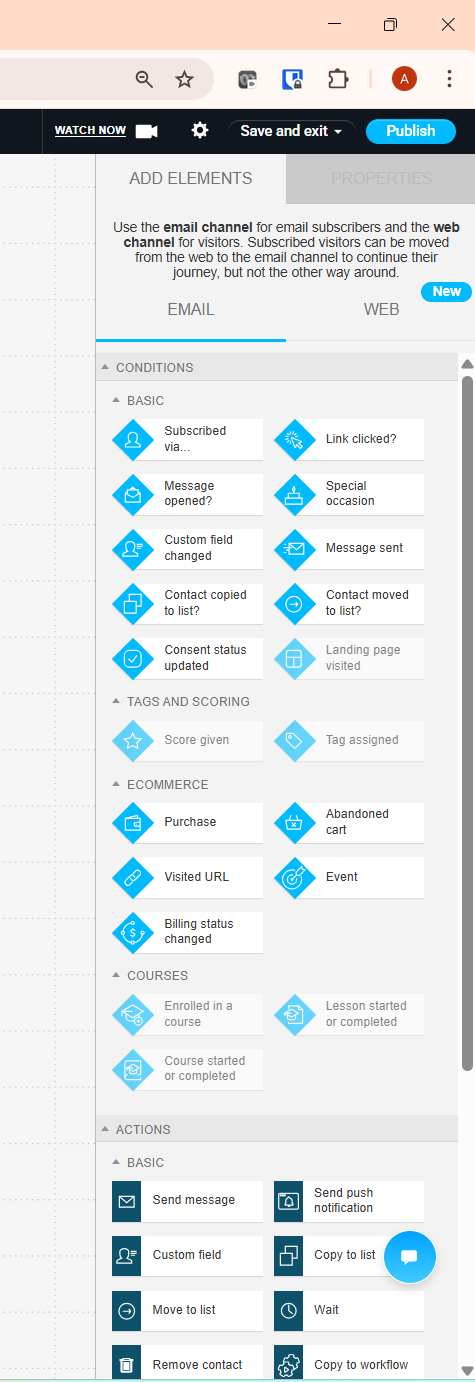
GetResponse’s visual workflow builder is genuinely capable. On the Marketer plan, you get unlimited workflows with 15+ condition types including email opens, link clicks, page visits, tag assignments, form submissions, and ecommerce events. The canvas-based interface makes building multi-step sequences intuitive, and over 50 pre-built workflow templates cover the most common affiliate marketing flows — welcome sequences, lead magnet delivery, re-engagement, and post-purchase follow-ups.
The screenshot below shows the automation canvas from my live InnovateHub Finance workflow — a lead magnet delivery sequence built directly inside GetResponse. You can see the trigger, filter, and send message steps connected in a clean visual flow.
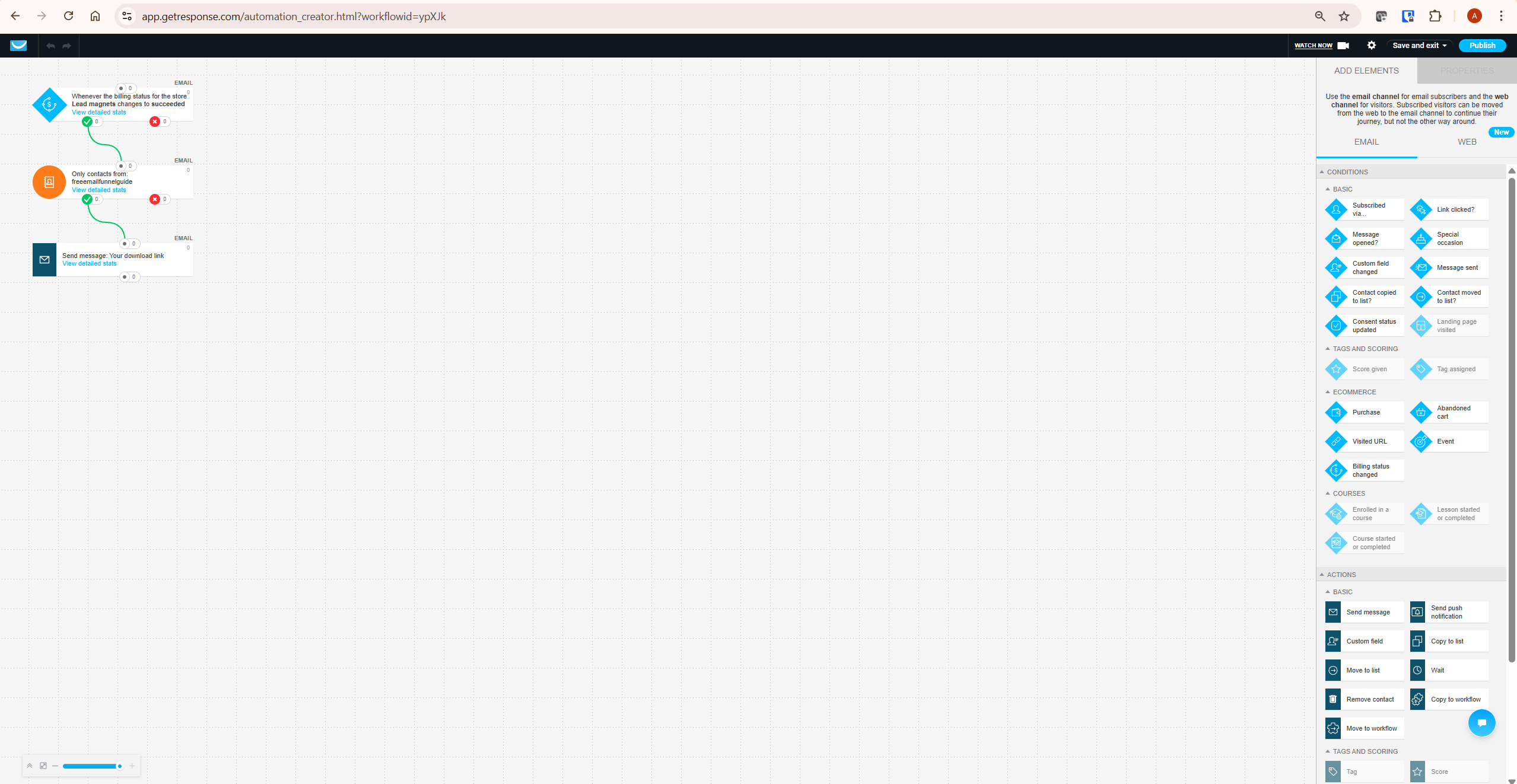
Where GetResponse automation has limitations: there is no predictive sending, no A/B testing of automation paths (only individual emails), and site tracking is less granular than ActiveCampaign’s. For most affiliate marketing workflows — deliver lead magnet, nurture over 7–14 days, tag based on link clicks, trigger product-specific sequences — GetResponse handles everything you need.
ActiveCampaign Automation
ActiveCampaign is legitimately the strongest automation platform in this price range. Its workflow builder supports unlimited branching, goal tracking, predictive sending, split testing of automation paths, and deeply granular site and event tracking. You can build conditional logic that responds to specific pages a subscriber visited, products they viewed, support tickets they raised, and CRM deal stage changes — all within a single workflow.
The catch: ActiveCampaign’s Starter plan caps automations at just 5 actions per workflow with no conditional branching. The full power of the builder only activates on the Plus plan ($49/month) and above. If you are comparing entry-level plans, GetResponse’s Marketer plan ($59/month) with unlimited workflows actually matches or exceeds ActiveCampaign’s Plus plan on the features most affiliate marketers use day-to-day.
GetResponse Automation Conditions — What You Can Trigger On
The screenshot below shows the full conditions panel inside GetResponse’s automation builder. Every blue tile is a trigger you can build a workflow branch around — from basic email engagement through to ecommerce events, course enrolments, and scoring rules.
Automation Verdict
ActiveCampaign wins on automation depth — no question. If you are building complex multi-channel sequences with CRM integration, sales pipeline triggers, and predictive sending, ActiveCampaign is the better tool. For the majority of affiliate content site owners running welcome sequences, lead magnet funnels, and topic-segmented nurture flows, GetResponse’s automation is more than sufficient and costs less to access at full capability.
Deliverability: The Honest Numbers
Deliverability is the one metric that determines whether your email marketing actually works. An automation sequence is worthless if the emails land in spam.
Based on independent testing by EmailToolTester — the most consistently cited independent deliverability benchmark in the industry:
- ActiveCampaign: 94.2% inbox placement — ranked first among all platforms tested
- GetResponse: 90.9% inbox placement — ranked fifth among platforms tested
- Industry average: 83.1%
Both platforms are above the industry average. ActiveCampaign’s 3–4 percentage point advantage is real and meaningful at scale — on a list of 10,000 subscribers, that is an additional 300–400 emails reaching inboxes per send. That said, both platforms’ deliverability scores assume you are following best practices: double opt-in, authenticated domain (SPF/DKIM), clean list hygiene, and sending relevant content to engaged subscribers.
Deliverability verdict: ActiveCampaign wins. The gap is not catastrophic for GetResponse users who maintain clean lists and good sending practices, but it is a genuine advantage worth acknowledging in any honest GetResponse vs ActiveCampaign comparison.
Landing Pages
Landing pages are essential for affiliate marketers building lead magnet funnels. Both platforms include a landing page builder, but the implementation differs significantly.
GetResponse Landing Pages
GetResponse includes unlimited landing pages on the Marketer and Creator plans, with over 190 responsive templates and an AI-powered builder option. When creating a new page, GetResponse gives you a clear choice: build it yourself using the drag-and-drop editor with ready-made templates, or use the AI-powered builder for faster page generation.

The integration between landing page sign-ups and automation triggers is seamless — a subscriber submits the form and enters your workflow immediately. For affiliate marketers building opt-in pages for lead magnets, review pages, or product comparison pages, GetResponse’s builder handles everything without requiring a separate tool.
ActiveCampaign Landing Pages
ActiveCampaign added landing pages as a feature in recent years through its “Pages” feature. The builder is functional but less mature than GetResponse’s — fewer templates, less design flexibility, and no AI builder. Landing pages are included from the Plus plan upward. For basic opt-in pages the tool is adequate; for more sophisticated page design, most ActiveCampaign users end up using a third-party tool like Unbounce or Leadpages alongside the platform.
Landing pages verdict: GetResponse wins. More templates, a more mature builder, and AI page generation included.
Webinars
This is one of the clearest differentiators in the GetResponse vs ActiveCampaign debate.
GetResponse includes built-in webinar hosting on the Creator plan — up to 100 attendees, registration pages, automated email reminders, screen sharing, polls, Q&A, and on-demand replay functionality. The entire webinar-to-email loop is automated: attendees who watch live, watch the replay, or register but do not show up each enter different follow-up sequences automatically. For affiliate marketers who want to run webinar funnels — teach something valuable, recommend a product — this is a meaningful advantage that requires no additional tools or cost.
ActiveCampaign has no native webinar tool. If you want webinar functionality alongside ActiveCampaign, you integrate with a third-party platform such as Zoom, GoToWebinar, or WebinarNinja, then connect the data back via Zapier or native integration. A Zoom Webinar plan starts at $149/month on top of your ActiveCampaign subscription.
Webinar verdict: GetResponse wins decisively. Built-in, integrated, no additional cost on Creator plan.
CRM Functionality
ActiveCampaign offers a genuine CRM with deal pipelines, contact scoring, sales automation, and the ability to trigger marketing sequences based on CRM deal stage changes. The integration between marketing automation and sales pipeline is tight and genuinely powerful for businesses with a consultative sales process.
GetResponse has CRM-adjacent features — tagging, contact scoring, and segmentation — but no dedicated sales pipeline tool. For pure affiliate marketing, where there is no sales team and the revenue model is commission on referred purchases, the absence of a CRM is not a practical limitation. The tagging and segmentation tools in GetResponse’s Marketer plan cover everything an affiliate marketer needs to segment and target their list intelligently.
CRM verdict: ActiveCampaign wins. Largely irrelevant for affiliate content site owners, essential for businesses with active sales processes.
Affiliate Marketing Policies: An Important Distinction
This is a section most GetResponse vs ActiveCampaign comparisons skip entirely — but it matters directly to affiliate marketers.
Both platforms allow affiliate links in emails, but with different restrictions. GetResponse’s policies are generally considered more permissive for affiliate marketers — you can include affiliate links in emails provided the content is substantive and the list is permission-based. The platform is widely used in the affiliate marketing community and the terms reflect that.
ActiveCampaign also allows affiliate links but has stricter account review policies and a history of being more aggressive in suspending accounts flagged for affiliate-heavy email patterns. Legitimate content-led affiliate marketers with opt-in lists rarely encounter issues — but it is a real operational consideration worth knowing before you build your entire email infrastructure on the platform.
Ease of Use
GetResponse has a gentler learning curve. The dashboard is organised logically, the automation builder is visual and intuitive for new users, and the onboarding materials are solid. Most users report being comfortable with the core workflow within a few hours of first use.
ActiveCampaign is more powerful but more complex. The left-hand navigation has significantly more items, the automation builder has more options — which means more decisions to make — and the CRM layer adds additional complexity. Independent reviews consistently note that ActiveCampaign requires 2–3 hours to feel comfortable with the automation builder. For a solo content site owner who needs to move quickly, this learning curve has a real opportunity cost.
Ease of use verdict: GetResponse wins. Faster to get productive, less overwhelming for non-technical users.
Integrations
ActiveCampaign offers 900+ native integrations versus GetResponse’s 170+. If your business relies on niche tools or has a complex tech stack, ActiveCampaign is more likely to have a native integration. GetResponse covers the major platforms — Shopify, WooCommerce, Zapier, Stripe, PayPal, WordPress — which covers everything most affiliate content site owners need.
Integrations verdict: ActiveCampaign wins on breadth. For most affiliate site use cases, GetResponse’s integrations are sufficient.
GetResponse vs ActiveCampaign: Head-to-Head Summary
| Category | GetResponse | ActiveCampaign |
|---|---|---|
| Pricing (1k contacts, full automation) | $59/month (Marketer) | $49/month (Plus) |
| Free plan | ✅ Yes (500 contacts) | ❌ Trial only |
| Automation depth | Good — 15+ conditions, unlimited workflows | Excellent — industry-leading |
| Deliverability | 89.7% (good) | 93.4% (excellent) |
| Landing pages | ✅ Included, 190+ templates | ✅ Included, fewer templates |
| Webinars | ✅ Built-in (Creator plan) | ❌ Requires third-party tool |
| CRM | Basic tagging/scoring only | Full CRM with pipelines (add-on) |
| Course creation | ✅ AI course builder included | ❌ Not available |
| Integrations | 170+ | 900+ |
| Ease of use | Easier for new users | Steeper learning curve |
| Affiliate-friendly policies | More permissive | Stricter review history |
| Contact billing (2026) | Active contacts only | All contacts including unsubscribed |
Who Should Choose GetResponse
- Affiliate marketers and content site owners who want email, landing pages, and automation in one subscription without paying for separate tools
- Anyone who wants to run webinar funnels without a separate platform cost
- Course creators and educators who want to build and sell online courses alongside their email marketing
- Marketers with growing lists who want predictable per-active-contact billing rather than ActiveCampaign’s all-contacts model
- New users who need to get productive quickly without a steep learning curve
Who Should Choose ActiveCampaign
- Businesses with an active sales team that needs marketing and CRM tightly integrated
- Ecommerce operations at scale where predictive sending and advanced behavioural triggers drive significant revenue
- Teams who need 900+ native integrations and have a complex existing tech stack
- Marketers for whom deliverability is the overriding priority and the 3–4% inbox placement advantage justifies the premium
- B2B businesses running sophisticated lead nurturing with deal pipeline integration
Final Verdict: GetResponse vs ActiveCampaign for Affiliate Marketers
For affiliate marketers and content site owners specifically, GetResponse wins this comparison in 2026 — and the reasoning is straightforward.
ActiveCampaign’s advantages — deeper automation logic, better deliverability, stronger CRM — are genuine. But most of those advantages only matter meaningfully if you are running a B2B operation with a sales team, or an ecommerce business with hundreds of post-purchase sequences. For an affiliate content site, GetResponse’s automation is more than sufficient. The webinar integration, course creation tools, more permissive affiliate policies, and all-in-one value proposition are harder to replicate on ActiveCampaign without adding significant third-party cost.
The November 2025 billing change — where ActiveCampaign now charges for all contacts including unsubscribed and bounced — is also a material consideration. As your list grows and ages, the divergence between your active subscriber count and your total contact count will widen, and ActiveCampaign’s cost will outpace GetResponse’s meaningfully.
After three decades in finance, my baseline principle is this: pay for capability you actually use, not capability that sounds impressive. In the GetResponse vs ActiveCampaign decision for most affiliate content site owners, GetResponse delivers everything you need at a lower total cost of ownership.
Frequently Asked Questions
Is GetResponse better than ActiveCampaign for beginners?
Yes, for most beginners. GetResponse has a gentler learning curve, a free plan to start with, and a more intuitive automation builder for users new to email marketing. ActiveCampaign is more powerful but significantly more complex — most users report needing several sessions before they feel comfortable with the full platform. If you are starting from scratch, GetResponse gets you productive faster.
Does ActiveCampaign have better automation than GetResponse?
Yes — ActiveCampaign’s automation engine is deeper. It supports more granular conditional logic, A/B testing of automation paths, predictive sending, and tighter CRM integration than GetResponse. The caveat is that the full power only unlocks on the Plus plan ($49/month) and above — the Starter plan caps workflows at 5 actions with no branching. For most affiliate marketing use cases, GetResponse’s automation on the Marketer plan covers everything needed.
Which has better deliverability — GetResponse or ActiveCampaign?
ActiveCampaign scores higher on independent inbox placement tests — 93.4% versus GetResponse’s 89.7% according to EmailToolTester’s benchmarks. Both are above the industry average of 83.1%. The gap is real but manageable for GetResponse users who maintain clean lists, authenticate their domain, and use double opt-in.
Can I use GetResponse or ActiveCampaign for affiliate marketing?
Both platforms allow affiliate links in emails, provided the content is substantive and the list is permission-based. GetResponse has a more established reputation among affiliate marketers and generally more permissive policies. ActiveCampaign allows affiliate links but has a stricter account review history for heavily promotional sending patterns. For content-led affiliate marketers with opt-in lists, both platforms work well.
What changed with ActiveCampaign pricing in 2026?
In November 2025, ActiveCampaign changed its billing model to charge for all contacts in an account — including unsubscribed, bounced, and unconfirmed contacts. This significantly increased costs for many users with older lists. GetResponse continues to bill based on active contacts only. If you have a list with significant churn history, factor this carefully into your cost comparison.
Does GetResponse include webinars and ActiveCampaign does not?
Yes. GetResponse includes built-in webinar hosting on the Creator plan, supporting up to 100 attendees with automated follow-up sequences and on-demand replay. ActiveCampaign has no native webinar tool — you would need to integrate with a third-party platform like Zoom Webinars (from $149/month) on top of your ActiveCampaign subscription. If webinar funnels are part of your strategy, this is a significant cost difference.
Which platform is better value for a growing affiliate site?
GetResponse offers better value for growing affiliate content sites. The all-in-one model eliminates the need to pay separately for multiple tools, and the active-contacts-only billing model keeps costs predictable as your list grows. Read our full GetResponse review for a complete platform breakdown, or see our GetResponse pricing guide for a detailed cost comparison.
Related GetResponse Articles
- GetResponse Review 2026: The Honest Verdict for Affiliate Marketers
- GetResponse Pricing in 2026: Plans, Features & What You Actually Pay For
- GetResponse vs Mailchimp: Which Email Marketing Platform Is Better?
- How to Build an Email Funnel with GetResponse (Step-by-Step Guide)
- How to Use GetResponse Automation for Affiliate Marketing (Advanced Guide)
This comparison is based on platform research as of early 2026 and my direct experience using GetResponse for InnovateHub Finance. Pricing and features change frequently — always verify current details directly with both platforms before making a purchase decision.
