
TradingView vs MetaTrader: Which Is Better for Crypto Trading in 2026?
This article contains affiliate links. If you sign up for TradingView through a link on this page, I may earn a commission at no extra cost to you. I only recommend tools I have genuinely evaluated.
Trading involves risk. Technical analysis tools do not guarantee profitable results. Past performance is not indicative of future results. Always manage your risk appropriately.
If you are trying to decide between TradingView vs MetaTrader and every comparison you read gives you a vague “it depends on your trading style” answer — this guide does not. After 30 years in finance using professional-grade analysis tools across multiple markets, I can tell you precisely where each platform wins, where it falls short, and which one is the correct choice for specific trader types. The TradingView vs MetaTrader question has a clear answer for most traders — it is just buried under generic comparisons that avoid taking a position.
TradingView vs MetaTrader looks like a direct competition on the surface. Both platforms support technical analysis, both have large indicator libraries, both are used by professional traders. The difference is in what they are fundamentally built to do — and that distinction determines which one belongs in your workflow.
By the end of this TradingView vs MetaTrader comparison, you will know exactly which platform fits your current trading approach, whether running both simultaneously makes sense, and what the upgrade path looks like as your trading evolves.
If you want to test TradingView as part of this comparison, the free plan covers everything needed to evaluate it. Get started with TradingView here.
Quick Answer: TradingView vs MetaTrader
TradingView vs MetaTrader in one paragraph: TradingView wins on charting quality, interface usability, multi-market coverage, and analytical depth. MetaTrader wins on automated trade execution, direct broker integration, and fully automated strategy deployment through Expert Advisors. For crypto traders and multi-market analysts whose edge comes from chart analysis, TradingView is the clear choice. For forex and CFD traders who run automated strategies that execute without human intervention, MetaTrader is the correct tool. Most serious traders who need both use them together — TradingView for analysis, MetaTrader for automated execution — treating them as complementary rather than competing platforms.

TradingView vs MetaTrader: What Each Platform Is Built For
The TradingView vs MetaTrader comparison starts with understanding that these platforms were built for fundamentally different primary functions — and that distinction drives every specific difference between them.
TradingView is a web-based charting and market analysis platform. It was built to be the best possible environment for technical analysis — clean charts, deep indicator libraries, flexible alert systems, multi-chart layouts, and cross-market data coverage. TradingView’s primary function is analysis. Execution is a secondary feature available through broker integrations, but it is not what the platform is optimised for.
MetaTrader — specifically MT4 and MT5 — is a desktop-based trading platform built by MetaQuotes. It was designed from the ground up as a broker-integrated execution environment. MetaTrader’s primary function is trade execution and automated strategy deployment through Expert Advisors (EAs) — programs that can monitor markets, identify signals, and place trades without any human intervention. Analysis exists in MetaTrader, but it is secondary to execution.
Once you understand this distinction, the TradingView vs MetaTrader comparison becomes much simpler: the right platform is whichever one matches what you primarily need to do. For a complete overview of TradingView’s full feature set, our TradingView review covers the platform in detail.
TradingView vs MetaTrader: Charting and Technical Analysis
This is the category where the TradingView vs MetaTrader comparison is most one-sided — and TradingView wins clearly.
TradingView’s charting interface is genuinely the best available for retail traders at any price point. Charts are fast, responsive, and visually clean. Zooming, panning, and switching timeframes all feel fluid. The chart type library covers candlestick, bar, Heikin Ashi, Renko, Point and Figure, and Kagi — meaning every analytical approach from standard price action reading through to advanced non-linear charting techniques is supported. Drawing tools, from trendlines and horizontal levels through to Fibonacci tools and complex pattern shapes, are comprehensive and save automatically to named layouts.
MetaTrader’s charting is functional but dated. The interface has changed little in design over the past decade. Adding indicators requires manual installation in many cases, chart customisation options are more limited, and the overall experience of using MetaTrader charts for analysis feels like using a tool built for a different era. Experienced MetaTrader users adapt to this — but traders evaluating the TradingView vs MetaTrader choice for the first time consistently find TradingView’s charting experience significantly more accessible and productive.
For traders who make decisions based on chart analysis, the TradingView vs MetaTrader charting comparison is not close. TradingView is the correct analytical environment. Our best TradingView indicators for crypto trading guide covers the specific indicator configurations that make TradingView’s analytical advantage most tangible.
TradingView vs MetaTrader: Indicators and Custom Scripts
Both platforms support custom indicator development — but the TradingView vs MetaTrader indicator ecosystem comparison reveals meaningful differences in accessibility and depth.
TradingView uses Pine Script as its indicator language — a purpose-built scripting language designed to be approachable for traders who are not professional programmers. At its simplest level, Pine Script allows you to modify an existing indicator’s parameters or visual presentation. At its most advanced, it allows you to build fully custom indicators that encode your specific trading logic, complete with alert triggers. The public indicator library on TradingView contains tens of thousands of community-built scripts, the majority available at no cost — meaning for most trading approaches, a working indicator already exists and can be adapted rather than built from scratch.
MetaTrader uses MQL4 (for MT4) and MQL5 (for MT5) — languages significantly closer to C++ in their syntax and complexity. For traders with programming backgrounds, MQL gives access to extremely sophisticated automated strategy logic. For traders without programming backgrounds, MetaTrader’s indicator development is a significant barrier. The MetaTrader marketplace (MQL5 Market) contains thousands of indicators and EAs, but many premium tools carry individual purchase costs.
In the TradingView vs MetaTrader indicator comparison: TradingView is more accessible for analysis-focused indicator use, MetaTrader is more capable for complex automated execution logic.
TradingView vs MetaTrader: Automation and Expert Advisors
This is the one category in the TradingView vs MetaTrader comparison where MetaTrader has a clear and significant advantage.
MetaTrader’s Expert Advisor system allows traders to deploy fully automated trading strategies that monitor markets continuously, identify signals based on defined criteria, place orders, manage positions, and adjust stop losses — all without any human intervention. An EA running on MetaTrader can trade 24 hours a day on a VPS server while you are completely offline. For forex traders who have developed algorithmic strategies, this capability is the entire reason MetaTrader exists in their workflow.
TradingView’s automation capability is alert-based rather than execution-based. You can build strategies in Pine Script, backtest them against historical data, and trigger alerts when conditions are met — but TradingView itself does not place the orders. Third-party webhook integrations can connect TradingView alerts to brokers for semi-automated execution, but this is significantly more complex to set up than a native MetaTrader EA deployment.
In the TradingView vs MetaTrader automation comparison: if fully automated strategy execution is a core requirement, MetaTrader is the correct choice. If alert-driven semi-automation is sufficient, TradingView covers this well with less complexity. Our TradingView alerts guide covers the alert system in detail.
TradingView vs MetaTrader: Market Coverage
The TradingView vs MetaTrader market coverage comparison is significant for traders who work across multiple asset classes.
TradingView aggregates price data from hundreds of exchanges and data providers across stocks, ETFs, cryptocurrencies, forex pairs, commodities, indices, and futures. You can switch between a Bitcoin chart on Binance, the S&P 500, EURUSD, and Gold within seconds — all in the same interface with the same tools. For multi-market traders or analysts who need to monitor correlations across asset classes, TradingView’s coverage is exceptional.
MetaTrader’s market coverage depends entirely on your broker. MT4 and MT5 show only the instruments your specific broker offers — typically forex pairs, CFDs on stocks and indices, and commodities. Cryptocurrency coverage varies by broker and is generally more limited than TradingView’s multi-exchange crypto data. In the TradingView vs MetaTrader market coverage comparison, TradingView wins decisively for traders who operate across multiple markets.
TradingView vs MetaTrader: Interface and Usability
The TradingView vs MetaTrader usability gap is one of the most immediately noticeable differences for new users evaluating both platforms.
TradingView is browser-based — no download, no installation, no broker account required to start. The interface is modern, clean, and immediately navigable. A trader who has never used TradingView before can load a chart, add RSI and EMA indicators, draw support and resistance levels, and set a price alert within fifteen minutes. The learning curve exists — mastering Pine Script and multi-chart layouts takes time — but the entry point is genuinely accessible.
MetaTrader requires download and installation. The interface is dense and functional but not modern — it was designed in an era when displaying maximum information took priority over visual clarity. For experienced MetaTrader users, the interface is familiar and efficient. For traders evaluating the TradingView vs MetaTrader choice for the first time, MetaTrader’s initial setup and interface can feel significantly more demanding than TradingView’s immediate accessibility.
TradingView vs MetaTrader: Pricing
The TradingView vs MetaTrader pricing comparison is more nuanced than it first appears.
MetaTrader software itself is free — you download it at no cost and use it through your broker’s account. The actual cost of MetaTrader is indirect: spreads, commissions, and swap rates charged by your broker. Premium EAs and indicators from the MQL5 Market carry individual purchase costs that can be significant for traders building complex automated strategies.
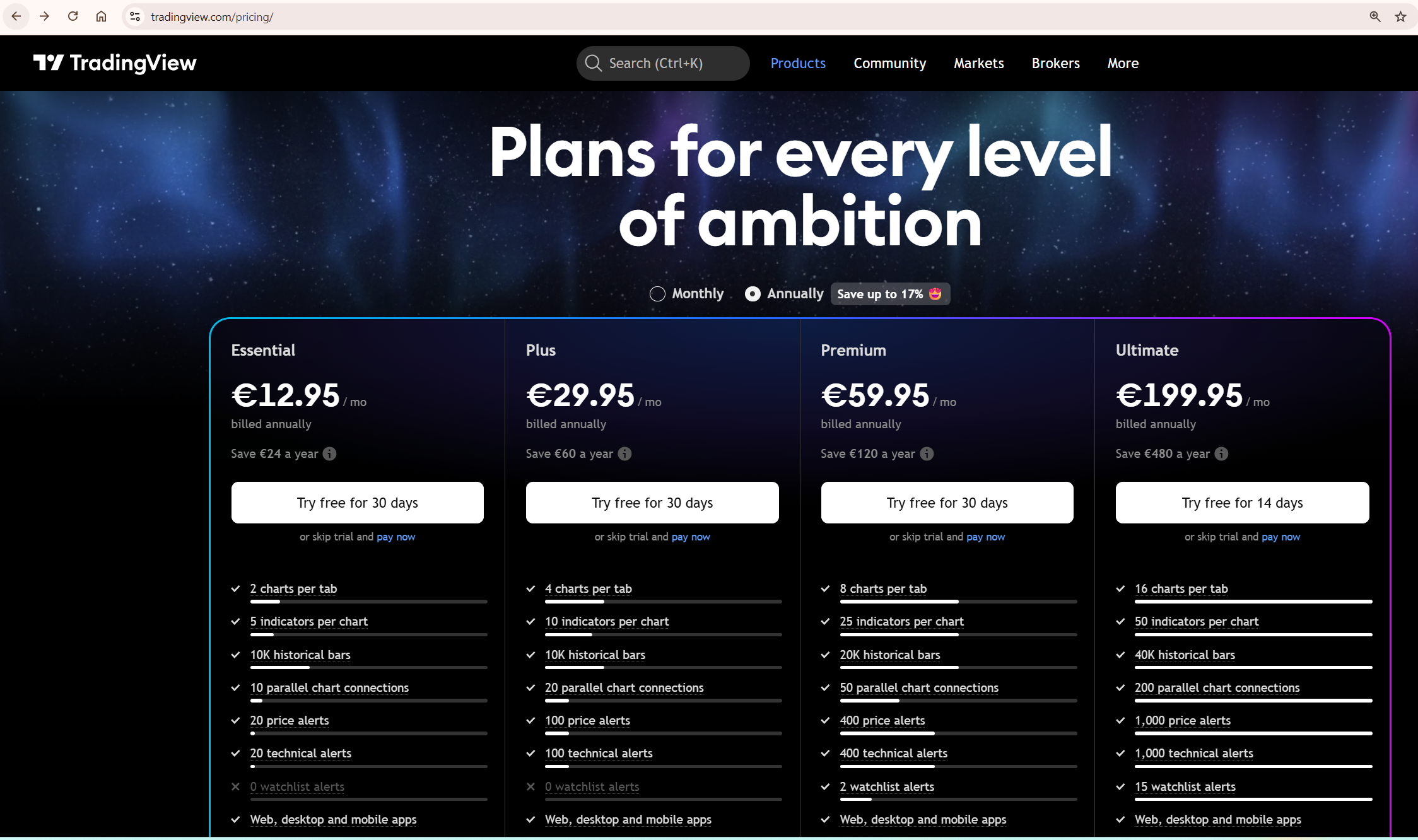
TradingView has a free plan that is genuinely functional for basic analysis — three indicators per chart, one chart per layout, limited alerts. The features that make the most meaningful difference for active traders — multi-chart layouts, expanded alert volumes, more indicators per chart — require paid plans starting at approximately €12.95 per month. For traders who use TradingView as their primary analysis environment, this cost is justified. For occasional users, the free plan may be sufficient.
For a detailed breakdown of what each TradingView plan includes and when upgrading is worth it, our TradingView free vs paid guide covers the decision with specific milestone recommendations. Explore TradingView’s current plan pricing here.
TradingView vs MetaTrader: Who Should Use Each Platform?
The TradingView vs MetaTrader decision maps directly to your trading approach and primary requirements.
TradingView is the right choice for crypto traders who need multi-exchange data coverage, traders whose edge comes from chart analysis and indicator-based decision making, multi-market analysts who monitor stocks, crypto, forex, and commodities simultaneously, traders who use alert-based workflows to monitor markets without constant screen time, and beginners who need a clean, accessible entry point into technical analysis.
MetaTrader is the right choice for forex and CFD traders who trade through a broker that provides MetaTrader access, traders who run fully automated strategies via Expert Advisors that execute without human intervention, and algorithmic traders whose strategies are already coded in MQL4 or MQL5 and require MetaTrader’s execution infrastructure.
Many serious traders use both. This is not a compromise — it is the most effective workflow for traders who need the best of both platforms. TradingView handles the analysis: multi-timeframe chart review, indicator setups, alert configuration. MetaTrader handles automated execution: EAs running strategy logic and placing orders through broker integration. The TradingView vs MetaTrader question, for these traders, is not either/or — it is both, used for different functions.
Frequently Asked Questions: TradingView vs MetaTrader
Is TradingView better than MetaTrader for charting?
Yes — TradingView is significantly better than MetaTrader for charting quality, interface usability, and analytical depth. The TradingView vs MetaTrader charting comparison is not particularly close. TradingView’s charts are faster, more visually clean, more customisable, and supported by a deeper indicator ecosystem. MetaTrader’s charts are functional but dated — adequate for traders who have built their workflow around them, but not the preferred choice for traders evaluating both options fresh.
Can I use TradingView and MetaTrader together?
Yes — and for traders who need both analytical depth and automated execution, using both is the most effective workflow. TradingView handles chart analysis and alert monitoring; MetaTrader handles automated strategy execution through Expert Advisors. The TradingView vs MetaTrader choice does not have to be exclusive — they serve different primary functions and complement each other well in a combined workflow.
Is MetaTrader better than TradingView for automated trading?
Yes — MetaTrader’s Expert Advisor system is more capable for fully automated strategy execution than TradingView’s alert-based automation approach. If your strategy requires orders to be placed automatically without human intervention, MetaTrader is the correct platform. If alert-driven semi-automation — where TradingView fires an alert and you manually execute the order — is sufficient, TradingView handles this well without the complexity of MetaTrader’s setup. This is the clearest differentiator in the TradingView vs MetaTrader comparison.
Which is better for crypto trading — TradingView or MetaTrader?
TradingView is the better choice for crypto trading. It aggregates data from all major crypto exchanges, supports thousands of cryptocurrency pairs, provides 24/7 alert monitoring, and offers the multi-exchange data coverage that MetaTrader’s broker-dependent architecture cannot match. The TradingView vs MetaTrader crypto comparison is one-sided — MetaTrader’s crypto coverage is limited to whatever instruments your specific broker offers, while TradingView gives you direct access to Binance, Coinbase, Bybit, OKX, and every other major exchange from a single interface.
TradingView vs MetaTrader: Final Verdict
The TradingView vs MetaTrader comparison resolves cleanly once you focus on primary function rather than feature lists. TradingView is the best analysis platform available for retail traders — superior charting, better indicators, cleaner interface, broader market coverage, and a genuinely accessible entry point for traders at every experience level. MetaTrader is the best automated execution platform for forex and CFD traders — deep broker integration, a mature EA ecosystem, and fully autonomous strategy deployment that TradingView cannot replicate natively.
For crypto traders and multi-market analysts, the TradingView vs MetaTrader decision is straightforward: TradingView. For forex algorithmic traders with existing MetaTrader strategies, keep MetaTrader for execution and consider adding TradingView for analysis. For traders who are new to both and building their workflow from scratch, start with TradingView — it is the right analytical foundation for the way most retail traders actually work.
For active traders who rely on chart analysis daily, TradingView is worth the investment. Explore TradingView’s plans here.
