
Semrush vs Ahrefs: Best Tool for Affiliate Marketers? (2026)
Disclosure: This site earns revenue through affiliate partnerships with other platforms. This article does not currently contain affiliate links for Semrush or Ahrefs. All recommendations are based on independent research and publicly available data.
For affiliate marketers running content sites, Semrush vs Ahrefs is one of the most consequential tool decisions you will make — and most comparisons online dodge the honest answer. Here it is: Semrush is the better all-in-one platform for affiliate content publishers, and Ahrefs is the better pure SEO tool for link-focused professionals. The right choice depends entirely on where you are in your site’s growth and what you actually use daily. After 30 years in finance and building an affiliate content site from scratch, what matters to me is not the longest feature list — it is whether the tool changes what I do and improves the outcome. This guide gives you the complete Semrush vs Ahrefs breakdown so you can make that call clearly.
Quick Answer: Semrush vs Ahrefs
Choose Semrush if you need an all-in-one platform covering keyword research, content planning, site auditing, competitor analysis, and AI visibility tracking in one subscription. It is the stronger choice for affiliate content publishers and solo operators who need breadth without juggling multiple tools. Choose Ahrefs if backlink analysis and link building are your primary focus — its referring domain index and near-real-time crawler are unmatched. For a content-heavy affiliate site at an early to mid stage, Semrush is the more practical starting point.
Semrush vs Ahrefs: Head-to-Head Comparison
| Feature | Semrush | Ahrefs | Winner |
|---|---|---|---|
| Keyword Database | 27.9 billion keywords, 142 locations | 28.7 billion keywords, 217 locations | Ahrefs (global breadth) |
| Backlink Index | 43 trillion links, 390M domains | 35 trillion links, 500M domains | Ahrefs (more domains) |
| Site Audit | 140+ checks, thematic reports, AI health score | 170+ checks, clean interface, always-on crawl | Tie |
| Content Marketing Tools | Full platform — briefs, templates, AI writer | Content Explorer only | Semrush |
| AI Visibility Tracking | Yes — ChatGPT, Perplexity, Google AI Overviews | Limited — add-on only | Semrush |
| PPC / Advertising Tools | Full PPC research suite | Ad intel only, no PPC management | Semrush |
| Ease of Use | Complex — steep learning curve | Cleaner interface, faster to navigate | Ahrefs |
| Entry Price (annual) | $117/month (Pro) | $108/month (Lite) | Ahrefs (slightly) |
| Free Plan | No — free tools only | Yes — Webmaster Tools (verified sites) | Ahrefs |
| Best For | Affiliate content publishers, all-in-one marketing | Link builders, technical SEO specialists | Depends on use case |
What Is Semrush?
Semrush launched in 2008 and has since grown into one of the most comprehensive digital marketing platforms available. It covers keyword research, rank tracking, site auditing, backlink analysis, content marketing, PPC research, social media management, and in 2026 added Semrush One — an AI visibility tracking layer monitoring brand citations across ChatGPT, Perplexity, and Google’s AI Overviews. With over 10 million registered users and approximately 117,000 paying subscribers, Semrush is the dominant choice for teams that need a single tool covering multiple marketing disciplines. For a full breakdown of its features and pricing, read our complete Semrush review.
What Is Ahrefs?
Ahrefs launched in 2010, initially as a backlink analysis tool, and has since expanded into a comprehensive SEO suite covering keyword research, site audits, rank tracking, and content research. Its AhrefsBot is the second most active web crawler after Googlebot, processing approximately 8 billion pages daily — which is why its backlink data refreshes faster than any competitor. Ahrefs introduced a $29/month Starter plan in January 2026, significantly lowering the entry barrier, though the Starter plan is too limited for professional use. The Lite plan at $108/month (annual) is the realistic entry point for serious work.
Semrush vs Ahrefs: Pricing Compared
Pricing is where the Semrush vs Ahrefs comparison gets more nuanced than most articles acknowledge. The headline numbers look similar — but the structure is meaningfully different. Understanding this is essential before committing to either platform. For a detailed breakdown of Semrush’s plans specifically, our Semrush pricing guide covers every tier and limit.
Semrush Pricing
Semrush runs on three tiers. Pro starts at $139.95/month (billed monthly) or approximately $117/month annually. Guru — the plan most affiliate content sites will need for the Content Marketing Platform — is $249.95/month or approximately $208/month annually. Business is $499.95/month. There is no free plan, though free tools are available without an account. Annual billing saves approximately 17% across all plans.
Ahrefs Pricing
Ahrefs has five tiers in 2026. The new Starter plan is $29/month — useful for evaluation but too restricted for professional use (500 credits/month, 1 project). Lite is $108/month annually — the realistic entry for freelancers and small sites. Standard is $199/month annually — the agency plan with 20 projects, 2 years of historical data, and Content Explorer access. Advanced is $374/month annually. Enterprise starts at $1,249/month annually. Ahrefs offers a free Webmaster Tools plan for verified site owners, giving limited access to Site Explorer and Site Audit — a meaningful advantage over Semrush’s no-free-plan position.
One important Ahrefs pricing warning: the Lite and Starter plans use a credit system on certain tools. Heavy usage can trigger additional charges beyond the base subscription. The Standard plan removes credit restrictions. This is a meaningful hidden cost that does not apply to Semrush’s equivalent plans.
Pricing Verdict
At comparable tiers — Semrush Guru ($208/month annual) vs Ahrefs Standard ($199/month annual) — the prices are nearly identical. Ahrefs wins on entry price with the Lite plan, and its free Webmaster Tools plan is a genuine advantage. Semrush wins on what is included at equivalent price points, particularly the Content Marketing Platform and AI visibility tools.
Semrush vs Ahrefs: Keyword Research
Keyword research is where most affiliate content publishers spend the majority of their time, and the Semrush vs Ahrefs comparison here is closer than the headline numbers suggest.
Semrush’s Keyword Magic Tool draws from a 27.9 billion keyword database across 142 locations. Its intent classification — informational, navigational, commercial, transactional — is the strongest in the market for affiliate content planning. The Keyword Gap tool compares your domain against up to four competitors simultaneously, surfacing keywords they rank for that you do not. For a content site building topical authority clusters, this is a workflow-defining feature. Our guide on keyword research with Semrush covers the full affiliate workflow step by step.
Ahrefs’ Keywords Explorer accesses 28.7 billion keywords across 217 locations — a larger global footprint. Its unique strength is click data: Ahrefs shows not just search volume but estimated clicks per search, accounting for zero-click results where Google answers the query without a click-through. This distinction matters for realistic traffic forecasting. Ahrefs also uses clickstream data to validate its volume estimates, which some SEO professionals consider more accurate than Semrush’s machine-learning model — particularly outside the US market.
Verdict: Semrush wins for US-focused affiliate content sites that need intent classification and topical cluster planning. Ahrefs wins for global keyword research and click-data accuracy. For most affiliate publishers starting out, Semrush’s workflow is more immediately actionable.
Semrush vs Ahrefs: Backlink Analysis
This is the category where Ahrefs has held a consistent, meaningful advantage — and the 2026 data confirms it still does.
Ahrefs indexes 35 trillion backlinks from 500 million referring domains. Its crawler processes 8 billion pages daily, meaning new backlinks appear in the index within hours of going live. The Site Explorer tool is widely regarded as the gold standard for competitor backlink research. The Link Intersect tool identifies sites linking to multiple competitors but not to you — creating a prioritised outreach list in minutes. For serious link building campaigns, Ahrefs is the professional standard.
Semrush indexes 43 trillion backlinks — more in raw count — from 390 million referring domains, which is fewer than Ahrefs. The Backlink Analytics tool covers referring domains, anchor text, Authority Score, toxic link detection, and lost/gained links. Its integration with Google Search Console makes the toxic link disavow workflow smooth. The Backlink Gap tool mirrors Ahrefs’ Link Intersect in concept, though with slightly less depth.
According to Backlinko’s 2026 comparison, Ahrefs remains the clear winner for pure backlink analysis and new link discovery speed. Semrush leads for integrated link auditing and toxic link identification workflows tied to Search Console.
Verdict: Ahrefs wins clearly for backlink research and link building. If link building is your primary SEO activity, Ahrefs is the correct choice. For most affiliate content sites at the early to mid stage — where content creation and keyword strategy drive growth more than link building — this advantage is less decisive.
Semrush vs Ahrefs: Site Audit
Both tools offer strong technical auditing — this is one of the most competitive categories in the Semrush vs Ahrefs comparison.
The Semrush site audit checks over 140 factors, organises results into thematic reports covering crawlability, HTTPS, Core Web Vitals, internal linking, and performance, and includes an AI Search Health score checking whether your pages are accessible to AI crawlers. The actionable “Why and how to fix it” explanation for every issue is particularly useful for site owners without a technical SEO background. We cover the full workflow in our guide on how to use Semrush Site Audit.
Ahrefs’ Site Audit checks over 170 factors and is notable for its always-on crawling feature — it continuously monitors your site rather than requiring a manual trigger. The interface is cleaner and more intuitive than Semrush’s, which makes it more approachable for beginners. Ahrefs also recently added an AI URL detection feature via its Project Boost Max add-on to monitor AI crawler access.
Verdict: A genuine tie. Semrush’s thematic reports and explanations are better for non-technical users. Ahrefs’ always-on crawling and cleaner interface suit experienced SEOs. Both will surface the same critical issues on a typical affiliate content site.
Semrush vs Ahrefs: Content Marketing Tools
This is where Semrush pulls ahead decisively for affiliate content publishers — and it is not close.
Semrush’s Content Marketing Platform (available from Guru plan upward) includes Topic Research for content ideation, the SEO Content Template which analyses top-ranking pages and produces a writing brief, the SEO Writing Assistant which integrates with Google Docs and WordPress for real-time scoring, and ContentShake AI for full draft generation. For an affiliate publisher producing multiple articles per week, this toolset provides a structured workflow from keyword to published page. As noted by Search Engine Journal, Semrush’s content tools represent one of the most complete content strategy platforms available at this price point.
Ahrefs’ content tools are significantly lighter. Content Explorer lets you research top-performing content on any topic and identify link prospects. Ahrefs has added free AI writing tools for tasks like title generation and meta descriptions, but there is no equivalent to Semrush’s content brief or writing assistant workflow. Content strategy at scale requires going outside Ahrefs entirely.
Verdict: Semrush wins decisively in the Semrush vs Ahrefs content tools comparison. For an affiliate content site where publishing volume and quality directly drive revenue, Semrush’s content tools represent a meaningful competitive advantage that Ahrefs simply does not offer.
Semrush vs Ahrefs: AI Visibility Tracking
This is the most forward-looking category in the Semrush vs Ahrefs comparison — and it matters more than most site owners currently realise.
Semrush One tracks whether your brand and content are being cited in AI-generated responses across ChatGPT, Perplexity, and Google’s AI Overviews. As AI search captures a growing share of information queries, knowing whether your content is being cited — or ignored — in AI answers is becoming as strategically important as knowing your Google rankings. Semrush integrates this directly into its site audit and position tracking workflows.
Ahrefs has added limited AI visibility features through its Project Boost Max add-on, but this is not natively integrated into the core platform in the same way. It is a reactive addition rather than a built-in strategic layer.
Verdict: Semrush leads meaningfully on AI visibility tracking. For a site building long-term authority in a competitive niche, this advantage will compound over time.
Who Should Choose Semrush vs Ahrefs?
Choose Semrush if you are:
- An affiliate content publisher needing keyword research, content tools, site auditing, and competitor analysis in one platform
- A solo operator or small team who cannot manage and pay for multiple separate tools
- Focused on topical authority building through consistent content publishing
- Interested in tracking AI search visibility alongside traditional rankings
- Running PPC campaigns alongside SEO — Semrush’s advertising tools have no equivalent in Ahrefs
Choose Ahrefs if you are:
- Running active link building campaigns where backlink data accuracy and speed are critical
- An experienced SEO professional who needs the most precise keyword difficulty and click data
- Managing multiple client sites at an agency where Ahrefs’ cleaner interface suits team workflows
- A verified site owner wanting free access to limited Site Explorer and Site Audit via Webmaster Tools
- Prioritising international keyword research across markets outside the US
If you are still weighing up whether either tool is worth the investment at your current stage, our honest assessment in Is Semrush Worth It? addresses the cost-benefit question directly for affiliate content publishers.
What To Do Next
If you are leaning toward Semrush — start with the free tools at semrush.com to evaluate data quality before committing. The Keyword Magic Tool and backlink checker are available without an account. If the data looks solid for your niche, the Pro plan covers everything a content site under 50 articles needs. Upgrade to Guru when you are ready to use the Content Marketing Platform consistently.
If you are leaning toward Ahrefs — use the free Webmaster Tools plan first if you own a verified site. It gives real access to Site Explorer and Site Audit data on your own domain, which is enough to evaluate whether the platform suits your workflow before spending $108/month.
For most affiliate content publishers at the early to mid stage: start with Semrush. The content tools, keyword workflow, and all-in-one coverage make it the more practical platform while you are building topical authority and growing organic traffic. The Semrush vs Ahrefs question does not need to be permanent — revisit Ahrefs when link building becomes a central part of your growth strategy.
The Honest Warning: Traffic Estimates Are Not Accurate
Every Semrush vs Ahrefs comparison glosses over this — but it is important enough to state clearly. Neither tool’s competitor traffic estimates are accurate. They are directional signals, not measurements.
Real-world testing has shown that Ahrefs can report a site’s organic traffic at 64,000 visits per month when actual Google Analytics data shows a completely different figure. Semrush estimates are built on a blend of clickstream data and machine-learning models — useful for spotting trends, useless for precise numbers. Both companies acknowledge this in their documentation.
What this means practically: when you use either tool to analyse a competitor’s traffic, you are getting a relative picture — is this site growing or declining, is it large or small, which pages appear to drive the most traffic. You are not getting a number you can put in a business plan. For your own site, Google Search Console and Google Analytics will always be your most accurate data sources. Both Semrush and Ahrefs are tools for understanding the competitive landscape, not for measuring it precisely.
This is not a reason to avoid either tool. It is a reason to use them intelligently — as strategic intelligence tools, not as reporting dashboards.
When Neither Semrush Nor Ahrefs Makes Sense Yet
Most comparison articles assume you are ready to spend $100-250/month on an SEO tool. That assumption is worth questioning directly.
If your affiliate site is generating no income yet — or income that does not justify a $140/month Pro subscription — neither Semrush nor Ahrefs is the right investment right now. Both are professional tools priced for professional returns. Spending $1,680/year on Semrush Pro before your site earns that back is a financial decision that does not stack up.
What makes more sense at an early stage: use Semrush’s free tools for keyword research, Ahrefs’ free Webmaster Tools for site health on your own domain, and Google Search Console as your primary data source. These three free resources together cover 80% of what a new affiliate content site actually needs. The paid tools earn their place when SEO is generating consistent revenue and the subscription cost becomes a rounding error relative to the income it supports.
The milestone worth targeting: when your site reaches 50+ articles and is generating consistent organic traffic, a Semrush Pro subscription pays for itself through better keyword decisions on every subsequent article. Below that threshold, the free tools are sufficient and the paid subscription is premature. For a detailed look at when the investment makes sense, our guide on Is Semrush Worth It? covers this decision framework directly.
Using Both Semrush and Ahrefs Together: When It Makes Sense
Many professional SEO agencies use both tools simultaneously — and for good reason. They are not truly competing products. They solve different problems at a professional level.
The practical dual-tool workflow looks like this: Semrush handles keyword research, content planning, site auditing, competitor traffic analysis, and position tracking. Ahrefs handles link building research — finding link prospects, identifying competitor backlink sources, monitoring your own link profile growth, and discovering new links within hours of them going live. At a combined cost of approximately $225/month annually (Semrush Pro + Ahrefs Lite), this setup is justifiable for an affiliate site generating $2,000+/month in revenue or for an agency billing multiple SEO retainers.
For a solo affiliate publisher at an early to mid stage: one tool is sufficient. Start with Semrush for the content and keyword workflow. Add Ahrefs when link building becomes a dedicated and recurring activity — not before. Adding Ahrefs before you have a structured link building process running is paying for a tool you will not use consistently enough to justify the cost.
Frequently Asked Questions
Is Semrush or Ahrefs better for beginners?
Ahrefs has a cleaner, more intuitive interface that is easier to navigate for new users. However, Semrush’s free tools and clearer onboarding resources give beginners more to work with without spending money first. For a beginner building an affiliate content site, Semrush’s all-in-one approach is more practical than Ahrefs’ SEO-specialist focus.
Can I use both Semrush and Ahrefs together?
Yes — many professional agencies use Semrush for audits, keyword research, and competitor analysis, while using Ahrefs specifically for link building research. At a combined cost of approximately $225/month annually (Semrush Pro + Ahrefs Lite), this dual-tool approach is justifiable for agencies billing multiple retainers. For a solo affiliate publisher, one tool is sufficient at the early stage.
Does Ahrefs have a free trial?
Ahrefs does not offer a traditional free trial with payment details. Instead, it offers a free Webmaster Tools plan for verified site owners, providing limited access to Site Explorer and Site Audit. The $29 Starter plan effectively functions as a low-cost trial for evaluation purposes, though its 500 monthly credits are consumed quickly in normal use.
Which tool has better customer support?
Semrush consistently receives higher marks for customer support responsiveness. Ahrefs has faced criticism in some 2026 user reviews for its “suspicious activity” detection system blocking legitimate usage on lower-tier plans. Both tools provide extensive documentation and training resources — Semrush’s Academy and Ahrefs’ YouTube channel are both genuinely useful free learning resources.
Which is better for rank tracking — Semrush or Ahrefs?
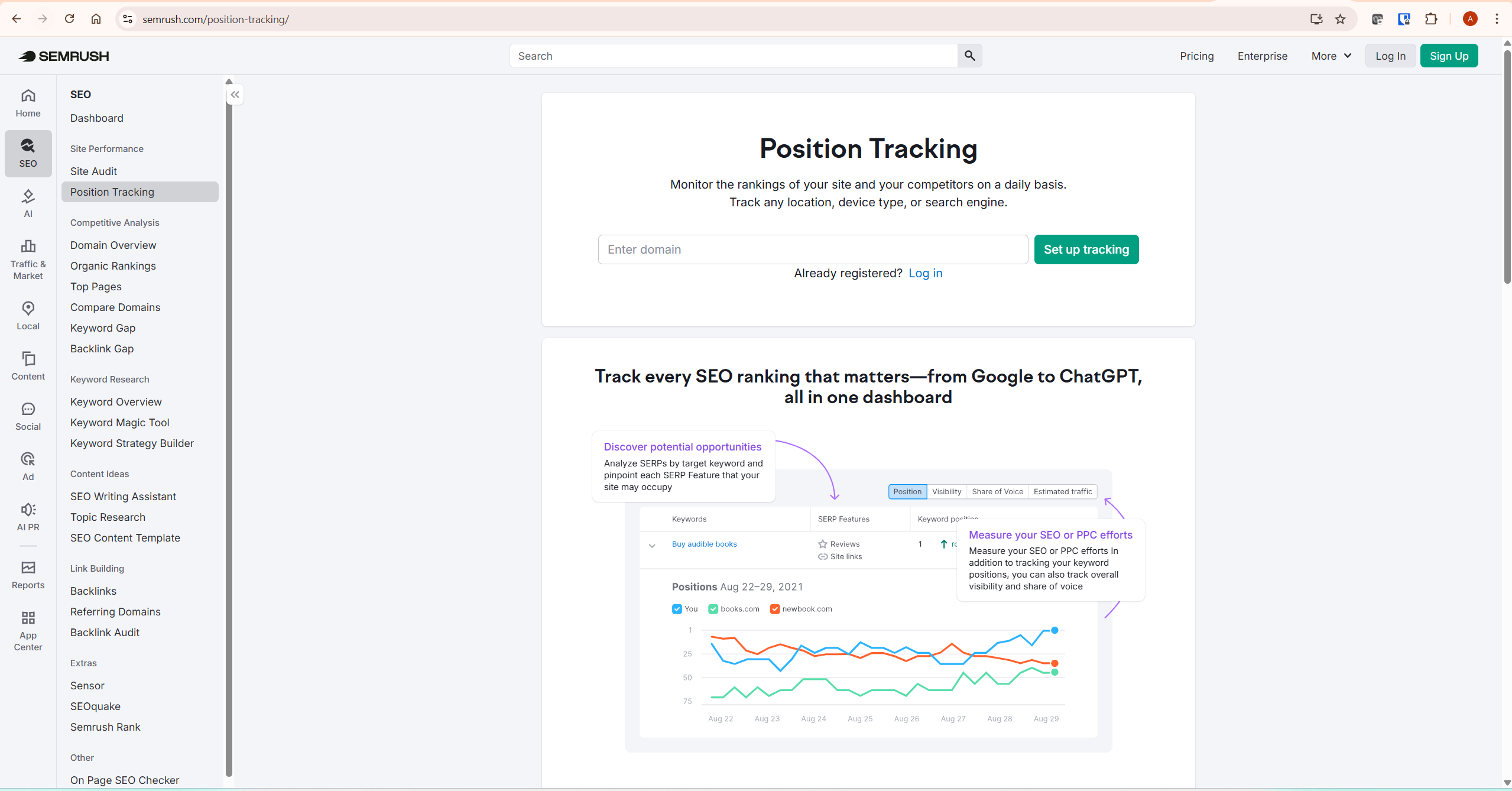
Both tools offer solid rank tracking with daily updates. Semrush’s Position Tracking supports more geographic granularity — down to city level — which matters for locally-targeted content. Ahrefs’ Rank Tracker has a cleaner interface and integrates well with its other tools. For an affiliate content site tracking national or international rankings, both tools perform equivalently. Our guide on how to use Semrush Position Tracking covers the setup process in full.
Final Verdict
The Semrush vs Ahrefs decision comes down to this: what does your affiliate site actually need right now? Ahrefs is the more focused, technically precise SEO tool — and if backlink analysis and link building are central to your strategy, it is the right choice. Semrush is the more complete platform for an affiliate content publisher who needs keyword research, content planning, site health monitoring, competitor intelligence, and AI visibility tracking without managing separate subscriptions for each. For most affiliate marketers building content-driven sites, Semrush is the more practical starting point. Ahrefs earns its place when link building moves to the centre of your growth strategy. Whichever side of the Semrush vs Ahrefs debate you land on, the key is committing to one tool and using it consistently.
For a complete breakdown of Semrush’s features and pricing, read our full Semrush review.
More guides in this cluster:
- Semrush Pricing Explained — every plan, limit, and add-on
- How to Use Semrush Site Audit — fix critical SEO errors step by step
- Semrush vs Ubersuggest — the budget alternative compared
- Is Semrush Worth It? — honest cost-benefit for affiliate sites
- How to Do Keyword Research with Semrush — affiliate content workflow
Pricing figures verified from publicly available sources. Always confirm current pricing directly on Semrush’s pricing page and Ahrefs’ pricing page before making a purchase decision.
